


photo: Torgeir Rorvik / Tinagent



textura has released five full-length recordings: Bright Star (2021), Swallowed by the Sky (2019), Monuments and Ruins (2012), Esther Marie (2010), and Kubla Khan (2008).
Physical copies and digital downloads of all releases are available at the textura Bandcamp site.
 |
Isnaj Dui: BRIGHT STAR Mastering: Ian Hawgood
|

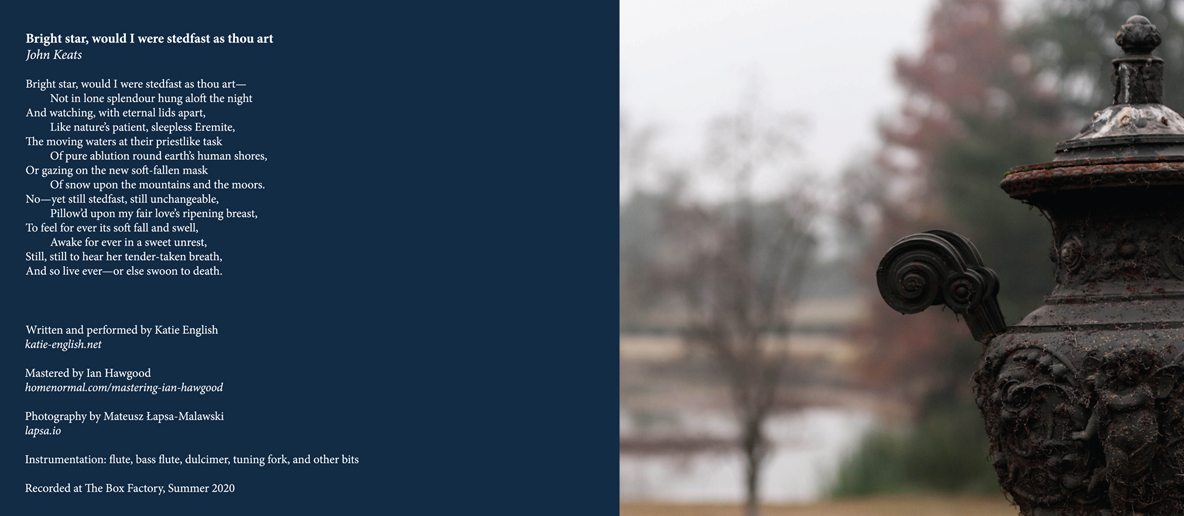
Physical and digital copies of Bright Star are available for purchase at the textura Bandcamp site.
TRACK LISTING (click on each track to hear a brief sound clip):
1. “Moving Waters” (13:30)
2. "Still Steadfast" (15:28)
3. "Swoon to Death"
(15:40)
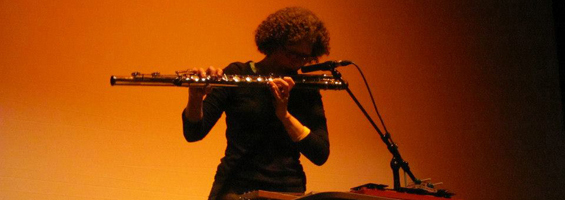
IN BEING poetry-themed, Bright Star is to some degree a sequel to Kubla Khan, textura's inaugural release—despite a twelve-year gap and the three label releases that appeared after that 2008 compilation. There is a major difference, however: whereas the first, inspired by the Coleridge poem, features original works by multiple artists, Bright Star is by a single one, Isnaj Dui, otherwise known as Katie English. Drawing on John Keats's sonnet for inspiration, the Halifax, UK-based artist produced three long-form instrumentals in her inimitable style that distill the poeminto musical form.
The material English created is, however, allusive rather than programmatic. Asked to elaborate on her approach, she replied, “I often find Morse Code to be a nice starting point with some projects and used a few short phrases from the poem to create some of the rhythmic elements of the piece.I explored the conflict between love and death over distance and immortality, with the recurring deep drone representing the ever-lasting star, and dissonant melodies to tear at any sense of ease or comfort. Some of the melodic and rhythmic motifs come and go, each time in a slightly different form, as though ever-present throughout changes around them. Other melodic and harmonic phases create a sense of fragility and inevitable loss, as if content to be in the moment whilst all the time knowing it will end.”
“Moving Waters” sets the scene by draping haunting flute figures across a softly rumbling base, the entrancing lilt of its movement suggestive of the title's subject matter. With flutes still softly intoning, glassy textures and gamelan patterns surface to deepen the entrancement in “Still Steadfast,” after which “Swoon to Death” pushes the material to its ethereal limit, the flutes returning to sing their seductive song one last time. English's treatment limns the poem's meaningsin spellbinding manner, but to say any more would spoil both artists' creations; further, to impose literal ties between the text and sound material would be similarly diminishing. Here's a case where interpretations are perhaps best left in the hands of the reader and listener.
Written and performed by Katie English
Instrumentation: flute, bass flute, dulcimer, tuning fork, and other bits.
Recorded at The Box Factory, Summer 2020
For more details, textura recently conducted an interview with English about the release here.
Bright star, would I were stedfast as thou art
John Keats (1795-1821)
Bright star, would I were stedfast as thou art—
Not in lone splendour hung aloft the night
And watching, with eternal lids apart,
Like nature's patient, sleepless Eremite,
The moving waters at their priestlike task
Of pure ablution round earth's human shores,
Or gazing on the new soft-fallen mask
Of snow upon the mountains and the moors—
No—yet still stedfast, still unchangeable,
Pillow'd upon my fair love's ripening breast,
To feel for ever its soft fall and swell,
Awake for ever in a sweet unrest,
Still, still to hear her tender-taken breath,
And so live ever—or else swoon to death.
Isnaj Dui
Katie English has been captivating listeners with her Isnaj Dui material for a number of years on labels such as Home Normal, Rural Colours, and FBox Records. Using flutes, home-made dulcimers, and electronics, English combines her classical flute training with interests in electroacoustic music and Balinese gamelan to create an intensely personalized music that sounds like no one else's.
 |
anthéne | Slow Dancing Society | orchestramaxfieldparrish: SWALLOWED BY THE SKY Mastering: Mike Fazio
|
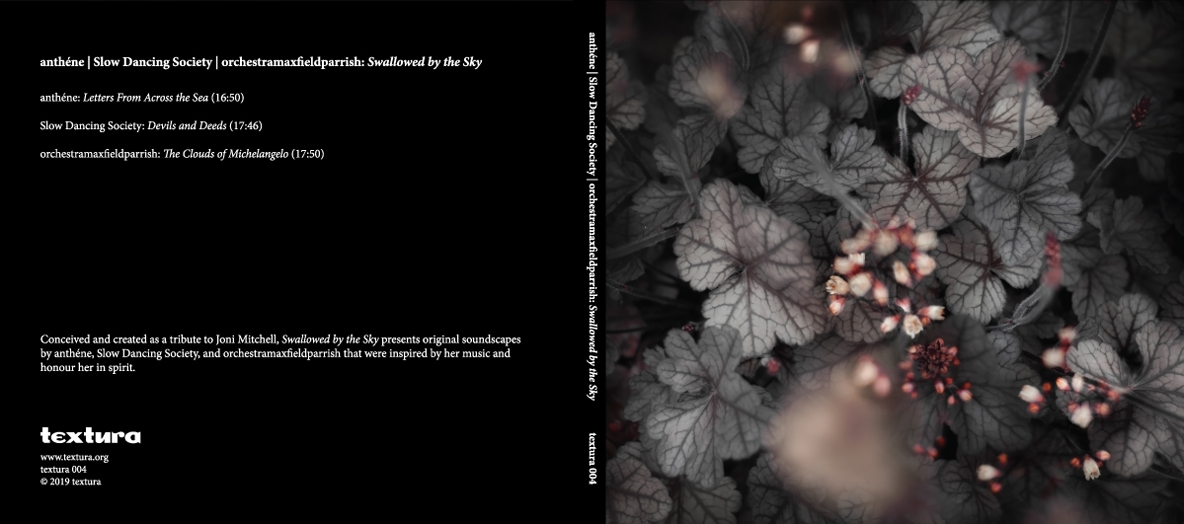
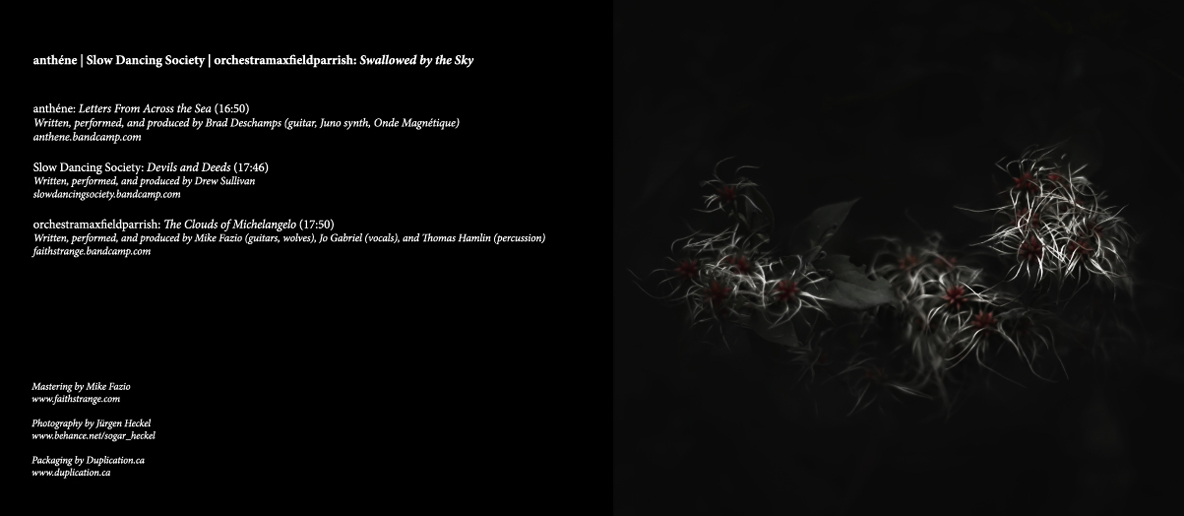
Physical and digital copies of Swallowed by the Sky are available for purchase at the textura Bandcamp site.
TRACK LISTING (click on each track to hear a brief sound clip):
1.
anthéne: “Letters From Across the Sea” (16:50)
2.
Slow Dancing Society: “Devils and Deeds” (17:46)
3.
orchestramaxfieldparrish: “The Clouds of Michelangelo” (17:50)

Conceived and created as a tribute to Joni Mitchell, Swallowed by the Sky presents original soundscapes by anthéne, Slow Dancing Society, and orchestramaxfieldparrish that were inspired by her music and honour her in spirit.
THOUGH THE NUMBER of popular artists who've had a transformative cultural impact is modest, Joni Mitchell is inarguably a member of that exclusive club. Certainly one indicator of her stature is the tribute compilation, of which a generous number have been released over the years, the recent Joni 75: A Birthday Celebration a prime example. In that and other instances, fellow singer-songwriters have recorded covers of her songs, but appreciation for Joni and her music extends beyond that immediate sphere to other stylistic realms, jazz and ambient soundscaping among them. To that end, Swallowed by the Sky, textura's fourth release, sees a trinity of artists associated with the latter genre, anthéne (Brad Deschamps), Slow Dancing Society (Drew Sullivan), and orchestramaxfieldparrish (Mike Fazio), presenting newly created, long-form works that are, among other things, homages to an artist all three hold in high regard.
Joni aficionados will no doubt recognize allusions in both the album and composition titles, but Swallowed by the Sky's connections run deeper than mere reference. While the anthéne and Slow Dancing Society settings are very much true to the stylistic character of the work for which they're known, their soundscapes feel as if her spirit was channeled during the creative process. To produce “Letters From Across the Sea,” Deschamps drew for inspiration from relatively scaled-down creations such as Clouds' “Tin Angel” and “Roses Blue” and explored the light-dark juxtapositions often present in her songs. In his piece's opening minutes, gently undulating tones and washes induce deep entrancement as the piece works its meditative magic; gradual shifts in the terrain occur as elements emerge from the background and effect subtle shifts in mood before retreating, clearing a path for darker tonalities to assert themselves. Complementary to anthéne's setting, Sullivan's “Devils and Deeds” generates tension in the circumspect sequencing of its guitar and keyboard figures. A slowly mutating base provides a firm foundation over top of which melodic motifs recur, the gaps separating their voicings adding to the tension. This is material where every gesture resonates with meaning and purpose, such that the emergence of swollen bass throbs (at the thirteen- and fifteen-minute marks) startles the listener with their force.
If the orchestramaxfieldparrish setting is daringly different from the material Fazio has released under the alias before, it's at the same time emblematic of his resolutely explorative approach to music-making. To bring “The Clouds of Michelangelo” into being, the guitarist worked with longtime friends Jo Gabriel (vocals) and Thomas Hamlin (percussion). Fazio began by using the C tuning (CACFGC) heard in “The Silky Veils of Ardor” and “Off Night Backstreet,” pieces redolent of the adventurous era that birthed The Hissing of Summer Lawns, Hejira, and Don Juan's Reckless Daughter. The percussion elements nod to “Dreamland” and “The Jungle Line,” whereas the howls at track's end reference the 1979 Mingus track “The Wolf That Lives in Lindsey” and were recorded at a Colorado wolf sanctuary. Fazio's eighteen-minute contribution to the project is a fantastic voyage in the truest sense, a transporting creation that advances with a sense of inevitability from one episode to the next.
These and other details testify to the deep connection all three artists have to Joni and her music. The remarkable, richly textured works they've created likewise show how profoundly they've been affected by her work and Joni herself as an artistic figure. Swallowed by the Sky will no doubt be followed by other tributes, but it's unlikely any will replicate it in stylistic terms. It's as original an homage as could be imagined and thus dovetails perfectly with the spirit of the artist it honours.
anthéne
Toronto-based Bradley Sean Alexander Deschamps operates as a solo artist under the anthéne alias and issues North Atlantic Drift material in partnership with Mike Abercrombie. Deschamps oversees Polar Seas Recordings and has released anthéne and North Atlantic Drift recordings on the label, as well as recordings by Celer, Hakobune, and David Newlyn, among others. Recent anthéne releases also have appeared on Home Normal, Whitelabelrecs, and Hibernate.
Slow Dancing Society
Since the release of his Slow Dancing Society debut The Sound of Lights When Dim in 2006, Spokane, Washington resident Drew Sullivan has mesmerized listeners with an impressive body of Hidden Shoal releases featuring his trademark blend of electronics, keyboards, and electric guitar. His recent two-volume set The Torchlight Parade, selected as textura's top ambient release of 2018, shows this distinguished ambient-electronic artist operating at a creative high.
orchestramaxfieldparrish
New York-based Mike Fazio has issued solo material under the orchestramaxfieldparrish guise since 1999, much of it through his Faith Strange imprint. His artistic sensibility has manifested itself in many different forms over the years, whether it be through releases issued under the orchestramaxfieldparrish name (2008's The Silent Breath of Emptiness and 2010's Crossing of Shadows, two examples of many) or as A Guide For Reason, orchestramaxfieldparrish presents ÆRA, or simply Fazio.
 |
Talvihorros | Damian Valles: MONUMENTS AND RUINS Mastering: James Plotkin
|
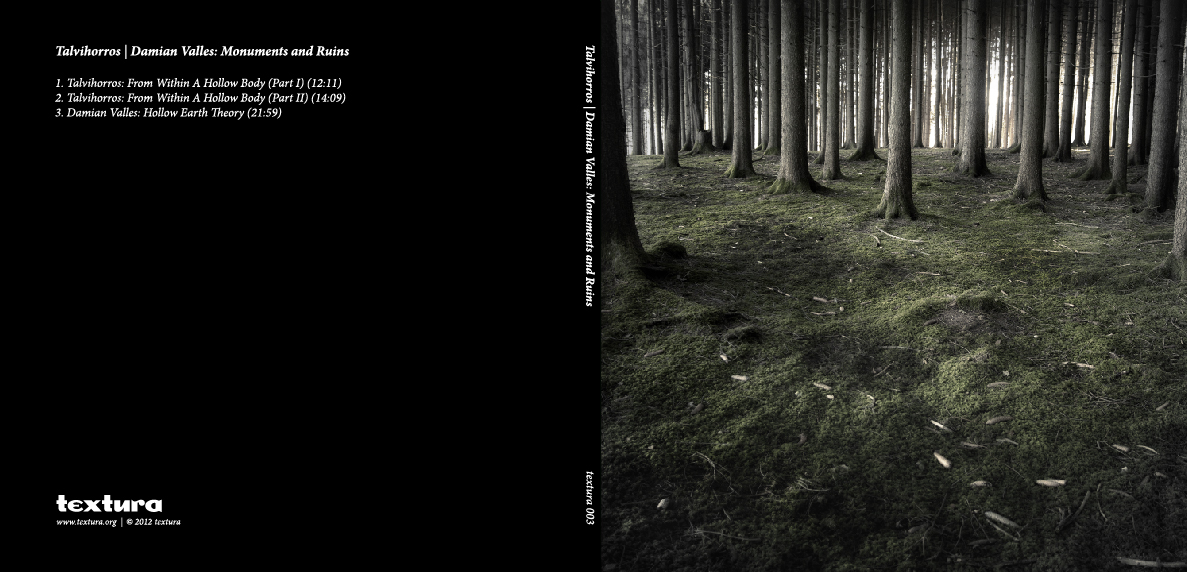
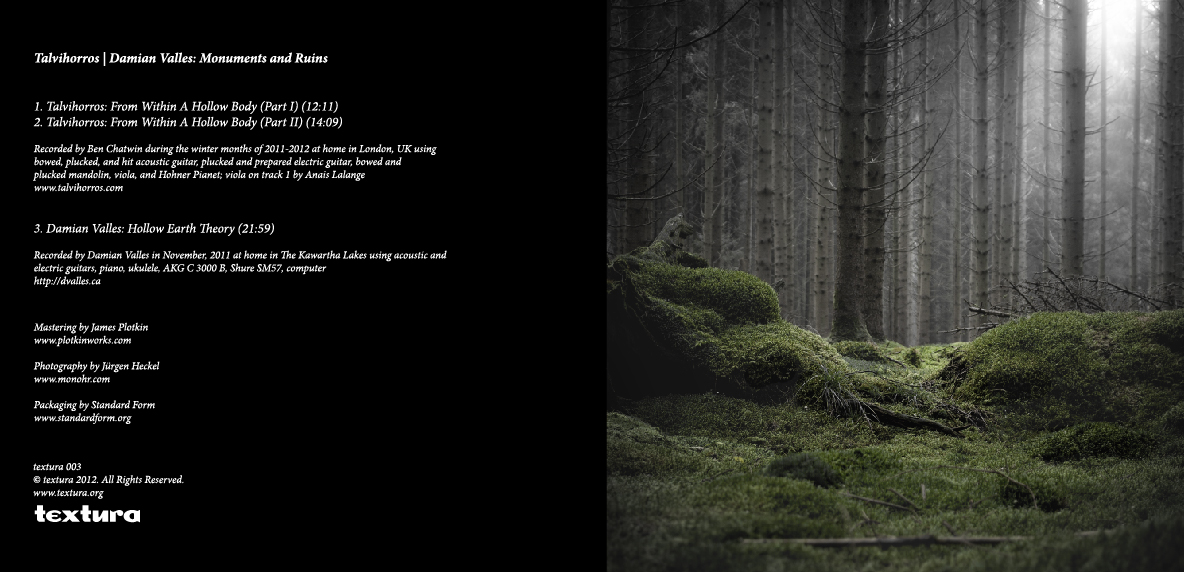
Physical and digital copies of Monuments and Ruins are available for purchase at the textura Bandcamp site.
TRACK LISTING (click on each track to hear a brief sound clip):
1. Talvihorros: "From Within A Hollow Body (Part I)" (12:11)
2. Talvihorros: "From Within A Hollow Body (Part II)" (14:09)
3. Damian Valles: "Hollow Earth Theory" (21:59)

IN LATE 2011, textura approached two of its favourite artists, Ben Chatwin (aka Talvihorros) and Damian Valles, to ask whether the two might be interested in contributing to a split release featuring newly created works by them. Much to our delight, the two, seeing themselves as simpatico artists, agreed and shortly thereafter produced the magnificent original material featured on Monuments and Ruins. What they created amounts to an incredible and immersive listening experience whose detail has been mastered in all its resplendent glory by James Plotkin. Those wishing to draw a connection between the album title and the musical content might hear Chatwin's two-part work as having rendered the majestic character of a monument into aural form, while Valles' piece conjures a vision of ruins.
Talvihorros's From Within A Hollow Body begins with bowed tones panning forebodingly between left and right channels before growing ever more grainy and epic. A sound-world of immense power declares itself as various layers of bowed and plucked guitars swell into a seething mass, until the storm lifts and a gradual lessening of intensity brings about a relative sense of calm. The work's second part unfolds in an elegiac haze as guitars shudder against a smoldering backdrop of soot and grime, before a beautiful series of strums emerge during the final minutes to bring the piece to a graceful close. Valles' Hollow Earth Theory emerges gradually from a swamp of scrapes and flutter like some diseased phantom condemned to roam the blasted remains of unidentified terrain. Gothic and bluesy, the music unspools in a dust-coated stream of piano shadings and grainy drones, before its equally portentous second half finds it dramatically expanding in scale and detail.
With the artists having created such powerful material, it was important that the visual presentation of the recording be as striking, and with that in mind two powerfully evocative photographs by Jürgen Heckel (aka Sogar) were selected to complement the works produced by Chatwin and Valles. textura is proud to be able to showcase the artistry of all involved on this distinctive release.
Tracks 1 and 2 recorded by Ben Chatwin during the winter months of 2011-2012 at home in London, UK using bowed, plucked, and hit acoustic guitar, plucked and prepared electric guitar, bowed and plucked mandolin, viola, and Hohner Pianet; viola on track 1 by Anais Lalange
Track 3 recorded by Damian Valles in November, 2011 at home in The Kawartha Lakes using acoustic and electric guitars, piano, ukulele, AKG C 3000 B, Shure SM57, computer
Talvihorros is the name under which Ben Chatwin issues his guitar-and-electronics works. Numerous techniques are used to coax a myriad of sounds from both acoustic and electric guitars, and home-made and vintage electronic equipment are used to process and manipulate recorded material into dense and dark sound collages that the London, UK-based composer augments with analogue synths, organs, bells, percussion, and static. Talvihorros recordings have been released on Hibernate (2011's Descent Into Delta, 2010's Music In Four Movements) and Benbecula (2009's Some Ambulance), among other labels.
Damian Valles is a Canadian multi-instrumentalist who creates experimental ambient and drone-based soundscapes using solo guitar and with a variety of percussive elements, piano, and field recordings. He also curates the Rural Route series on Standard Form and performs as part of the experimental band, Boars, alongside Alex Durlak and Jeff McMurrich. He has issued several releases in multiple formats (limited CD-Rs, a cassette, two net-label releases, and compilation appearances) with the most recent being the full-length Skeleton Taxa (Drifting Falling, 2011), and his forthcoming LP, Nonparallel (In Four Movements), will be released by Experimedia during 2012.
 |
Mains de Givre: ESTHER MARIE textura 002 Mastering: Eric Quach
|
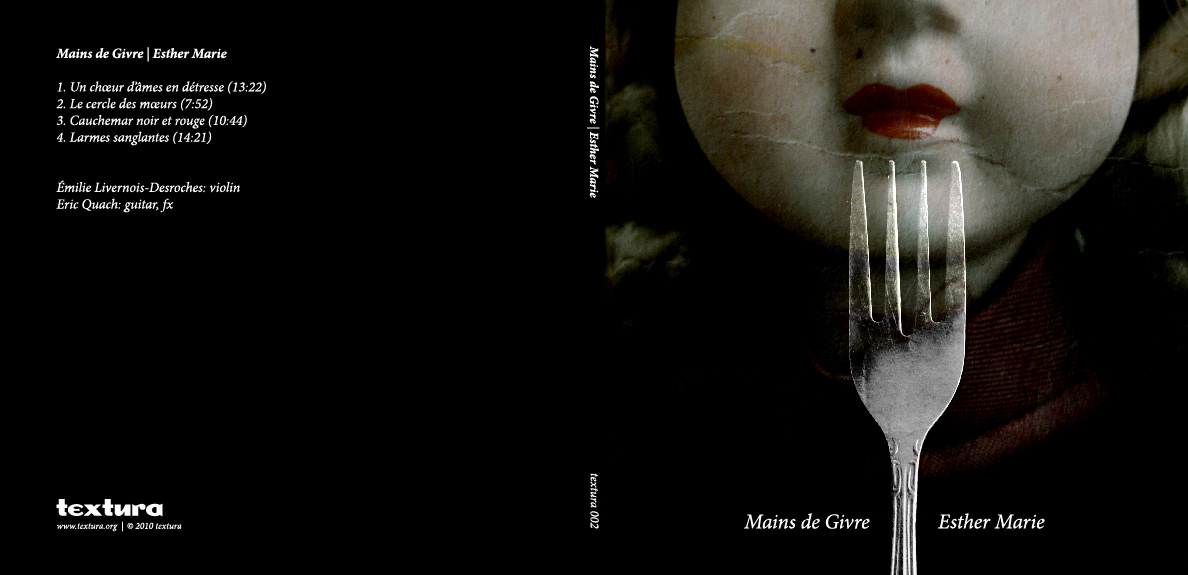

Physical and digital copies of Esther Marie are available for purchase at the textura Bandcamp site.
TRACK LISTING (click on each track to hear a brief sound clip):
1. "Un chœur d'âmes en détresse" (13:22)
2. "Le cercle des moeurs" (7:52)
3. "Cauchemar noir et rouge" (10:44)
4. "Larmes sanglantes" (14:21)
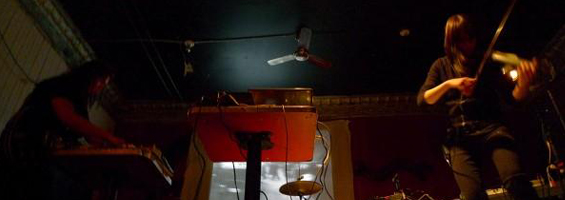
MAINS DE GIVRE is a violin-centered soundscaping project involving self-taught experimentalist Eric Quach and classically trained musician Émilie Livernois-Desroches, both of whom call Montreal home. Quach is widely known for the experimental ambient work he's produced under his thisquietarmy alias and also is the founder of the instrumental-shoegazer band Destroyalldreamers. Livernois-Desroches has played violin since she was seven years old and been teaching since 2003. She has been a part of various chamber music and symphonic orchestras, and performs with a wide variety of bands in styles ranging from pop to medieval to metal. While her previous best-known project was the melodic folk-black metal band Blackguard (formerly known as Profugus Mortis), Mains de Givre is her most experimental project to date.
Quach and Livernois-Desroches first crossed paths in 2003 while playing with their respective bands Destroyalldreamers and Sugarshack as part of the emerging post-rock scene in Montreal. Following each other's musical achievements over the years, their mutual respect for each other grew until they found themselves six years later embarking on a studio collaboration initially intended to be part of a thisquietarmy release. As their personal and musical chemistry grew, their newfound closeness turned the collaboration into an official long-term project they christened Mains de Givre (frost hands) after a nickname that had been given to Émilie (émilie-aux-mains-de-givre) by her bandmates.
Mains de Givre's debut album, Esther Marie, originates from material recorded at the duo's first jam session in the spring of 2009. The recording opens with the very first notes the two played together, notes that evoke an eerie sadness that permeates the album and characterizes the mood of their collaboration. With the violin as the lead instrument, Quach's guitar playing is restrained yet also tense, as he generates dark, slowly evolving drone atmospheres alongside subtle, looped-based patterns that swirl within the lower end of the sound spectrum.
|
|
VA: KUBLA KHAN Mastering: Mike Fazio
|

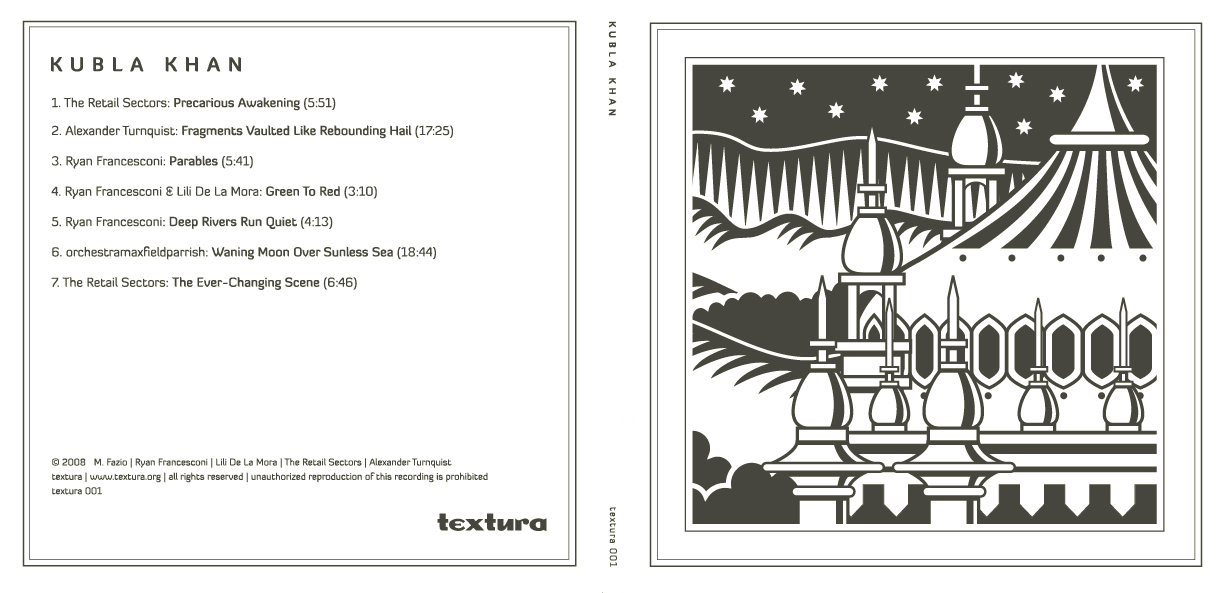
Physical and digital copies of Kubla Khan are available for purchase at the textura Bandcamp site.
TRACK LISTING (click on each track to hear a brief sound clip):
1. The Retail Sectors: “Precarious Awakening” (5:51)
2. Alexander Turnquist: “Fragments Vaulted Like Rebounding Hail” (17:25)
3. Ryan Francesconi: “Parables” (5:41)
4. Ryan Francesconi & Lili De La Mora: “Green To Red” (3:10)
5. Ryan Francesconi: “Deep Rivers Run Quiet” (4:13)
6. orchestramaxfieldparrish: “Waning Moon Over Sunless Sea” (18:44)
7. The Retail Sectors: “The Ever-Changing Scene” (6:46)

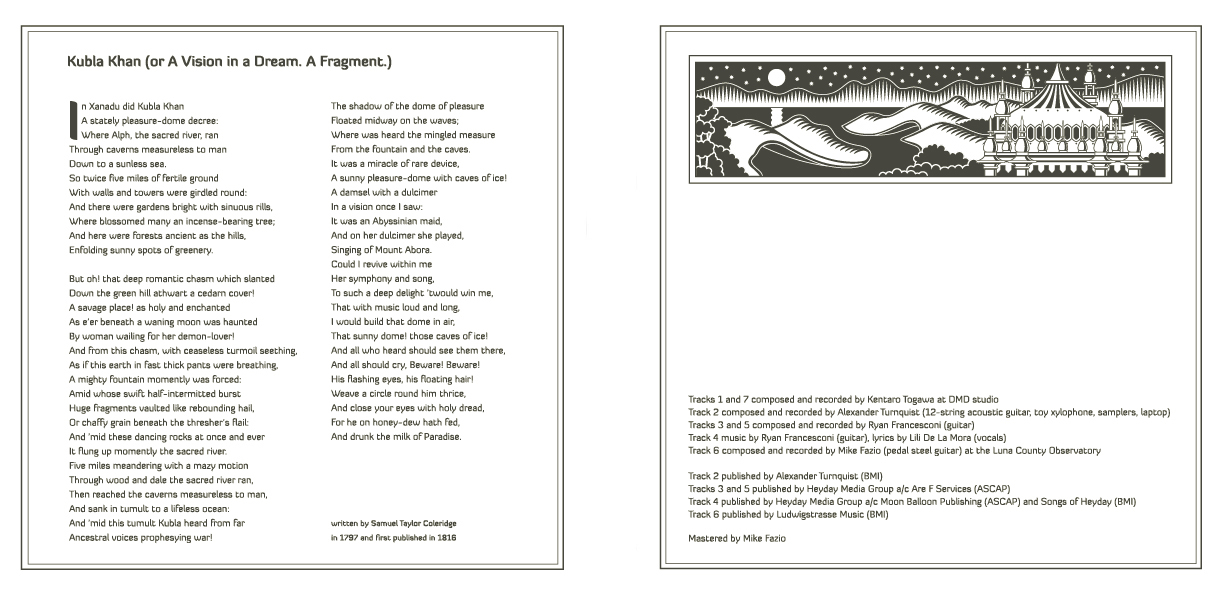
FIRST-YEAR UNIVERSITY students enrolled in English Literature 101 invariably read Wordsworth, Byron, and Keats, but the poetic work that likely lodges itself in memory most of all is Samuel Taylor Coleridge's “Kubla Khan, or a Vision in a Dream. A Fragment,” and not just because the author himself claimed it was inspired by an opium-induced dream. Written in 1797 and first published in 1816, the poem includes imagery so vivid it lends the work an hallucinatory quality that sets it apart from all other Romantic poetry, and the opening lines alone can entrance even the most resistant student:
In Xanadu did Kubla Khan
A stately pleasure-dome decree:
Where Alph, the sacred river, ran
Through caverns measureless to man
Down to a sunless sea.
Some may recognize Xanadu from Orson Welles' Citizen Kane as the name of the immense estate that Charles Foster Kane built for his second wife Susan Alexander (who came to regard it as nothing more than a fortress of solitude from which she had to escape). Needless to say, we at textura were captivated by the poem when we first read it all those years ago—so much so that when we decided to establish a textura label we immediately thought of Coleridge's poem and its rich potential as an inspirational midwife for musical work. And so it came to pass that four stylistically-diverse artists—Alexander Turnquist, The Retail Sectors, orchestramaxfieldparrish, and Ryan Francesconi & Lili De La Mora—contributed their abundant artistry to textura's premiere release in the form of unique interpretive responses to the poem.
Some of the artists drew upon the majestic spirit of Coleridge's poem while others used a particularly evocative passage as a conceptual springboard. The Retail Sectors bookends the hour-long recording with two epic samplings of Kentaro Togawa's signature instrumental rock. In the first, “Precarious Awakening,” intricate guitar and bass lines unite for an elegant pas de deux as the piece moves through a series of ever-intensifying climaxes; the ponderous second, “The Ever-Changing Scene,” brings the recording to a graceful close but not before exposing the listener once more to Togawa's smoldering attack. At the recording's center, Ryan Francesconi & Lili De La Mora present the wistful and alluring vocal ballad “Green To Red” while Ryan frames it with two lovely guitar meditations, “Parables” and “Deep Rivers Run Quiet.” The first, the more uptempo of the two, spotlights the crystalline and rather harp-like sound of his deft acoustic picking; true to its title, the second adopts a more ruminative mien. In contrast to those song-structured pieces, Alexander Turnquist and orchestramaxfieldparrish (Mike Fazio) contribute long-form soundscapes that are simultaneously immersive and transportive. In the seventeen-minute “Fragments Vaulted Like Rebounding Hail,” Turnquist uses 12-string acoustic guitar, toy xylophone, samplers, and laptop to produce an initially turbulent and ultimately peaceful galaxy of rustling static and flicker, while Fazio's heavily-processed pedal steel guitar creates a celestial realm of shimmering streams, slow-burning tones, and glistening waves in “Waning Moon Over Sunless Sea.”
Despite the artists' stylistic differences, Kubla Khan's admittedly disparate parts coalesce to deliver a resplendent listening experience that feels immensely satisfying and whole.
Ryan Francesconi & Lili De La Mora
Seattle resident, multi-instrumentalist, and CalArts graduate (degrees in Guitar, Composition, and Electronic Music) Ryan Francesconi brings a deep love of Balkan folk music and ambient acoustic music to his solo releases under the RF moniker and his collaborative work with vocalist Lili De La Mora (their remarkable debut collection Eleven Continents) and Joanna Newsom (whose harp playing also graces the duo's album). In his productions, Francesconi applies subtle electronic treatments to field recordings, vocals, and classical instrumentation to produce rich and highly personalized work.
orchestramaxfieldparrish
Since 1999, Mike Fazio has issued solo material under the orchestramaxfieldparrish guise and since 2005 been active as one-half of the experimental ambient-industrial outfit Gods of Electricity. Fazio's symphonic sculpting of electric guitar- and pedal steel guitar-generated sounds is heard to marvelous effect on the frozen vistas of orchestral sweep comprising his recent release The Silent Breath of Emptiness. Drifting chords and sustained tones coalesce into metallic soundscapes of lyrical beauty during the work's five connecting parts.
The Retail Sectors
Kentaro Togawa, the one-man band behind The Retail Sectors, creates music of remarkably rich variety without straying from his trademark guitar-bass-drums set-up. In his tracks, Togawa, who also heads up the Japan-based label Symbolic Interaction, weds pristine guitar lattices to a blistering attack. His recently issued The Starlight Silent Night may be the most perfectly-realized distillation of The Retail Sectors' sound to date.
Alexander Turnquist
Alexander Turnquist is a New York-based acoustic guitarist and sound sculptor whose Faint at the Loudest Hour and Apneic have garnered considerable acclaim (Pitchfork gave the former an 8.2 rating). Given the apparent ease with which he can produce rapidly-picked cyclical patterns of entrancing, raga-like design, it's understandable that his name is mentioned alongside James Blackshaw and Sir Richard Bishop but Turnquist—as exemplified by the meditative Apneic and his amazing Kubla Khan contribution—often ventures beyond strict acoustic guitar playing for more unconventional territory.
Ryan Francesconi & Lili De La Mora: "Green To Red"