

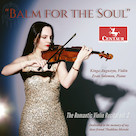
Kinga Augustyn: Balm for the Soul: Romantic Violin Recital Vol. 2
Centaur Records
Whereas the inaugural, 2015-issued chapter in violinist Kinga Augustyn's Romantic Violin Recital series centred on technical virtuosity, the second volume, the aptly titled Balm for the Soul, captures her artistry in a different way by focusing on romantic longing, introspection, and the pure, unsullied beauty of Romantic music. To render material of such consoling and ineffable beauty into physical form, Augustyn utilizes a ravishing tone and a finely honed gift for sculpting a phrase. In delivering these transporting pieces with nuance and clarity, she intensifies the music's emotional impact. Consistent with its title, the album, recorded in June 2025 and one of the loveliest violin recitals to have appeared this year, is pitched as restorative, accurately so.
In featuring the NYC-based violinist and the terrific pianist Evan Solomon only, Balm for the Soul grants us an almost wholly unobstructed view of her playing and thus allows us to appreciate all the more the masterful poise of her phrasing and artful control of her vibrato. The violin veritably sings in her hands, especially when the programme includes pieces by Amy Beach, Edward Elgar, Felix Mendelssohn, and others, each selection thoughtful chosen to amplify the theme. Augustyn has an uncanny talent for connecting with a composer's vision and externalizing it with clarity and purpose. She also excels at calibrating emotional expression so that it exudes refinement without becoming overwrought.
The recording was purposely designed to feel like an intimate live recital, and to that end the pair performed the set for a small New York audience the evening before the June 2025 studio session; each piece was also recorded straight through to match the natural flow of a live performance. While executing at this high level might be daunting to some, it comes easily to Augustyn when the foundation she draws upon is solid. A multiple award-winner and graduate of The Juilliard School and Stony Brook University, she's appeared throughout the world as a soloist with orchestras of the highest renown and on many a concert stage as a recitalist and chamber musician.
Kreisler's Three Old Viennese Dances open the set, with the listener immediately captivated by the joyful outpouring that is “Liebesfreud,” the entrancing lilt of the duo's rendition, and Augustyn's authoritative handling of the material. A more melancholy feel introduces “Liebesleid,” but the music soon turns rhapsodic, a style ideally suited to the violinist. The lighter-spirited tone of the first dance returns for “Schön Rosmarin” to conclude the three-part setting on a resoundingly satisfying note. Meanwhile, Kreisler's arrangement of “Dumka” from Dvorák's Slavonic Dances oscillates between poignant nostalgia and rousing folk gestures, double stops extensively called upon to articulate the music's comforting warmth.
Paganini's Cantabile sings as sweetly as its title promises, Augustyn clearly in her element when the piece includes an abundance of singing melodies she can give her resplendent expression to. Speaking of cantabile, one could hardly surpass Manuel Ponce's “Estrellita” (from Canciones mexicanas) for the sheer beauty of its ache. At seven minutes, Henryk Wieniawski's haunting Légende is the release's longest piece, but it's never less than transfixing when the recitalists deliver its piano-and-violin dialogue with characteristic finesse.
Amy Beach's haunting Romance resonates magnificently in Augustyn's expert hands, her treatment as powerful and tender as it needs to be. Another natural encore choice for sending listeners out of the concert hall swooning, Elgar's intoxicating Salut d'amour exemplifies her talent for communicating emotion, in this case tenderness, with finesse. Were Elgar's piece not available, Shostakovich's “Romance” (The Gadfly Suite), Tchaikovsky's “Mélodie” (Souvenir d'un lieu cher), or Mendelssohn's “On Wings of Song” (6 Gesänge) would prove a more than credible substitute.
While she concentrates on Romantic repertoire on this release, Augustyn's range is considerable, as shown by a discography that includes albums dedicated to music by Piazzolla and Paganini, as well as one featuring contemporary solo violin works by Penderecki, Carter, Berio, and others, Turning in Time. Balm for the Soul shows that's she's clearly comfortable in this particular milieu, however, so much so that she gives the impression of having been born to it. Every one of its eighteen performances stops one in one's tracks, so to speak, when each is distinguished by the consummate artfulness of her playing. Solomon comports himself wonderfully throughout, but with such a partner it's easy to overlook how splendidly he accompanies her. One of Augustyn's avowed goals for the release was to enable listeners to “step away for a moment from the noise of the world” and most assuredly such an opportunity's been made possible for those fortunate enough to hear it.August 2026