

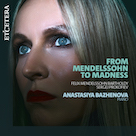
Anastasiya Bazhenova: From Mendelssohn to Madness
Etcetera
Records
Even though pianist Anastasiya Bazhenova's debut album From Mendelssohn to Madness is enticingly titled, her release's trajectory from Felix Mendelssohn Bartholdy (1809-1847) to Sergei Prokofiev (1891-1953) less reflects the change in general temperament from the one to the other and more the emotional spectrum encompassed by the three works presented. That said, if there are turbulent moments, they more arise within Prokofiev's Piano Sonata No. 6 in A major than in the other's Lieder ohne Worte (Songs Without Words) and Fantasia in F-sharp minor.
Such material suits Bazhenova's character, whose performances and choice of repertoire emphasize those emotional extremes without sacrificing poise and control in the process. Precision and expression combine in her playing, such that a work is executed with finesse but with passion too. The Voronezh-born pianist began playing at the age of four and later studied at the Voronezh Academy of Arts and the Norwegian Academy of Music in Oslo. Bazhenova's performed across Europe but in North America too, her debut appearance at New York's Carnegie Hall a highlight.
Returning to the album title, for Bazhenova it's a comment on the way one's inner landscape alters in accordance with the mounting destabilization of external reality. To that end, the state of the world during Mendelssohn's time qualifies as more tranquil than the tumultuous one of Prokofiev's. The values of order, clarity, and beauty that held sway during the earlier period eventually gave way to the trauma and violence of war, rebellion, and revolution. For her, the tension lurking beneath the surface of Lieder ohne Worte (written between 1829 and 1845) becomes more overt in the Fantasia in F-sharp minor (1833) until the struggle between light and dark finds its greater realization in Prokofiev's sixth sonata, completed in 1940 and the first of his three "War Sonatas.” Eruptions on a grand scale permeate the work, such that anguish, fury, irony, and melancholy all find a place within its four movements.
Introducing the release are six selections from Lieder ohne Worte, whose eight volumes—six published during Mendelssohn's lifetime and two posthumously—contain forty-eight concise, lyrical settings. He's at his most entrancing in the pretty opening selection, the first from opus nineteen, which Bazhenova delivers with exquisite phrasing and pacing. As haunting is the gracefully flowing sixth from opus thirty-eight, the pianist again precisely attuned to the composer's material. Lighter in tone, the jaunty sixth from opus sixty-seven plays like a jovial student exercise; not for the faint of heart, the light-speed tempo of the bumblebee-like fourth (from the same opus number) calls on Bazhenova's virtuosity. The jittery scamper of the second (also from the sixty-seventh) calms the pace ever so slightly before the fourth from opus eighty-five completes this part of the recording with a lyrical romantic expression that's wholly endearing.
Sometimes referred to as the "Scottish Sonata" and composed around the same time as his fourth symphony (the “Italian”), Mendelssohn's Fantasia progresses through three movements that range from brooding to boisterous. Entering softly with sprinkles of arpeggios, the melancholy opening movement exudes an understated restlessness before blossoming into a more declarative passage that explores a song-like theme emblematic of the composer. A shorter scherzo lifts the spirits at the work's centre with its youthful spirit and playful buoyancy, after which the fantasy concludes with a rapturous presto finale whose high-velocity runs, again, put Bazhenova's virtuosity to the test.
The ear's instantly tickled when Prokofiev's sixth piano sonata, premiered by the composer himself in April 1940 on a Moscow radio broadcast, begins with clangorous chords catapulting mercilessly. Fluctuations in the activity level occur thereafter without the music ever losing its sardonic bite. Grinding gestures and pounding chords reinforce the music's obsessive single-mindedness and flirtations with, yes, madness of a particularly gripping kind. Less harrowing is the mischievous, scherzo-like “Allegretto,” which marches determinedly and with an undercurrent of mockery. The sonata exposes its shadowy side with a lugubrious waltz, its “Tempo di valzer lentissimo” marking hinting at its spooky atmosphere. Bringing the work to a rollicking close is a torrential “Vivace” that races furiously to the finish line. Echoes of the opening motive emerge, albeit tangentially, within the flurries until the pace abruptly slows for ghostly patterns that recall the preceding movement. The calm's soon replaced with rapid-fire flourishes and more refractions of the opening theme to send the release out on a high-flying note.
Needless to say, Bazhenova's playing is stellar throughout and all the more impressive for being her debut album. Perhaps the final word should go to Etcetera Records, however, which has presented her release beautifully with a striking, high-quality design and bewitching portrait photographs. Other labels would do well to follow its lead when presenting their own products.August 2026