

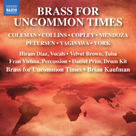
Brass for Uncommon Times: Brass for Uncommon Times
Naxos
Start with a cover image that looks as if the earth's continents are being buried under acid rain or nuclear haze and then move to text on the reverse side that states the release's contents deal with “the pandemic, racial unrest, global conflict, reflections on the realities of war, the pervasive use of gun violence, pollution, and social strife,” and you might reasonably conclude the recording is one to more endure than enjoy. But don't be too hasty: Brass for Uncommon Times's eponymously titled debut album isn't an hour-long exercise in despair. While acknowledging head-on the challenges with which global citizens are contending, the album also celebrates humanity's capacity for hope and resilience, and in that regard it's telling that the ensemble elected to conclude the release with Félix Mendoza's uplifting Guerra de Secciones rather than something gloomier.
Something else merits clarification too: directed and conducted by Brian Kaufman, Brass for Uncommon Times lives up to its name in featuring sections of trumpets, trombones, horns, euphoniums, and tubas, but it also includes a large percussion section, pianist, and organist. More than forty musicians are called upon for the seven performances, with the ensemble's members originating from orchestras, military bands, and universities. The composers whose works are presented hail from the United States, Canada, Japan, and Venezuela and include Mendoza, Valerie Coleman, Barbara York, Satoshi Yagisawa, Katelyn Petersen, Katahj Copley, and Harrison J. Collins.
Riffing on the title of the familiar Copland work and written in response to the crises of the pandemic and racial unrest, Coleman's Fanfare for Uncommon Times introduces the set auspiciously. Her statement departs from the traditional fanfare in acknowledging struggle and uncertainty in addition to resilience and resolve. Emerging with bowed vibraphone and robust declamations, the music intersperses triumphant bluster with reflection, the gesture consistent with the multi-dimensionality of its thematic content. Diverse percussion textures enrich the arrangement without detracting from the impact of the brass elements. Blueshine Emblem, An Eternal Elegy by Japanese composer Yagisawa follows, with conflicts of various kinds intimated in the oscillation between solemn episodes and hyper-energized ones. Tension and urgency permeate the uptempo parts, peace and contemplation the slower ones.
One of the more striking pieces on the album comes from Canadian-American composer York (1949–2020), who wrote more than forty works for tuba and euphonium. Advancing through three movements, her Concerto for Tuba ‘Wars and Rumors of War' features internationally renowned tuba player Velvet Brown as the soloist in its musical rendering of a young soldier's awakening to the brutal realities of war. Interestingly, while Prokofiev, Rachmaninov, and Shostakovich were apparently inspirations, the work's opening “Allegro marcato” movement calls Kurt Weill to mind even more in its coupling of martial snare drum rhythms and sardonic melodies. Serene by comparison is the work's lyrical “Tranquillo” movement, graced by muted brass textures that amplify the music's solemnity and convey the soldier's longing for home. The reality of war reinstates itself for the “Allegro furioso,” Brown growling through its bluesy middle section and fleet-of-finger for its militaristic conclusion.
Copley's majestic Beyond exudes dignity as it reverently memorializes victims of gun violence. The ensemble's brass textures vividly articulate feelings of loss but the music also, through its affirmative tone, communicates hope that the souls rising are achieving peace as they leave sorrow and suffering behind. Complementary to it is Petersen's Respire, which unfolds across twelve-plus minutes as a requiem of sorts for those wrestling with personal struggles and environmental collapse. Prayerful chorale expressions are voiced by brass instruments before a sombre interlude arises that brings organ and piano to the forefront. Respire doesn't shy away from confronting despair, yet in resolving on a peaceful note it also emphasizes the power of persistence.
In celebrating the energy and promise of a new generation, Collins' fanfare-like Young Voices is as exuberant and empowering as it should be—even if the challenges young citizens face are monumental. And, as earlier mentioned, the set concludes with Mendoza's Guerra de Secciones, a percolating, life-affirming piece that draws on the rhythms and sounds of Venezuela. Bolstering its celebratory feel are vocals, drum kit playing, and percussion by Hiram Diaz, Daniel Prim, and Fran Vielma, respectively. When a vocal call-and-response section arises, the album feels as far removed from the ponderousness of Respire as could be imagined. There are multiple takeaways from the album, but perhaps the strongest is simply the finesse the ensemble brings to each one of the seven performances. Brass for Uncommon Times can blaze with the best of them—Mendoza's piece is proof enough of that—but also play with acute tenderness (see “Tranquillo”) when the music calls for it.September 2026