

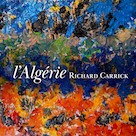
Richard Carrick: l'Algérie
New Focus Recordings
Nothing else sounds quite like l'Algérie (2024), the second album-length chapter in a trilogy composed by pianist Richard Carrick (b. 1971) and performed by Either/Or, the chamber quintet he co-founded and co-artistic directs. As its title inmates, the nine-part work was inspired, in part, by the music of the Maghreb region of North Africa and by extension Carrick's own family background (his mother was born in the town of Aïn Bessem in northern Algeria). In fusing formal composition and musical elements that evoke that North African subregion, Carrick, a Paris-born US/French citizen of French-Algerian and British descent, has created something wholly distinctive and engaging.
Joining him on the adventure are violinist Jennifer Choi, cellist John Popham, percussionist Justin Jay Hines, and oud player Bahar Badieitabar, the ensemble's instrumentation alone reflecting Carrick's cross-cultural sensibility. Currently Chair of the Composition Department at Berklee College of Music, he's a graduate of Columbia University and the University of California-San Diego who also studied at IRCAM and the Koninklijk Conservatorium. With musical interests so broad, he's fortunate to have Either/Or as both a creative outlet and vehicle. As two of the work's parts reveal (“Interlude” and “Inconnue”), the quintet is comfortable improvising in addition to executing notated charts; the line separating improv and composition also blurs during “Gnawa Loops” when Choi and Badieitabar solo like jazz players.
While l'Algérie can be experienced on purely musical grounds as a wide-ranging study in stylistic contrasts, musical traditions, and moods, it also allows the listener to treat it as a travelogue through the Algerian region. It qualifies as both an imagined public journey and personal meditation on family history. That the work refuses to be easily categorized—the catch-all world music makes the most sense, even if it ventures into folk, classical, and jazz—is one of the things that recommends it. Realizing that a visit to Algeria might not be on the immediate horizon, Carrick “decided that to let the music guide me, to write a journal describing an imagined voyage to Algeria through music that I love from that region.”
The journey begins with “Mémorial,” whose shimmering tones (produced by e-bows on piano strings) offer a cryptic, memory-haunted portal, the movement's time-suspending, dream-like quality enabling the listener to ease smoothly into the work's sound-world. Experimental textures intersect with oud picking and bell tinklings to intensify the exotic aura before Badieitabar ushers “Aïn Bessem” into being with an unaccompanied intro. Referencing directly the town where Carrick's mother was born, the melancholy that emerges from the pairing of oud and violin feels both forlorn and nostalgic. With the advent of “Joie,” the arrangement focus shifts rapidly to prepared piano, oud, and percussion, with the movement's folk-dance swing amplified by the strings' animated intertwining. Presenting the players at their most free and individually explorative, the wholly improvised “Interlude” follows, Badieitabar in particular making the most of the opportunity for self-expression.
Hines's hand drums and swaying rhythms imbue “La Reine” (at nine minutes the longest movement) with the aromatic mystery and intrigue of a spy caper, Carrick's jazzy acoustic piano offering a counterpoint to oud and strings—close your eyes and it's easy to picture yourself at some late-night Algerian cafe absorbing the faint traces of music from a nearby club. Carrick's inner piano treatments lend the music a metronomic feel during “Les Cloches,” after which the feverish “Gnawa Loops” delivers the work's most emphatic groove-centric statement. Whereas the penultimate “Inconnue” revisits a free-jam ethos, “Traverser” concludes the work with a through-composed expression that patiently guides the piece to a satisfying resolution.
In being performed by quintet, the work feels intimate; at the same time, pronounced timbral contrasts make the group seem larger than it is. While the trilogy's parts, The Atlas, l'Algérie, and The Path—the first, scored for piano and string quartet, imagines a trip into the titular mountain range and the third embraces a groove-driven approach inspired in part by ‘70s fusion and North African dance music—would have the greatest impact were they to be experienced together, l'Algérie, commendably compact at forty-five minutes, hardly suffers when presented alone.May 2026