

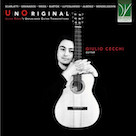
Giulio Cecchi: UnOriginal – Julian Bream's Unpublished Guitar Transcriptions
Da Vinci Classics
Julian Bream (1933–2020) built on the canon of guitar transcriptions of Andrés Segovia (1893-1987) by bequeathing to his inheritors transcriptions extending from the Renaissance and Baroque to works by twentieth-century composers such as Britten, Maxwell Davies, and Walton. While Italian guitarist Giulio Cecchi (b. 1997) doesn't contribute guitar transcriptions of his own to his debut release, he's done the next best thing in presenting an album of Bream's unpublished transcriptions.
The pieces by Isaac Albéniz (1860–1909) and Enrique Granados (1867–1916) offer their share of rewards, but it's the multi-part works by Béla Bartók (1881-1945) and Witold Lutoslawski (1913–94) that recommend the release most. Fleshing it out are standalones by Domenico Scarlatti (1685–1757), Felix Mendelssohn-Bartholdy (1809–47), and Sylvius Leopold Weiss (1687–1750). Cecchi's star has risen quickly. It's been only four years since he acquired his Master's degree at the “O. Vecchi – A. Tonelli” Musical Institute in Modena and seven since graduating from the Fiesole School of Music with his Bachelor's. In addition to receiving awards and teaching at a number of schools, he's active as both a solo and chamber musician and performs in duos with flutist Emma Longo and guitarist Lorenzo Pampaloni.
Interestingly, while the modern guitar perpetuates the repertoires associated with the lute, most of the Bream transcriptions on UnOriginal (not perhaps the best choice of title for the negative connotation the word carries) originate from harpsichord and piano. The transition from the one instrument's context to the other's proves to be seamless, however, when the intricate patterns of the keyboard naturally transfer to the guitar. An excellent illustration is Scarlatti's Sonata in E Minor, K87, which effects the change from harpsichord to guitar so fluidly one could be excused for presuming it was created on guitar. Cecchi's unhurried pacing and precise articulation amplify the melancholic beauty of the material. Chords, strums, and single-note picking lend an almost orchestral quality to the rendition without at the same time sacrificing the work's poetic austerity.
Granados's six-part Valses poéticos captivates the moment its waltz-inflected “Introducción, Vivace Molto, Melodico” initiates the cycle with expressions rousing and tender and thereafter sustains the attention with wistful reflections and infectious dance turns, all of which Cecchi delivers with sensitivity to mood, tempo, and phrasing; reprising the lovely waltz passage from the opening movement for the final gives the cycle a well-rounded shape too. More Spanish flavour arrives with two settings by Albéniz, “Córdoba,” the last of the four Cantos de España, and “Cataluña,” from the Suite Española. Delivered with painterly care, the former opens with evocations of tolling funeral bells before developing into a harmonics-enhanced setting suggesting stillness and contemplation. With an increase in energy, the now-vigorous piece then springs to life with embracing expressions and rhythmic flourishes. One of the album's prettiest pieces is “Cataluña,” which intoxicates with expressive colour.
Its six parts extracted from Bartók's 44 Duos for Two Violins, Petite Suite was never recorded by Bream and remains to this date unpublished (studies of it were made at London's Jerwood Library, to which Bream donated his scores). After beginning in a sombre mode (“Sadness”), the material grows sunnier, with optimism, for example, exuded by “New Year's Song” and free-spiritedness conveyed by the folk dance-styled “Burlesque”; “A Fairy Tale” returns us to earth with a ponderous closing statement. Perpetuating the folk dimension is Lutoslawski's Melodie ludowe, whose twelve parts (all but one under two minutes) present the first complete guitar transcription of the original piano cycle. Again a variety of moods is explored, from the plaintive (“Ach mój Jasienko”) and brooding (“Jest drozyna, jest”) to the animated (“Hej, od Krakowa jade”), jubilant (“Na jabloni jablko wisi”), and tender (“Od Sieradza plynie rzeka”). Enticing melodies enrich the work (see “Zalatny”), whose Polish folk tunes were recast by Lutoslawski for pedagogical purposes.
Elsewhere, solemnity infuses the Tombeau German lutenist Weiss wrote to memorialize the late Bohemian count and lutenist Jan Antonín Losy, but the inclusion of soothing moments makes for a lyrical homage that's multi-dimensional. Helping to distinguish the elegiac sixth song from Mendelssohn's Lieder ohne Worte is Bream's use of harmonics, which Cecchi replicates expertly. His command of guitar technique impresses throughout UnOriginal, but it's the humility he brings to these performances that impresses as much. Musicality is paramount here, as is the interpreter's commitment to honouring the material and by extension Bream. The set-list is commendable too for featuring works by a broad array of composers, Bartók and Lutoslawski particularly noteworthy in that regard.May 2026