

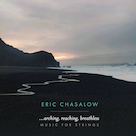
Eric Chasalow: … arching, reaching, breathless
New Focus Recordings
How fitting that Eric Chasalow (b. 1955) is both Irving G. Fine Professor of Music at Brandeis University and the Director of BEAMS (Brandeis Electro-Acoustic Music Studio) when his latest release features works in the time-honoured chamber music tradition and others reflecting his electroacoustic interests. Consistent with that, he earned his doctorate at Columbia University, where he studied composition and flute, but also studied at the Columbia-Princeton Electronic Music Center. A list of those with whom he's collaborated exemplifies the range his work encompasses, with forward-thinking ensembles such as Boston Modern Orchestra Project, Collage New Music, New York New Music Ensemble, and Talea Ensemble among those cited.
The subtitle accompanying … arching, reaching, breathless—Music for Strings—is in no way circumscribing: operating within a strings-only milieu, Chasalow presents pieces of dramatically varied character and scored for solo performer, duo, trio, string quartet, and string sextet. A strong literary dimension grounds three of the seven pieces, with Greek mythology and Wallace Stevens reference points. The former emerges in the opening piece, The Wings That Bear the Night Away, in drawing on the myth of Icarus and Daedalus, while two Stevens poems are key to The Snow Man and Disillusionment of Ten O'Clock.
The three works are excellent examples of Chasalow's electroacoustic side: as Mari Kimura performs the opening work, the violinist is accompanied by preexisting string quartet material the composer subjected to granular synthesis; in the other two, cellist David Russell sings the poems while playing, live electronic accompaniment factoring into the equation. Such bold solo presentations make for an enriching complement to the duo and trio works and the single-movement Second Quartet and three-part String Sextet. In addition to Kimura and Russell, the Lydian String Quartet, violinists Clara Lyon and Julia Glenn, cellist Hannah Collins, and pianist Steven Beck appear.
The seventy-minute recording takes flight with The Wings That Bear the Night Away, Kimura's violin darting every which way and, evoking Icarus's ascent, fluttering bird-like into the sky. Against the jittery flickering of the electronic backdrop, Kimura scales ever upwards, her attack vicious in its intensity and her phrases growing fragmented as the figure approaches the sun. Naturally, his earthward plunge is musically intimated, even if the piece ends with a swirling flourish more suggestive of upper heights. From Kimura's incredible solo performance we turn to Third Piano Trio: Rock Hill Variations, composed in January 2022 when Chasalow was in residence at Copland House. Performed by violinist Lyon, pianist Beck, and cellist Collins, the trio setting begins with enigmatic piano figures before the others enter to perpetuate the elusive, darting movements of the keyboard. Gradually the piece assumes a clearer shape with nimble lines, aggressive pizzicati, and rhythmic gestures emerging with authority. An elegiac middle passage shifts the music into a quieter zone until energy reinvigorates the material and the trio catapults towards the finish line. To Chasalow's credit, the piece might have connections to Copland but it's a Chasalow expression full stop, not an exercise in imitation.
Russell's renderings are definitely album highlights, in part due to his dramatic poem readings. Playing cello whilst reciting allows him to combine the two elements with maximum control, and the subtle application of live electronics proves enhancing too. In its slow unfurl, The Snow Man exudes an icy, ethereal quality; with his tremulous voice splintering into ghostly echoes, Disillusionment of Ten O'Clock exudes a cryptic, almost nightmarish quality by comparison.
Interestingly, Chasalow's Second Quartet exists in two permutations, one an hour long and the other a quarter its length. Whereas the longer version is designed to be performed in a gallery space with loops developed and then collated into a fifteen-minute form, the version performed by The Lydian String Quartet is the shorter one. Its impact is in no way diminished by brevity, however: the field of pizzicati accents with which it begins gradually morphs into a series of bowed flourishes and violent outbursts. Plucks, harmonics, and bowed fragments interlace, until haunting violin phrases, punctuated by gentle pizzicato chords, lead into a gradually swelling concluding episode that seems to reference from oblique angles classic string quartet repertoire. Arriving fast on its heels is String Sextet, which augments the Lydians with violist Kelder and cellist Collins. Movement titles alone convey the work's character, with “Long arching lines, reaching and breathless,” “Beautifully imperfect, as if droned on sympathetic strings,” and “Asymmetrical march, fading memory and embedded scherzo” providing a clear outline of the eighteen-minute setting. Following the aggressive, Brahms-influenced opening movement, the meditative central one unfolds mysteriously, like elements only fleetingly visible within an engulfing fog. Originally scored for flute and piano, To the Edge and Back appears here in a violin-and-piano transcription by violinist Glenn, with Beck her partner on the exuberant and oft-vivacious set-closer.
… arching, reaching, breathless is pitched as a collection of Chasalow's music for strings, and it definitely checks that box. It's also, however, a terrific portrait of the composer in the breadth of its material and thus might be regarded as representative of his music-making (a quarter-century separates the earliest and latest works too). The powerful impression created by the works is attributable not only to the writing but to the calibre of musicianship involved. Chasalow's a lucky man for having performers as gifted as Kimura, Russell, and the Lydians to help bring these pieces to life. No performance is ever the last word, yet it would be difficult to imagine the versions on the release being bettered by others.July 2026