

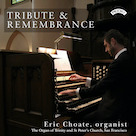
Eric Choate: Tribute & Remembrance
Priory
Eric Choate is many things, an organist, conductor, composer, and teacher. He's organ professor at the San Francisco Conservatory of Music and Director of Music at the city's Episcopal Church of St. Mary the Virgin. Choate delivers recitals throughout the United States and Europe and as a conductor is Chorus Master of the Marin Symphony. He's given performances with the San Francisco Symphony Chorus, Berkeley Symphony Chorus, and others, and recently conducted Vaughan Williams' Dona Nobis Pacem at Carnegie Hall. Recordings by him have appeared on Arsis Audio, Ulysses Arts, and Priory Records, and his compositions have been performed by VOCES8, American Bach Soloists, Friction Quartet, and more. The man is busy.
It's his personae as organist and composer that are featured on Tribute & Remembrance, a splendid recording of pieces by American composers Byron Adams and David Conte, the English composer Ian Venables, and Choate himself. Key to the music's impact is the instrument he plays, the organ at Trinity+St. Peter's Episcopal Church in San Francisco, which affords its organist a huge palette of colours with which to work. Built in 1924 by Ernest M. Skinner, the instrument's fifty-four ranks of pipes enables him to effectively evoke the strings, woodwinds, and brass of a symphony orchestra. As this presentation of contemporary compositions shows, Choate's an expert at coaxing from the instrument a glorious polyphony of voices.
As he clarifies on the inner sleeve, each work on the album pays homage to another composer or style, cases in point Venables' Rhapsody to Herbert Howells and Conte's Prelude & Fugue to the great French teacher and composer Nadia Boulanger. Tribute & Remembrance is bookended by Choate works, the opener Fantaisie and closer Procession & Chorale, the latter written for his own wedding ceremony at San Francisco's Grace Cathedral. Entering plaintively, Fantaisie unfurls with grace and dignity, blossoming as it does into an enveloping rhapsody and modulating circumspectly between moods. The gleam of the organ's tones amplifies the majesty of the material, which oscillates between high drama, elegiac introspection, and child-like wonder. Fantaisie, like most of the others on the album, pushes past ten minutes and thus presents itself as an odyssey-like travelogue. Venables' Rhapsody in memoriam Herbert Howells follows, its music suitably melancholy, angst-ridden even, and tone reverential.
The first of two multi-part works, Adams' four-movement Suite in Olden Style, which references the Baroque period through a contemporary lens, begins with a radiant “Sinfonia” before advancing through a gentle “Fugue,” contemplative “Siciliana,” and celebratory “Rigaudon.” The second is Prelude & Fugue in memoriam Nadia Boulanger by Conte, a teaching colleague of Choate's at SFCM. Opening at a near-whisper, “Prelude” ponders questioningly during its first minute before swelling into a probing self-examination and finally emphatic declamation; “Fugue” blossoms as it should into a rapturous entwining of gleaming patterns and chords. Choate's set-ending Procession & Chorale is, naturally, as triumphant in tone, celebrating as it does his own betrothal. Stately, romantic, and adventurous, the piece makes for a fitting and satisfying conclusion. Aside from the compositions and the performances, both of which are excellent, what recommends the fifty-four-minute release most is the majestic sound of the Ernest M. Skinner organ itself, which is never less than engrossing.October 2026