

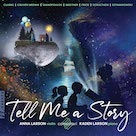
consonari: Tell Me a Story
Navona Records
As Tell Me a Story vividly shows, the sound husband-and-wife duo Anna Larson (violin) and Kaden Larson (piano) produce under the consonari name is even more riveting when the material performed is fantastical in nature. A cursory scan of the composition titles reveals that literary, legend, and folk traditions inspired many of the curatorial choices, with Rebecca Clarke's Midsummer Moon, Karol Szymanowski's Mythes, and Kari Cruver Medina's titular suite all evoking powerful visual images as analogues to their musical contents. Even in the absence of that storytelling dimension, the performances by the chamber duo would still beguile.
The range encompassed by the album, recorded in the summer of 2025 in Salt Lake City, is broad. We have on the one hand African-American folk idioms explored by Florence Price in her Fantasy No. 1 and on the other Greek mythology addressed by Szymanowski in the three-part Mythes. Consistent with the storytelling theme, George N. Gianopoulos's Sara Teasdale-inspired City Vignettes and Nikolai Medtner's Three Nocturnes are rooted in the night, the time when dreams most fully flower. Much as a child might be eased off to slumberland at day's end by a parent-read story, consonari's release transports the listener at album's close with Medina's tales of goats, fairies, and dragons.
The Larsons, who founded consonari in 2019 while studying at Indiana University, favour contemporary composers and ones lesser-known and under-represented in their programming. Consistent with that, both Matthew Schultheis's mercurial meditation The burial of the stars (which takes its title from Walt Whitman's “On the Beach At Night”) and Medina's Tell Me A Story were commissioned by the chamber duo in 2024 and premiered a year later. Outside of consonari, Anna is an adjunct instructor in applied violin and chamber music at the University of Texas at Tyler and Tyler Junior College and performs in multiple orchestras, while Kaden is a founding member of the Ensign Piano Quartet and Professor of Piano/Music at Tyler Junior College (Tyler TX).
Written in 1933 around the same time as her Fantasie nègre and Symphony No. 1, Price's Fantasy No. 1 receives an inspired, high-energy reading, with Anna's opening cadenza delivered with authority before the piece transitions into a boisterous episode. A second lyrical statement emerges thereafter, its dignified folk-spiritual tone captured movingly by the violinist. Enhancing its impact, double-stopped phrases intensify the plaintive ache of the music, after which the rollicking attack reinstates itself for the coda. Midsummer Moon (1924), written by the British composer and violist Rebecca Clarke for Hungarian violinist Adila Fachiri, unfolds like a romantic rhapsody, its hazy atmospheric tone imbuing it with Debussy-like colour. In places calling Vaughan Williams' The Lark Ascending to mind, the work sees Anna's violin fluttering on high with bird call-like notes before easing into alternately serene and rapturous modes.
Setting music to miniature poems from a 1911 collection by Teasdale, Gianopoulos initially created City Vignettes (2013, rev. 2023) as a work for mezzo-soprano and guitar, but arrangements for non-vocal presentations were subsequently created, including the one for violin and piano performed here. Whereas loneliness and melancholy are palpably conveyed in consonari's treatment of “Dawn,” tinges of hope surface during the graceful arcs the duo traverses in “Dusk.” At work's end, the plodding stream with which Kaden introduces “Rain at Night” suggests the steady fall of precipitation. Just as the pieces by Gianopoulos and Schultheis were inspired by poets, Medtner based his Three Nocturnes on Goethe's poem “Nachtgesang” (Night Song). Poetic elegance informs the opening “Andante con moto, sempre leggiero” movement, lyrical poignancy the “Largamente,” and yearning entrancement the concluding “Moderato.”
Mythes (1915), by Polish composer Szymanowski, was likewise written for a violinist, in this case Paul Kochanski. Again, rich, evocative atmospheres are conjured by the writing when “Fountain of Arethusa” initiates the work on an engrossingly dream-like note. Communicating self-absorption musically is no easy task, yet Szymanowski does so effectively in “Narcissus” by giving it a probing introspective character. Livelier by comparison is “Dryads and Pan,” with its nimble, dance-like gestures, though there are are haunting moments of quietude also. At twenty-one minutes, Mythes is one of the set's longest pieces, which allows the Larsons ample time to intoxicate the listener with Szymanowski's mythological realm. It's also one of the most technically challenging for the many textures and effects both players are required to deliver—trilled double stops and ghostly harmonics for the violinist, for example, and extended trills for the pianist.
The work that's most emblematic of the album concept is, of course, the titular one by Medina, which bookends three fairy tale-like parts with “Tall Tales” and “Bedtime Stories.” After the former initiates the work with an infectious country folk-dance (replete with foot stomping), “Three Billy Goats Gruff,” “The Fairy Folk,” and “Once Upon a Time… There Were Dragons” bedazzle. The first trots merrily along, much like the hoofs of the Gruff brothers Little, Middle, and Great Big, while the second captivates with tender folk voicings and elfish whimsy and the third heroic drama. “Bedtime Stories” aptly ends the set with slow and gentle expressions perfectly designed to ease little ones off to sleep. One imagines that just as Tell Me a Story concludes the album, so too would it be sequenced last at one of consonari's recitals, all the better to send patrons home fulfilled and excited to reacquaint themselves with their own childhood story collections.October 2026