

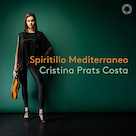
Cristina Prats Costa: Spiritillo Mediterraneo
Pentatone
Violinist Cristina Prats Costa's solo recording debut is distinguished not only by her bewitching wizardry as a player but in the fresh concept she devised for the project. Grounded in her Spanish heritage and drawing its title from lutenist Andrea Falconieri's “Il Spiritillo Brando” (the opening part of Il primo libro di canzone), Spiritillo Mediterraneo offers a sumptuous portrait of seventeenth- and early eighteenth-century music as shaped by the cultures of the Mediterranean. A multi-hued mosaic is presented by Costa and her colleagues that's permeated with Italian, French, and Spanish colours. (Interestingly, the seventy-three-minute album wasn't recorded in any of those countries but instead in Canada at the Church of St. Mary Magdalene and Trinity-St. Paul's United Church in Toronto, Ontario.)
A scan of the instrumentation alone conveys as much: joining the violinist are violoncellist Michael Unterman, harpsichordist Charlotte Nediger, Joseph Phillips on viola da gamba and bass, and Lucas Harris on archlute, theorbo, and Baroque guitar. Augmenting that collective, however, are Naghmeh Farahmand on daf, darbuka, and tambourine and Esmeralda Enrique on castanets, and it's these percussive elements that bolster the album's Spanish dimension. As an album-accompanying note astutely argues, “The Mediterranean emerges here not as a boundary but as a crossroads, where Italian virtuosity, Spanish rhythmic fire, and French elegance converge,” words wholeheartedly borne out by the recording. Personalizing the project all the more, three Spanish pieces appear in Costa's own arrangements.
Of the twenty-five tracks, fourteen are “Ayres” by Naples-born violinist Nicola Matteis; interspersed throughout, they're a connecting glue that renders the presentation more cohesive. Before we encounter the first three “Ayres” we have works by Falconieri and German violinist Heinrich Ignaz Franz von Biber. Aptly positioned in the opening slot, the former's Il primo libro di canzone (1650) might be seen as a microcosm for the project when its four parts touch on Italian, Spanish, and French styles. Two effervescent “brando” dances (the inclusion of castanets in the second one make the Spanish connection all the more explicit) appear alongside a lovely melancholy setting (“La Suave Melodia”) that Costa delivers with exquisite poise—an early illustration of her exceptional violin artistry.
Whereas most of the “Ayres” (like the majority of the album's) are exercises in brevity and concision, Biber's Sonata No. 5 in E Minor (1681) extends across eleven minutes. Opening stately with harpsichord and violin leading the way, the work's vocal-like quality shines through vividly in the aria-styled violin part; a brief yet furious cadenza by Costa follows, her virtuosity dazzling, before an adagio passage slows the pace and the work shifts to variations of regal and scintillating character. Contrasts in tempo and style are successively explored, with changes effected abruptly between episodes. Of all the album pieces, it's Biber's panoramic work that provides the most remarkable showcase for Costa's virtuosic command of her instrument.
Matteis's first “Ayre,” “Aria malinconica,” engages for the affecting melancholy of its expression and the exquisite control Costa demonstrates in her lyrical voicings and trills. A cantabile quality elevates the subsequent “Ground in E Major,” which advances from an initial adagio statement to a livelier rhythmic treatment and back again. Its sweetly singing tone carries over into the tender “Adagio in A Minor” and “Aria in D Minor,” the latter assuming a distinct tone when Farahmand's her percussionist partner. In the most prolonged presentation of Matteis material, seven pieces appear as a group, with the first, “Giga. Al genio Turchesco,” exuding noticeable Turkish flavour and “Diverse Bizarrie sopra la vecchia Sarabanda ò pur Ciaccona” enticing with a gentle lilt and lyrical melodies. A rarity on the album, "Preludio in A Minor” and “Passaggio rotto. Andamento veloce” are delivered by Costa alone, the latter particularly striking for its scalar runs and searing emotional expressions.
Her first arrangement is of guitarist Santiago de Murcia's Fandango, whose Spanish dance character's amplified by the coupling of violin and castanets. Her arrangement of guitarist Gaspar Sanz's Españoleta likewise accentuates that Spanish connection when castanets bolster its rhythmic vitality (how nice to see Harris enjoy a solo moment too); Costa's third arrangement, of organist José de Nebra's Seguidillas is no less beguiling. The movement into the album's concluding section begins with her rendering of the piercing middle movement, the vocal-like “Recitativo. Grave,” from Vivaldi's Violin Concerto in D Major RV 208 and progresses to a stunning treatment of Johann Schop's Baroque-styled solo violin-and-continuo recasting of Alessandro Striggio's Renaissance madrigal “Nasce la pena mia.” Costa couples dreamily with Nediger on the “Sarabande” from Jean-Féry Rebel's Violin Sonata No. 7 in G Minor before ending the set with one final Matteis “Ayre,” “Aria burlesca.”
On Spiritillo Mediterraneo, the match between performer and material is about as perfect as could be imagined. Costa's violin artistry and the obvious personal connection she has to to the period music presented is clear from start to finish, and she's wonderfully supported by the colleagues she recruited for the project. As a way into the release, one could start with Biber's panoramic work and then proceed to Sanz's Españoleta, but frankly one could begin anywhere and be immediately captivated. As solo recording debuts go, Costa's is a disarmingly accomplished one.July 2026