

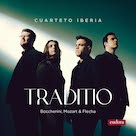
Cuarteto Iberia: Traditio
Eudora Records
One of the more interesting things about Cuarteto Iberia's debut album Traditio is that its material is sequenced non-chronologically. After two ten-minute pieces by Luigi Boccherini (1743–1805), the String Quartet No. 14 in G major (aka “Spring”) by Mozart (1756–91) appears before the set's completed by a work from Spanish composer Mateo Flecha "El Viejo" (1481–1553). Certainly one might have expected an album so titled to order the material so that the evolutionary transition from one piece to the next would be accentuated; instead, violinists Marta Peño and Luis Rodríguez, violist Mario Oltra, and cellist Arnold Rodríguez go a different way.
In their words (as articulated in liner notes), the album's repertoire adheres not to a chronological criterion but a conceptual one as “each work proposed a different way of engaging with received legacy.” Consistent with that is the group's desire to focus on how each work wrestles with tradition internally as opposed to how it does so with others. While the Latin word “traditio” stands for the practice of transmission, typically from one generation to the next, for Cuarteto Iberia what's important isn't preservation but instead grappling with interpretation and revivifying earlier-created works through performance. Consequently, every playing-related consideration having do with dynamics, tempo, pacing, and articulation is confronted through a contemporary lens.
Eight years on from its Madrid founding, Cuarteto Iberia's achieved the chemistry to which all ensembles aspire. Participating in master classes and international music festivals has nurtured this award-winning group's development and refined the rapport its members share. Despite spanning multiple centuries, the works on the release are obviously not of recent vintage. Even so, the superior quality of the performances suggests that treatments of contemporary works would be handled with as much integrity and perspicuity as the four here. Regardless of the order of presentation, the recording impresses for its stellar musicianship and the precision with which the four deliver each piece.
Traditio begins with a pair of two-part settings by Boccherini that, in the group's estimation, reflect the cultural identity of Madrid in his time, the Quartettino in G major, G. 230 and the Quartettino in G major, op. 44, G. 223, known as “La Tiranna.” Weddings of classical form and Spanish culture occur in both pieces, the music never less than enticing and alluring in the group's confident readings. Quartettino in G major, G. 230 assumes a special status for being a work that's never before been edited or recorded. Such a circumstance presents a unique challenge in that the musician must approach the work in the absence of any discographical precedent. Extra pressure comes with interpreting a work for the first time, especially when it was written centuries ago and its creator long gone. Executed with patience and sensitivity, the ten-minute pieces sound fully alive when rendered so expressively by Cuarteto Iberia.
Aptly titled for being warm and luminous, Mozart's "Spring" quartet advances through four movements, starting with a robust allegro and moving on to a bright menuetto, gentle andante, and second allegro. Clearly attuned to the composer's sensibility, the group distinguishes its elegant half-hour interpretation with musicality, balance, and synchronicity. The ease with which the four engage in conversational interplay impresses, as does their refined handling of dynamics and pacing. Again, the performance disarms for the seeming ease with which the musicians make a centuries-old work sound wholly contemporary.
Perhaps no work better illustrates the concept animating Traditio than Flecha's La Negrina, arranged audaciously by the group's cellist and also a first recording. Rather than attempt an historical reconstruction, Cuarteto Iberia re-imagines it by incorporating vocal parts and percussion instruments. In their own words, the gesture doesn't constitute a crude attempt to modernize the work but instead is intended to “acknowledge that transmission necessarily implies transformation and adaptation to the present.” Opening plaintively, the seven-minute work sustains that tone whilst also punctuating it with spirited vocal melodies, drums, and shakers.
The quartet eloquently captures its approach to this album by characterizing the score as “a point of departure, not a closed object.” While each of the four pieces comes with a blueprint, it's the work's modern-day interpreters who must grapple with a work anew whenever it's performed. Anything but automatons, musicians, Cuarteto Iberia included, breathe fresh life into works such as these by actively renewing them every time they're played.October 2026