

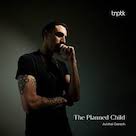
Avishai Darash: The Planned Child
TRPTK
Included in the booklet for The Planned Child is a personal note by its creator, Amsterdam-based Avishai Darash that, while brief, casts an illuminating light on the solo piano pieces presented on the forty-five-minute release. Conspicuous by its absence, however, is anything bio-related, which is perhaps surprising when his professional background is so varied and extensive. Reviewing the experiences he's had allows for an enhanced appreciation of the music he created for the release. By his own admission, The Planned Child came together over the past year, but “has been more than sixteen years in the making.” It makes sense, then, to first acquire some impression of what happened in the time leading up to the album's creation before turning to its contents.
Darash's early teen years were spent learning about and producing psychedelic trance and electronic music but attending his first jazz concert at sixteen prompted a shift into learning about music theory and taking piano lessons. After studying for a Bachelor's degree at the Jerusalem Academy for Music and Dance, he moved to the Netherlands in 2010 to attend the Conservatorium Van Amsterdam for jazz performance and to subsequently collaborate with Dutch/Moroccan oud player Mohamed Ahaddaf on a number of tours and albums. Various genre interests converged on Darash's 2015 debut album Impermanence when it featured jazz players and a string quartet. Other albums followed, as did stints from 2017 to '19 and 2020 to '23, respectively, as the pianist for the Andalusian Orchestra and Marmoucha Orchestra, fruitful partnerships that in the latter case spawned eight studio albums and one live album. Other projects have been undertaken with dance companies and DJs, each one testifying to the breadth of his interests.
The Planned Child strips his music-making to its essence, however, in concentrating on solo piano performance, even if two of its twelve settings are duos featuring him and cellist Maya Fridman. Yet his background experiences still emerge when the pieces, some formally composed and others improvised, reflect his interests in classical music, jazz, folk, and other genres. No electronic beats are present, yet the rhythmic urgency that animates some tracks could be traced to that part of his background. In that aforementioned note, Darash mentions that he considered various formats for the project, from quartet and orchestra to electroacoustic, before deciding to stick with “where it all began: the piano." Even though doing so would be exposing in the extreme, the choice simply felt right for him at this moment. Recorded at Fattoria Musica, Osnabrück in May 2025, the album couples new material with pieces written as long ago as fifteen years, making for a solo piano recital that while cohesive accounts for his personal journey over the past decade-and-a-half.
The somewhat Satie-like “For You” initiates the set endearingly, especially when TRPTK's production team captures the performance in its customary pristine manner. The melancholy lilt of the opening piece proves more than a little enticing, and one comes away from it as impressed with Darash's exquisite technique and artful rendering of material that could conceivably have been written by Yann Tiersen. A jazzier uptempo treatment distances “The Land of Milk and Honey” from “For You,” the tune's buoyant rhythmic flow and blues-tinged melodic inflections bringing an early injection of energy to the recording. Those opening settings indicate that their creator largely eschews dissonance, opting instead for harmonious writing grounded in strong melodic expression.
With Fridman adding her resonant cello voice to the performance, Darash's gift for crafting pretty melodies is amplified even more during “Adulthood.” The subtlest hint of a minimalism influence seeps into “Song of the Heart,” with Fridman again accenting the attractiveness of Darash's music. The rippling runs spreading throughout “Lilies on the Water” hint at an Impressionism influence, which frankly wouldn't surprise when Darash's background is so broad. One of the more adventurous travelogues is "When a Child Sleeps,” which explores so much tonal ground during its seven minutes (much of it technically challenging) it's tantamount to a mini-concerto. While he doesn't clarify which of the pieces are improvised, it's possible the free-flowing “Conversations” is one of them, even if it at the same time calls Bach to mind. “Contemplation Meditation” and “Dharma" likewise feel like ones that might have materialized in real-time.
Darash's statement that The Planned Child represents his sincere attempt to share “the truest sound of who I am, without compromise or disguise” is borne out by the music's directness of expression. Exposed to the fullest degree possible, he lays his music bare and in doing so highlights all of the qualities—elegance, luminosity, melodicism, harmony, etc.—that make this recording so appealing.August 2026