

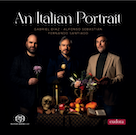
Gabriel Diaz, Alfonso Sebastian, & Fernando Santiago: An Italian Portrait
Eudora Records
Two elements comprise An Italian Portrait, liner notes by countertenor Gabriel Diaz, whose glorious vocal instrument is on full display throughout, and equally glorious performances by him, harpsichordist Alfonso Sebastian, and baroque cellist Fernando Santiago of five Georg Friedrich Handel cantatas. Diaz's notes, while interesting in their thoughts about gender, the composer's sexual orientation, and other matters, provide next to no details about the works themselves, such that anyone wanting historical background or context must find it elsewhere. Fortunately such information is close at hand and obtainable with only a modicum of effort.
Here first, then, a bit of context. Between 1706 to 1710, Handel enjoyed an extended travelogue through Italy, an experience that couldn't help but inform his creative practice and which found its immediate flower in a number of secular cantatas, including the five here. In contrast to the epic scope of Handel's oratorios, the cantatas are pitched at a less grand scale and endear for their intimacy and chamber scoring. And unlike works that are hours-long, these five are pocket-sized, each one a succinct work of ten or so minutes and alternating between recitativos and arias. In place of an oratorio ablaze with multiple soloists and choirs, we have the splendour of a single vocalist, Díaz, regarded as one of the greatest countertenors of his time and who's graced opera houses and concert stages throughout Europe.
Derived from Italian poetry, the texts for these works centre on secular love, often unrequited and therefore lending itself to intense emotional outpourings of despair, anguish, and longing. While the cantatas could be sung by women or men, here it's exclusively Diaz, and the performances are none the worse for being so. An Italian Portrait begins with Irene, idolo mio, which, as intimated by its title, has to do with the romantic travails of a lover suffering at the cruel hand of his beloved Irene. In most of the cantatas, a brief, scene-setting recitativo's followed by a florid aria, with two featuring two pairs of each, two others three recitativo-aria combinations, and one structured with a recitativo in between two arias.
The cantatas aren't sequenced chronologically—Irene, idolo mio was composed after 1710, while the second, Clori, degli occhi miei, and third, Stanco di più soffrire, date from sometime between 1707 and 1708—but it's a detail of little consequence. In the second instance, the cantata is again titled after a woman, Clori in this case the cause of the lover's desire and torment. Even if one isn't fluent in Italian, the agony of the singer's unrequited passion comes through vividly in Díaz's performance.
Whereas the first two contain names in their titles, the three that follow reference emotional states, Stanco di più soffrire the emotional weariness wrought by suffering (conveyed particularly clearly in the slow unfurling of its first recitativo and aria), Lungi da me, pensier tiranno the distress engendered by separation, and Dolc'è pur d'amor l'affanno the sweetness that paradoxically attends romantic anguish. Whereas the second and third cantatas were created in Italy during Handel's time there, the others were composed after 1710 following his return to England, with the fifth and final one, Dolc'è pur d'amor l'affanno, believed to have been written in London circa 1717. It parts company with the others in framing a central recitativo with two arias, which makes for a compelling change in form and presentation.
Díaz's bright, agile voice illuminates Handel's material with a delivery distinguished by elegant phrasing, intonation that's precise and clear, and expression seamlessly wedded to the emotion in play. His partners never overwhelm or compete with him, but they're not shrinking violets either. Sebastian's rich harpsichord textures complement and support Díaz splendidly, while Santiago's incisive and authoritative cello makes its presence felt as strongly. Aided by production that captures their sound with clarity and resonance, the three make marvelous music together when their sensibilities are so well-aligned and joined in common purpose.November 2026