

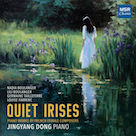
Jingyang Dong: Quiet Irises: Piano Works by French Female Composers
MSR Classics
With Quiet Irises, NY-based Chinese-American pianist Jingyang Dong delivers an illuminating master class on French women composers Nadia and Lili Boulanger, Germaine Tailleferre, and Louise Farrenc. Not only does the release, recorded at Mount Vernon's Oktaven Audio in January 2025, highlight the nuanced artistry of each figure, it honours their perseverance in having produced enduring works during a time when oppressive circumstances threatened to silence their voices. Now more than ever the value of their efforts is being recognized, in no small part thanks to advocates such as Dong. The nuance and sensitivity she brings to her playing is well-matched to the lyrical and expressive tone of the material featured on the release. An additional French connection lies in the fact that the pianist studied in France and speaks French fluidly too.
Beyond being called by Erik Satie his “musical daughter” (after hearing her Jeux de plein air), Tailleferre holds the distinction of being the only woman to have claimed membership in the French collective Les Six, while Nadia Boulanger's recognized as one of the twentieth-century's most influential teachers, with Aaron Copland, Philip Glass, and Astor Piazzolla three of her better-known students. In 1908, she was awarded second prize in the Prix de Rome; her younger sister Lili became the first woman to win first when she did so five years later. Sadly, she died in 1918 of intestinal tuberculosis at only twenty-four years old, an event that prompted Nadia to cease composing and instead dedicate herself to teaching. Farrenc conducted a life-long battle against social resistance and advanced the causes of women in multiple areas. When she was appointed professor of piano at the Paris Conservatory in 1842, she was the only woman to have held such a position in the nineteenth century; she was paid significantly less than her male colleagues, however, but after the successful premiere of one of her works in 1850 her demand for equal pay was met. While she had her champions, Berlioz among them, her works faded from memory following her 1875 death, a fate that befell many a woman artist.
Whereas the three Farrenc movements that compose Les Italiennes are of substantial length, many of the album's other pieces are miniatures. Dong's as partial to the latter as the former, however, as she notes that a short piece can be more challenging than the longer when mood, structure, and tone must be established with dispatch and clarity. The settings by Lili Boulanger, Tailleferre, and Farrenc's Impromptu all fit within that category, but before they appear, there's Nadia Boulanger's Vers la vie nouvelle, written during WWI and emblematic tonally of the period. Sombre chords and a plodding pulse initiate the piece on a downcast note, but traces of hope emerge as the music determinedly makes its steady ascent. In Dong's interpretation, the music evokes a scene of war-related catastrophe from which hope tentatively emerges, the moment signified by snow gently falling and clearly audible in a shift into harmonious optimism. As the music reaches its triumphant resolution, it's tempting to draw a parallel between it and the rise of the composers' spirits as facilitated by Dong.
Quiet Irises then turns to Lili's Trois morceaux, delicate sound poems of intense evocative power. “D'un vieux jardin” arrests immediately with unpredictable progressions that seem to suggest a tie to jazz harmony and flirt with chromaticism; less dark-hued is “D'un jardin clair,” which exudes a gently rhapsodic, Debussy-esque air. The liveliest of the three is “Cortège,” which dances playfully for two minutes and imbues youthful gaiety with extroverted flourishes. Tailleferre's Deux pieces pour piano follows, the first, “Largetto,” an understatedly emotional expression of lyrical grace and neoclassical dignity and the second, “Valse lente,” possessing an elegant song-like allure reminiscent of Ravel. Two more Tailleferre pieces appear, Romance fittingly titled in its gently reflective ruminative expression and Seule dans la forêt a haunting poetic evocation of a child running through a forest, alone.
Two works by Farrenc bring us to the end of the set, the first, Impromptu, perpetuating the miniatures theme with an elegant, Chopin-like statement and the second, Les Italiennes, an imposing work whose three cavatinas grants Dong ample material with which to work. Farrenc here converts Italian opera melodies into engaging pianistic form, the rousing first “Cavatine de Norma” a wide-ranging series of variations on Bellini that Dong embraces with excitement and enthusiasm. Both “Cavatine de la Straniera” and “Cavatine de Berenice” appeal for their youthful spirit and generally radiant tone, the latter especially boisterous and joyous. All of the album's works make demands on the pianist's virtuosity in different ways, but Les Italiennes poses technical challenges that exceed many of the others and that she meets handsomely.
In issuing Quiet Irises, Dong is doing her part to engender a newfound appreciation for works that have been unjustly overlooked and are now beginning to receive their due. In rescuing these pieces from potential oblivion, she's reminding us of the value of these composers' works but also implicitly suggesting that unlimited more treasures are waiting to be exhumed from the archives and shared anew. Her home turf might be on the other side of the Atlantic, but she shows herself to be eminently comfortable in the milieu of these French composers.August 2026