

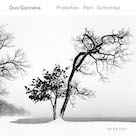
Duo Gazzana: Prokofiev, Pärt, Schnittke
ECM New Series
Recital duos must look upon the Labèque sisters and Duo Gazzana with some degree of envy when both are blessed with a natural telepathy to which all chamber outfits aspire. Katia and Marielle Labèque are perhaps the most widely known “sister act,” but the Italian-born Gazzana siblings, violinist Natascia and pianist Raffaella, have made strong names for themselves too. Keeping things simple, the duo titles its ECM New Series albums after the composers whose works are featured, be it 2018's Ravel, Franck, Ligeti, Messiaen or its latest, Prokofiev, Pärt, Schnittke. A scan of the composers whose works appear on the five ECM releases reveals the duo to be remarkably versatile in its repertoire, and aficionados of twentieth-century material will certainly appreciate a collection that presents two Sergei Prokofiev works alongside ones by Alfred Schnittke and Arvo Pärt.
Just as the sisters are deeply bonded, so too are the three composers, given that all were forced to operate within a politically oppressive environment that posed no small amount of danger to those who went creatively against it. As Italian author Stefano Catucci states in liner notes, for all three music “was an exercise in resistance and a search for the soul: a way to confront the present precisely by starting from the past they carried within themselves and to imagine exit routes far removed from the progressive optimism of the West and its avant-garde movements.” Recorded at the Reitstadel, Neumarkt in February 2025, the album spans a half-century, ranging as it does from Prokofiev's Five Melodies (1925) to Pärt's Spiegel im Spiegel (1978).
The recording begins, however, with the other Prokofiev work, his four-part Sonata for Violin and Piano No. 1 in f minor, begun in 1938 and completed in 1946. According to Catucci, David Oistrakh, the work's first performer and the consultant for the violin part, reported that Prokofiev advised him to “make it sound if it were the wind blowing over a cemetery.” Consistent with that is a subtly macabre opening movement that creeps into view stealthily before coming more vividly to life. Marked “Andante assai,” the gloomy movement's marked by tense double-stops from Natascia and ominous, low-register chords from Raffaella. It's also distinguished by quicksilver runs from the violinist that are so effortlessly executed one can't help but take notice. Significantly more animated is the subsequent “Allegro brusco” movement, which alternates between march-driven percussive episodes and emphatically lyrical ones. Bitingly sardonic as well as romantic expressions surface as this seven-minute stream of many moods develops, the music sizzling in the sisters' hands. A luminous and haunting “Andante” follows that shows the two are just as capable of playing with delicacy, after which the closing allegro-styled part sees light-speed theatrics ultimately give way to a reprise of the work's opening material.
Spiegel im Spiegel has become a favourite for many, and it's easy to understand why when it so seductively juxtaposes a melodic element that incrementally develops and a tolling other that serves as a bell-like ground. Tension escalates as the melodic voice progressively builds on each return and the parts synchronize hypnotically. Theirs isn't the only treatment of the work, but the Gazzanas deliver a superb reading that's marked by exquisite control and delicacy of touch. In pacing it so steadily and executing it with humility, the two maximize the music's tension and poetic grace.
A return to Prokofiev follows, with Five Melodies presenting concise transcriptions of songs written for voice and piano. It's a less substantial work than the opening one but possesses ample appeal nonetheless. The opening “Andante” arrests instantly when its opening violin phrase recalls one from Gershwin's “I've Got a Crush on You” (“Could you coo, could you care”), though the resemblance is, one presumes, accidental (the song was written in 1928). Not surprisingly, the violin often exudes a rather vocal-like quality in these settings, regardless of whether the tone's serene (“Lento, ma non troppo”), agitated (“Animato, ma non allegro”), or playful (“Andantino leggero e scherzando”).
Schnittke's known for his poly-stylistic approach and penchant for knitting disparate parts into collagistic wholes, but Gratulationsrondo (1973) finds him resisting that urge for a sunny expression that largely hews to a traditional classical style. Listeners familiar with his work might be surprised by how much the piece eschews any of the grotesquerie and disfigurement that emerges elsewhere in works by him. The youthful ardour of Gratulationsrondo certainly makes it easy to embrace, however.
The Labèques might be more internationally known than the Gazzanas, but the latter have established themselves forcefully too, helped in no small part by their five releases on ECM. The duo's latest builds on the strength of its first four releases with a fifth that takes its place solidly alongside the others. One comes away from the release impressed by their curatorial smarts but even more their superb musicianship.August 2026