

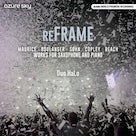
Duo HaLo: reFrame
Azure Sky Records
One of the primary reasons why saxophonist Andrew Harrison and pianist Jason Lo established Duo HaLo was to tie the saxophone more deeply to the classical tradition, and certainly reFrame argues powerfully in favour of the connection. If anything, one comes away from the recording mystified as to why the instrument isn't as much a staple of the classical milieu as other woodwinds. Such a reaction's attributable, in part, to the performances of material by Katahj Copley, Nadia Boulanger, Amy Beach, Paule Maurice, and Nicky Sohn that make such a compelling case on behalf of the saxophone. Interestingly, the thematic terrain explored in the album's pieces has to do with, among other things, belonging, a fitting subject, all things considered.
The Indian-American saxophonist and Chinese-American pianist both earned Doctorate of Musical Arts degrees from the University of Southern California's Thornton School of Music. When not delivering Duo HaLo concerts at universities and venues throughout the United States, Harrison teaches classical saxophone at Sonoma State University while Lo is the Keyboard Area Coordinator at the University of La Verne. Other themes explored on the recording include memory, displacement, and self-doubt, with Harrison's immaculate tone, vocal-like expression, and sensitive articulation doing much to convey the emotions associated with the themes. He and Lo are virtuosos on their respective instruments but use that to connect emotionally with the listener, and certainly the intimate character of the material is reinforced when only two instruments are involved.
Originally written for alto saxophone and orchestra between 1948 and 1955, Maurice's Tableaux de Provence presents five “pictures” of the south of France, but these sonic landscapes are less attempts at literal depiction than painterly re-imagining. There are dances and joyful songs in these vignettes but lyrical melancholy too. The fluidity of the duo's attack is evident in a vibrant run-through of “Farandoulo di chatouno / Farandole des jeunes filles.” Whereas Harrison's alto dances acrobatically through that opening part, the slower second, “Cansoun per ma mio / Chanson pour ma mie,” calls for a more lyrical treatment that's no less memorable. The mood turns lively again for the march-driven “La boumiano / La bohémienne” before the work's most delicate “picture,” “Dis alyscamps l'amo souspire / Des alyscamps l'âme soupire,” ventures even more probingly inward. Rather than conclude the work plaintively, Maurice places the rousing "Lou cabridan / Le cabridan” last to leave us with an evocation that's spirited and playful.
Composed in 1909 for voice and piano, Boulanger's lovely Cantique unfolds contemplatively, with the vocal part in the original reframed by saxophone on this concise three-minute treatment. Harrison reduces his alto to a hush for the heartfelt rendering, though moments arise where a more emphatic attack is called for. Sohn's Three Apartments in Houston was written to capture his experiences as a composer immigrating to the United States and beginning a new life in Houston, the experience further complicated by the pandemic raging at the time. In place of the excitement associated with coming to a new country, Sohn had to deal with isolation and the impossibility of feeling part of a community. After an introductory rumination marked by tenderness and hope, the work presents portraits of three apartment locations, with moods ranging between jubilant and introspective. Melancholy infuses the “1904 Addison Road” movement, which during certain passages exudes a rather “Danny Boy”-like quality. "2512 Shakespeare Street,” by comparison, ends the work on a note of jazzy abandon.
Originally arranged for trumpet and piano, Copley's reFRAME explores the concept of “imposter syndrome,” the feeling of doubting one's credibility even when genuine achievement should prevent self-doubt from arising. Each of the work's three movements deals with a stage in the process of self-reclamation, with the first recognizing instability, the second responding to it with self-reflection, and the third conveying self-acceptance and positive change. Copley's sparkling writing reflects those stages vividly, with the opening “reFRACTED” jittery and anxious, “reFLECTIONS” a haunting lyrical meditation, and “reAFFIRMED” a triumphant self-embrace. At album's end, Beach's Romance, written in 1893 for violin and piano, sounds in Duo HaLo's hands as if it was born for the saxophone-and-piano pairing. Many performances of the popular piece are available, but the singing one presented by Duo HaLo charms as much as probably any you've heard.
The saxophone's generally the lead voice on the album, but Lo's contribution shouldn't be overlooked when his instrument partners seamlessly and sensitively with Harrison's. Detailed liner notes by the latter that expand on the themes and their connections to the five works enhance one's appreciation for what the two accomplish with the project. The Copley work gives the album its title, of course, but it also dovetails with the duo's mission to encourage listeners to view something from another angle, in this case to see the saxophone as an instrument that has as rightful place within a classical milieu as any other. No one will likely come away from the album believing otherwise.October 2026