

Emiko Edwards: Rodeo: Works by Aaron Copland
Lexicon Classics
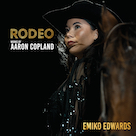
Emiko Edwards' Copland-themed album arrives with a Ty Ferrell cover photo showing the pianist sporting a cowboy hat, a gesture that could cue the listener to expect a set featuring Billy the Kid, Fanfare for the Common Man, and, of course, Rodeo. Yet as wonderful as an album featuring such material would be, Edwards has, for the most part, chosen works that are less familiar and not quite as user-friendly as those populist pieces. The reason's simple: in place of solo piano transcriptions of Copland material, she presents his solo piano works as they were originally written and which are rarely performed and recorded. To be sure, Rodeo: Works by Aaron Copland isn't without its accessible moments, as shown by the inclusion of “Saturday-Night Waltz” from Rodeo, but a work such as his Piano Sonata turns out to be more representative of the release's character.
Inspiration for the project came, in part, from her 2024 move to Missouri with her husband, who's now physician-on-call for the bull riding competition at the Sikeston Jaycee Bootheel Rodeo (where the cover photo was shot, incidentally). Copland naturally came to mind after the pianist settled into, in her words, “one of the nation's most storied rodeo towns,” and the broad stylistic range of the composer's piano oeuvre bolstered the appeal on all-Copland recording might have. A further connection was established when she recorded the set near Yaddo, the artist colony where Copland premiered his Piano Variations.
Derived from Copland's film score for The Cummington Story (1945), In Evening Air initiates the set with a brief setting of gentle warmth and poetic splendour. The sensitivity of Edwards' touch and her pacing amplify the impact of this engaging expression before its place is ceded to a more tumultuous work, the Piano Sonata of 1941. Reflecting the time of its creation, the three-part sonata exudes tension, uncertainty, and anxiety, qualities evident from the opening chords of the probing “Molto Moderato.” Ranging widely, the movement opens ominously, advancing as it does through cryptic shadows and daunting passageways. Moments of introspective calm also arise, however, to allow the nerves to settle in between the dramatic eruptions. Dancing rhythmic gestures emerge too that anticipate the central “Vivace,” which lunges into position with nimble patterns delivered with gusto and metronomic precision by the pianist. Oscillating between moments of luminous calm and wrenching despair, the concluding “Andante sostenuto” assumes the air of a solemn, thirteen-minute requiem, even if the date of its writing precedes the war's end by four years.
The heaviness of the sonata's alleviated by “Saturday-Night Waltz,” the third of four episodes in Copland's ballet Rodeo and, buoyed by its lilting dance patterns and tender melodies, the album's most beguiling setting. One can't help but be struck by the patience and control with which Edwards executes the material and thereby magnifies its emotional effect. With Four Piano Blues, Copland pays homage to four pianists, with a pithy description accompanying each portrait: for Leo Smit, the apt, rather Gershwin-esque "Freely poetic,” for Andor Foldes the ruminative “Soft and languid,” for William Kapell the hushed “Muted and sensuous,” and for John Kirkpatrick the rousingly jazzy “With bounce.”
If hints of dissonance surface in the sonata, they come fully to the fore in Piano Variations, which was influenced by Copland's studies with Nadia Boulanger and of which Leonard Bernstein apparently said any room in Boston could be emptied within three minutes when he played it. Introduced by a stark, brooding theme, the adventurous, heavily chromatic work thereafter ventures down multiple pathways, some dark in the extreme and others less foreboding. We're about as far removed from the pastoral bliss of Appalachian Spring as might be imagined. As if designed to mirror the opening, the album ends with a gentle statement, Down A Country Lane recalling in its folk-like simplicity and lyricism the Copland persona with which the general public's familiar.
After listening to Rodeo, it's hard not to concur with the New York Classical Review, which opined, ”One has rarely heard a pianist bring out so many of the nuances latent in Copland's piano music” and described the Edwards-Copland combination as an “exceptional meeting between composer and musician.” The value of Rodeo is enhanced not only by the superb pianism demonstrated by Edwards in her interpretations but in giving exposure to material that's too-little known. Countless albums of Copland's popular works are available, ones featuring his Piano Sonata, Four Piano Blues, and Piano Variations considerably less so. Edwards' album reflects flatteringly on her as a pianist and curator whilst also adding significantly to our appreciation of the work Copland produced.September 2026