

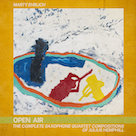
Marty Ehrlich: Open Air: The Complete Saxophone Quartet Compositions of Julius Hemphill
Out Of Your Head Records
Saxophonist Marty Ehrlich deserves some kind of medal for honouring the great Julius Hemphil l1939-95) with this terrific set. While another artist might see fit to include a Hemphill tune (or two) on a release, Ehrlich's not only recorded the forty saxophone quartet compositions Hemphill created between 1978 and '89 for the World Saxophone Quartet (WSQ), he and a select crew of other saxophonists have channeled the spirit of that great outfit in their own inspired renditions. Others have celebrated the work Hemphill did, Tim Berne a particularly noteworthy champion, but no one's done as much to promote and preserve the legacy of this singular artist as Ehrlich. Open Air is, full stop, a remarkable achievement.
The World Saxophone Quartet wasn't the only one of its time—the still-active Rova Saxophone Quartet had enthusiastic followers too—but it was the preeminent one due to the exceptional calibre of the writing and the talents of its original members, Hemphill, Oliver Lake, David Murray, and Hamiet Bluiett. Mirroring the character of a string quartet but with improv and soloing factored in, the saxophone quartet format enabled the four to straddle jazz and chamber classical fluidly. In releasing classic albums such as Revue, Plays Duke Ellington, and Rhythm and Blues, the WSQ ensured that its terrific discography would live on and become a wellspring of inspiration for future generations. Many compositions on the group's albums were by Hemphill, which makes it easy to understand why the group's greatest creative period ended with his death from diabetes (with Arthur Blythe taking his place, the albums Metamorphosis and Breath of Life did, however, manage to rise to the level of those featuring Hemphill).
A few other details merit mention before addressing the performances. Five assemblages are credited, with three replicating the quartet line-up of the original and coupling Ehrlich with Lisa Parrott (soprano, alto), Jeff Lederer (tenor), and Andy Laster (baritone) in one, Allan Chase (soprano, alto), Jason Robinson (tenor), and Brian Landrus (baritone) in another, and Sam Furnace (alto), Andrew White (tenor), and Alex Harding (baritone) the third (the latter outfit's different from the others in that its rendering of “What I Know Now” derives from a 1997 recording by The Julius Hemphill Sextet, At Dr. King's Table, added when Ehrlich realized he'd overlooked recording a new version of the tune). The other two configurations pair Ehrlich with Rob DeBellis in one and Brian Landrus the other, in both cases overdubbing used by the duos to approximate the quartet sound. The leader plays alto, soprano, tenor, clarinet, flute, and alto flute, while DeBellis and Landrus are likewise credited with multiple woodwinds. One comes away repeatedly awed by how convincingly the duos simulate a quartet's playing, Landrus and Ehrlich in “Dar El Sudan” and “Romance in Time” merely two instances of many.
One of the distinguishing aspects of Hemphill's pieces is their abundant melodic content, with some pieces (see “Touchic',”“Slide,” “Stick,” and “Border Town”) enticing with two or three times as many melodies as one might usually encounter. The textural splendour exemplified in these performances also makes them stand out, be it the resplendent, chamber-like scene-setter “Open Air (for Tommy)” or “Revue,” which sees Ehrlich and Landrus matching the epic quality of the WSQ original. Hemphill's reflective side's well-accounted for in the wistful melancholy of "My First Winter” (both treatments) and “Cool Red,” while tunes such as “Stick,” “Sweet D,” “One/Waltz/Time,” and “Revue” accentuate his bluesier inclinations. The gorgeous ballad “Georgia Blue,” which distinguished Hemphill's 1984 JAH Band album of the same title, receives a sumptuous reading by the Ehrlich, Parrott, Lederer, and Laster configuration, with the leader crowning the performance with an expansive, heartfelt solo. Solos are sprinkled throughout the release (a particularly memorable one by Ehrlich in “Bayou Sketches,” for instance), though not always, with some pieces hewing to a through-composed design (e.g., “New Prayers”). Let's not forget that the WSQ swung grandly, a fact not lost on Ehrlich and his collaborators when tunes like “R & B,” “Funny Paper,” “Functions,” and “Plain Song” roar gloriously, the latter highlighted by a punchy Lederer solo.
Regardless of the configuration in play, the musicians are exemplary, which makes for performances marked by authority and precision. While forty pieces might seem a lot to digest, many are in the two- to four-minute range, which makes listening to the release in one sitting a manageable proposition. Ehrlich calls the WSQ's recordings “essential listening,” and he's right. But so too is Open Air for assembling Hemphill's complete saxophone quartet material into a single double-CD statement. Among other things, the release presents an incontrovertibly compelling argument on behalf of his gifts.September 2026