

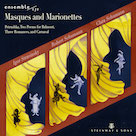
ensemble132: Masques and Marionettes
Steinway & Sons
On this splendid debut album, ensemble132 delivers performances of seminal works by Igor Stravinsky and Robert Schumann, with material by the latter's partner Clara included for good measure. Led by co-Artistic Directors pianist Sahun Sam Hong and cellist Zachary Mowitz, the group's completed by violinists Abi Fayette and Maria Ioudenitch and violist Luther Warren. In some respects, Masques and Marionettes is Hong's show, considering that he's the one responsible for arrangements of three of the four works. Creating versions of Petrushka and Carnaval for piano quintet and piano quartet can't have been easy, but the evidence shows Hong's done a remarkable job. Fleshing out the release are treatments of Stravinsky's Two Poems of Konstantin Balmont and Clara's Three Romances for Violin and Piano, the album content generous and the ensemble performances rich.
Hong took on a seemingly impossible challenge in producing a chamber treatment of Petrushka, given the incredible scoring Igor Stravinsky gave to the ballet. The timbral resplendence of the composer's orchestral arrangement is gone, naturally, yet Hong and the other ensemble132 members compensate for it in their zestful performance. Exploding with excitement, the group's enthusiastic rendition makes for a riveting listening experience. Hong's comment, “Great music transcends the confines of instrumentation,” is supported by the result. Establishing the album's storytelling dimension are short Stravinsky settings based on Balmont's poetry, the two apéritifs that offer an enticing portal into the ballet. Vocal lines in the original songs are transferred to violin and cello, respectively, with the aromatic “Forget-me-nots” intoxicating immediately, especially when the composer's personality imposes itself so clearly on the material, and “The Dove” proving as haunting.
The middle one of the composer's three great early ballets, 1911's Petrushka followed L'Oiseau de feu by a year and preceded Le Sacre du printemps by two and perpetuated the audacity of the composer's writing in the first with music of equally visionary character. Abundant in Russian folk tunes, jagged syncopations, and bitonal harmonic gestures, Stravinsky's wildly inventive and experimental writing elevates this vivid story of a puppet empowered by magic and sorcery at an 1830s St. Petersburg fair to the highest level of art. Casting a magical spell from its dramatic opening onwards, the work advances through thirteen gripping parts, the players delicate for its gentle moments, charming for its irreverent ones, and emphatic for its most aggressive. After stoking fire with “The Shrovetide Fair,” the ensemble slows the pace for the alternately singing and ominous “(The Magic Trick)” before the onset of the vibrant “(Russian Dance)” and crushing “(Peasant with Bear),” each episode rendered dazzlingly by the quintet. Brooding passages mix with radiant and rustic ones as the performance advances, Stravinsky's innovative handling of counterpoint and layering astonishing for its time. It's a tremendous and inspired performance by the ensemble.
Originally scored for violin and piano but here performed by three pairs of ensemble132 members, Clara's Three Romances (1853) gravitates away from the fury of the ballet for a more introspective presentation, the work's tender and rhapsodic tone captured with exquisite poignancy by Hong and Mowitz in the first, lyrical grace by the pianist and Warren in the second, and romantic splendour by Hong and Ioudenitch in the third.
Presented in twenty-one parts and composed when Robert was twenty-four, Carnaval can't help but exude a channel-surfing quality when one vignette gives way to another so rapidly. That's no serious knock against the work, however, which never fails to hold one's attention as it powers through thirty-one minutes of material. Miniature portraits of fictional figures are juxtaposed with ones based on close friends and colleagues from Robert's life, such that the familiar names Eusebius and Florestan crop up alongside Chopin and Paganini in Schumann's imaginary “League of David” music society. After introducing itself grandly with “Préambule,” Carnaval presents engaging snapshots of contrasting mood and style, and the music more intimate when performed by four instead of five ensemble members. A poetically delicate “Eusebius” is followed by a jaunty “Florestan,” enigmatic “Sphinxes,” sizzling “Papillons,” amorous “Chiarina,” and hushed “Aveu” before the piece climaxes with the triumphant group dance “Marche des Davidsbündler contre les Philistins.”
Recorded in August 2025 at Boston's Futura Productions, the seventy-seven-minute release is a debut of which the group, founded in fall 2019, should be proud and obviously augurs well for its future. Hong's also performed a great service for ensembles beyond his own in adding to the chamber repertoire terrific new arrangements for them to consider. One imagines any number of piano quintets salivating over the prospect of working Hong's remarkable translation of Stravinsky's ballet into their own set-lists.October 2026