

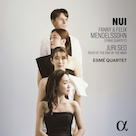
Esmé Quartet: Nui
Alpha Classics
As intimated by its title—“nui” means “sister” in Korean—a family-related concept does tie the three works on the Esmé Quartet's third Alpha Classics release together. Recorded in December 2025 at Salle Colonne in Paris, the release opens with Fanny Mendelssohn's String Quartet in E-Flat Major, written during the last year of her life, and ends with her brother Felix's Quartet No. 6 in F minor, composed in the aftermath of her sudden death. Between them lies a newly commissioned work by Korean-American composer Juri Seo, which, inspired by the Korean folk song “Eommaya nunaya” (“Mother, Sister”), extends the concept to the contemporary era. But let's be clear, while the concept gives a satisfying connecting thread to the fifty-five-minute recording, it's not truly needed when the calibre of playing is as stellar as it is here.
Currently celebrating its tenth year of existence, the award-winning Esmé Quartet (violinists Wonhee Bae and Yuna Ha, violist Dimitri Murrath, and cellist Yeeun Heo) delivers these works with a searing emotional intensity that makes the performances gripping. Feelings of sisterhood come naturally to the group when Wonhee, Yuna, and Yeeun have spent nearly a decade together (the group formed in 2016 in Cologne, Germany), and that feeling of connection expanded further when Dimitri joined the quartet in 2023. As Nui shows, the deep bond the four have developed is evident at every moment of their playing.
The tenderness of Fanny's four-part quartet is established at the outset in beginning with an “Adagio ma non troppo” movement. Executed with exquisite patience and control, the material exudes melancholy, yet gracefully and with dignity and poise. All such tonalities are articulated with characteristic sensitivity by the musicians, who segue seamlessly from introspection to urgency. After that expressive beginning, the work exchanges poetic lyricism for the energized acrobatics of its concise “Allegretto,” Esmé's members proving as adept at playing in a fervent mode as a gentle one. The tempo slows once more for the twice-as-long “Romanze,” the character of the music now warmly romantic and the string textures at their most lustrous. As the work nears its close, the group sizzles through the rapturous “Allegro molto vivace,” the violinists dancing through their parts jubilantly and their partners providing furious counterpoint. Fanny's quartet clearly testifies to the high level at which she was creating before her untimely death.
A single-movement work lasting approximately eight minutes, Seo's River At the End of the Mind (2025) forms a satisfying counterpoint of its own to the Mendelssohn works. The tenderness of its plaintive song is immediately affecting and transporting too. Traces of the Korean folk song that inspired it resonate throughout and imbue it with a wistful quality whilst also imparting comfort and a sense of peace. It's not a one-dimensional evocation, however, as episodes of agitation emerge too as a contrast to the soothing ones.
While Felix's quartet is, like Fanny's, in four movements, it departs from hers in sequencing its “Adagio” third and accentuating allegros. Esmé Quartet has performed the piece nearly fifty times during its ten-year tenure and has clearly acquired a deep grasp of the work and its emotional landscape. The four attack its opening “Allegro vivace assai” with ferocity without sacrificing nuance and attention to detail in the process. Slightly less furious is the subsequent “Allegro assai,” even if here ample heat's generated in between repeated voicings of the impish, ear-catching theme. As anticipated, it's the “Adagio” that plunges the work most resolutely into grief, hauntingly so as handled by the quartet. One imagines Felix channeling the sorrow he felt over his sister's passing into the movement's poignant expression. Resolving the work on a less solemn note is its breathtaking “Finale: allegro molto,” which Esmé's members dig into with as much passion and fervour as anything else on the release.
Ten years is a long time for any group, yet as the photos included with the release indicate the members of Esmé Quartet are all young with decades of music-making still to come. Given the sterling performances they deliver on Nui, it would be a shame if the synergy the four have developed were to come to a premature end. With any luck, ten years from now the group'll be celebrating another anniversary milestone with what might by then be its sixth or even seventh release.
October 2026