

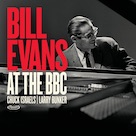
Bill Evans: At the BBC
Elemental Music
If anyone deserves an award for contributions to the arts, it's producer Zev Feldman, whose curatorial efforts have helped bring fifteen Bill Evans productions into the world. Working with the Bill Evans Estate, Feldman returns with yet another essential document and presents it with all the care he and his team gave the earlier volumes. At the BBC is a special and singular addition to the Feldman series and Evans discography for a number of reasons.
Issued in CD and double-LP formats, the recording derives from the March 19th, 1965 television broadcast of Jazz 625, with English trumpet player Humphrey Lyttelton the host. While the two half-hour sets were filmed back-to-back on that date, they were aired on May 12th and December 29th that year and were Evans' sole performance at the BBC TV studio. At the time of the taping, his trio with bassist Chuck Israels and drummer Larry Bunker was midway through a month-long stint at Ronnie Scott's and thus in particularly fine form. Evans' most celebrated trio is, of course, the groundbreaking, template-reconfiguring one with Scott LaFaro and Paul Motian (the bassist tragically died in a car accident in '61, while the drummer left two years later to play with pianist Paul Bley), yet the second one with Israels and Bunker makes an extremely compelling case for itself. They'd been together for two years, and the telepathic, laser-sharp rapport the trio had developed is audible throughout.
Feldman honours the pianist with a lavish presentation that includes a booklet featuring commentaries by the producer, Evans scholar Marc Myers, pianists James Pearson and Jamie Cullum, and, perhaps most valuably, a revealing interview with Israels about his time with Evans. His comments about the isolation he felt from the pianist due to his drug habit are deeply affecting, tinged as they are with regret and sadness. However great that personal distance was, however, there was none such on performance grounds—even if the bassist and drummer had to be fast on their feet when Evans, eschewing a set-list, would cue them with an intro and expect them to follow. But as they knew the repertoire so well (Israels correctly describes the trio as a “well-oiled machine”), the two were able to jump in and make a performance sound flawless. Callum's comments that the group “really swung” and deserves not to be judged against the one with LaFaro and Motian as it had “a fire of its own” are supported by the performances.
There's nothing revelatory about the selections, as the set-list comprises familiar staples of Evans' repertoire. There's also no denying either, however, the magic that arises during the trio's renderings. Evans' "Waltz for Debby" and "Re: Person I Knew” are here alongside standards such as "Come Rain or Come Shine” and "Someday My Prince Will Come,” yet none feels tired; on the contrary, they're invigorated by the trio's wholly engaged execution. As Myers astutely notes, in stripping the visuals away, the recording facilitates greater focus on the music and one listens “in a more attentive and granular way. Rather than hear the music as background to what you are seeing, you feel it and the trio's excellence more deeply.”
Structured with the half-hour television segment in mind, each of the Lyttleton-introduced sets is framed by brief takes on “Five.” After his flattering scene-setting (and appreciative audience applause), the trio digs into Earl Zindars' “Elsa,” the pianist's penchant for elegant swing taking no time at all to make itself felt. Even at this early juncture, the musicians' chemistry is obvious when each responds to the others with pinpoint precision. Wielding brushes, Bunker swings powerfully and Israel, often sharing the lead with Evans, asserts himself with authority. Yes, the pianist carries the melodic load, but the trio nevertheless exemplifies his ideal of democratic balance. After crisp, bluesy takes on “Summertime” and “Come Rain or Come Shine,” a luminous treatment of “My Foolish Heart” shows the trio in deft ballad form and raising lyricism to a high art. A breezy riff on “Re: Person I Knew” sees the urge to swing reasserting itself, Israel again showing himself to be an equal force to the leader in the soloing department. As the first set nears its end, the trio stokes an ever greater fire in a blazing rendition of John Carisi's “Israel,” the performance highlighted by high-energy trade-offs between bass and drums and then piano and drums.
Intro and outro aside, the second half boasts an entirely different set-list. A Zindars composition again initiates the proceedings, with this time a radiant version of “How My Heart Sings” leading the way. Engaging instantly is the group's confident, lithe reading of Miles Davis's “Nardis,” the pianist's acrobatic solo a model of phrasing and invention. Evans' fondness for Broadway tunes emerges in the inclusion of Anthony Newley's “Who Can I Turn To,” which receives a warm, affectionate treatment, “Someday My Prince Will Come” is given a breathless run-through, and Evans' iconic “Waltz For Debby” closes out the half with a suitably poetic and lyrical take. Sound-wise, things are fine but for a slightly distracting burr on the piano during the early going; thankfully, it settles down and becomes less noticeable as the recording advances. In no way does such a minor technical detail argue against the release of this invaluable collection. Admittedly Evans' music would live on in the absence of Feldman's releases, yet they add so much to our appreciation of the pianist they've become an indispensable part of a still-evolving portrait.May 2026