

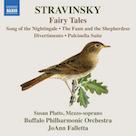
JoAnn Falletta & the Buffalo Philharmonic Orchestra: Stravinsky: Fairy Tales
Naxos
This splendid release from conductor JoAnn Falletta and the Buffalo Philharmonic Orchestra (BPO) features four Stravinsky works thematically linked by fairy tale connections yet strikingly different for presenting different stylistic sides of the composer. Of the four, Pulcinella Suite is the best known, with Song of the Nightingale, Divertimento, and The Faun and the Shepherdess following in turn. A striking composite portrait of the famously chameleonic Stravinsky is thereby presented and ravishingly so. Of course, while the four, written between 1906 and 1934, do offer a satisfying overview of this fertile period in his creative life, they constitute a microcosm of his total output if one considers the many more stylistic chapters that would be written in the decades to come.
Eminently well-qualified to take on the project is the Grammy-winning Falletta, whose discography boasts more than 135 titles and who's augmented her position as Music Director of the BPO (the appointment made in 1999) with full guest-conducting and recording schedules. The range of material she's conducted is broad and extends from early repertoire to newly commissioned pieces. Partnering with the BPO and Falletta on the album is Canadian mezzo-soprano Susan Platts, who's performed and recorded with them previously and, singing in Russian, contributes a sterling performance to The Faun and the Shepherdess.
As different as the four works are, they nevertheless bear Stravinsky's indelible imprint. If there's an exception, it's The Faun and the Shepherdess, which, being an early work, is not yet quite as Stravinsky-esque as the others; in fact, the opening song, “Pastushka," could be mistaken for one by Richard Strauss in being so chromatic and expressive. With texts derived from Alexander Pushkin, the work is a compact ten minutes and was written as a gift to Stravinsky's first wife shortly after their marriage; that the song-cycle is so little known is a wrong Falletta and company do their part to right. If a tad less rapturous than “Pastushka,” the animated “Favn” is gripping too, while the dramatic “Reka” finds the fifteen-year-old Lila pursued by the faun but evading capture by drowning in a river. In Conversations with Stravinsky, the composer recognized the work as sounding little like himself and more, in places, lie Wagner and Tchaikovsky. No matter: the work's enchanting, regardless of the influence others had on its writing, and Platts excels.
While not as obscure as The Faun and the Shepherdess, Song of the Nightingale is also less familiar than it should be. Stravinsky had begun his first opera, The Nightingale, in 1908 but set it aside to produce The Firebird (1910), Petrushka (1911), and The Rite of Spring (1913) before completing it a year later. Bearing in mind that its May 1914 debut performance followed the scandalous premiere of The Rite of Spring, it hardly surprises that The Nightingale, while positively received, didn't have the seismic impact of the earlier work. The idea of a ballet being extracted from the opera was discussed by Diaghilev and Stravinsky, which led to Song of the Nightingale being created in 1917 and premiered two years later. Derived from Hans Christian Andersen's fairy tale about an emperor and the two nightingales with which he's presented (one real, one mechanical), the four-part work unfolds without pause for twenty-one minutes.
Instantly arresting, the work begins with a bold flourish that's quickly followed by a thematic statement emblematic of the composer's style. Acrobatic flute gestures evoke the nightingale's voice, after which regal passages suggest activities taking place at the royal palace and the emperor's entrance. In the third movement, solo flute again represents the singing of the nightingale, with a violin duet suggesting the bird's interactions with the emperor. The final movement pivots into sombre passages when the gift of a mechanical nightingale leads the emperor to think it a better singer than the real thing, which leads to the latter's banishment. Reconciliation eventually occurs, however, with another duet for violin and flute signifying rapprochement. Signature Stravinsky rhythms and melodies permeate this colourful work, and a number of episodes hint at connections between it and the three landmark ballets created before it.
Also derived from Andersen is 1934's Divertimento, from the 1928 ballet Le Baiser de la fée and known as Stravinsky's homage to Tchaikovsky on the thirty-fifth anniversary of his death. In fact, it's more than a homage as little-known piano pieces and songs by Tchaikovsky were woven by Stravinsky into the piece. As is sometimes the case, the original ballet underwent transformations, first becoming an orchestral suite in 1931, then a transcription for violin and piano, and subsequently the four-movement version presented here. Whereas the writing style of Song of the Nightingale aligns it to the other ballets of the period, the elegant Divertimento is emblematic of Stravinsky's neo-classical writing and more calls to mind a kindred work such as Apollon musagète. While there's a programmatic dimension to Divertimento also, it wholly rewards when broached as a purely musical expression. The sprightly motive that introduces the “Danses suisses” movement tickles the ear, as do other horn and woodwinds episodes. The buoyant scherzo beguiles, as does the unashamedly romantic “Pas de deux” with which the piece ends. In being such a classic example of Stravinsky's neo-classical style, Divertimento deserves to be better-known too.
At album's end is the much-loved Pulcinella Suite, the 1922 original based on the music of Neapolitan composer Pergolesi (1710-36) and its revised version arriving in 1949. The treatment comprises eight parts that convey the character of a Baroque dance suite. If anything, the overture could have been delivered even more effervescently by the BPO, but its version isn't lacking for charm and suavity. Taking the place of the tenor in the original ballet, the solo oboe and violin players bring equivalent degrees of heartfelt lyricism to the haunting “Serenata: Larghetto.” The three-part “Scherzino” and “Tarantella” are as lively and exuberant as they should be, while “Gavotta” is unerringly elegant and “Vivo” memorable for its blustery trombone.
Falletta and the Buffalo Philharmonic Orchestra excel throughout, the performers showing themselves to be as adept at interpreting earlier works as later ones. To single out one rendering would wrongfully imply the others are inferior to it; that said, the performances of Song of the Nightingale and Divertimento are particularly strong, though a persuasive case could be made for The Faun and the Shepherdess given Platts' contribution. While another orchestra might have presented a slightly more vibrant reading of Pulcinella Suite, the BPO's hardly pales dramatically by comparison.May 2026