

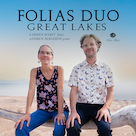
Folias Duo: Great Lakes
Folias Music
Two decades into their Folias Duo career, flutist Carmen Maret and guitarist Andrew Bergeron have created what's perhaps their most accomplished recording to date. The couple's releases have always been marked by their excellence as musicians and writers, but never has there been a subject matter better suited to their talents than the Great Lakes. The eight pieces that make up the suite have elicited from them newfound levels of ingenuity and imagination, making the release, their ninth, an indispensable addition to their discography. To celebrate the accomplishment, Great Lakes has been made available in the usual download and CD formats but also vinyl, a first for the duo.
While the couple is Michigan-based, fixing them to any one specific locale goes against the persona they've established as troubadours criss-crossing the United States, Canada, South America, and Europe and delivering hundreds of concerts. Listening to their music, one can't help but conclude that their music is consistently inspired by the places they visit and the people they meet (while the two do appear in formal concert settings, you're also just as likely to find them on an outdoor stage or at a park). Maret and Bergeron are also, however, academics: both earned Master of Music degrees from Michigan State University and are on faculty at Aquinas College and Grand Rapids Community College.
Stated otherwise, it would be hard to imagine the compositions for Great Lakes originating from a cloistered studio with the two hermetically sealed off from the outdoors. That said, the album was recorded in December 2025 at Oktaven Audio in Mount Vernon, New York, though that stage followed the formal writing of the album material. The eight compositions, five by Bergeron and three by Maret, resist straightforward categorization, straddling as they do classical, folk, and jazz and likewise inhabiting a space between through-composition and improvisation. Five of the pieces are titled after the lakes, the remainder more generally registering as meditations on transformation and experience. Particularly effective is the duo's handling of sequencing and arrangement, with two pieces respectively performed by each musician alone. Expanding on the music's timbral range, Maret plays standard flute but also bass flute, alto flute, piccolo, and tambin, a Guinean flute.
Maret's opening “Locust Storm” was crafted, naturally, to suggest the dance-like flutter of the titular insect, her flurries an effective evocation of its movements. With Bergeron's picking racing at an even faster clip alongside, Maret spirals through one pattern after another, the focus alternating between the two throughout. Notes by the flutist clarify that a variety of techniques and effects were incorporated to suggest the character of a swarm, from flutter tonguing to shifting metres. Exchanging flute for piccolo, her “The Way Through” exudes a pace that's slightly slower and a tone comparatively more introspective than the exuberant opener. Here as ever, the connection between the musicians is seamless, each one supporting the other at every turn and the playing marked by fluidity.
The five lake portraits follow, beginning with Bergeron's “Lake Ontario" and featuring Maret on tambín. The guitarist shares that the piece “draws on the Saharan blues of Tinariwen,” the result an easy-flowing intoxicant whose polyrhythmic design enhances its lilting quality and folk poetry character. Structured to move from solitude to gathering and finally return, his “Lake Huron” was inspired by the memory of a paddling experience and the stillness of the water, the glow of lights in the distance, and the soft sounds of paddling under a night sky. The lower timbres of alto flute permeate the framing sections of the piece, with C flute used for the central social-gathering section. Testifying to the couple's resourcefulness, material as varied as a Baroque chaconne and West African rhythms were drawn upon during the writing process.
At almost twelve minutes, his “Lake Superior” is the set's longest piece, fittingly so for a lake that's the largest freshwater one by surface area in the world. To capture the lake's stirring beauty but also its unpredictability and the dangers it poses, he structured the piece to advance through multiple sections, from serene to turbulent, and used unusual metres and chromatic harmonies to maximize tension and instability. Maret's alone on Bergeron's entrancing “Lake Erie,” her double-tonguing and animated arpeggios suggesting the energy and unpredictability of this smallest and shallowest of the lakes. Bergeron then flies solo on “Lake Michigan,” the tune's rondo form, shifting keys, tremolo effects, and shimmering picking helping to make it a beguiling conclusion to the lake portraits. Closing the set effervescently is Maret's Emily Dickinson-inspired “And Blaze the Butterflies,” scored for C, alto, and bass flutes and effectively translating into musical form the vividness of a dream state.
In the interest of full disclosure, the album's fifty-six minutes resonate for me more than it might another for the simple reason that four of my happiest years were spent at an Ontario town on Lake Huron, and swimming in its cool waters and exploring the area's nature settings are to this day cherished memories. Listening to Folias Duo's evocation of that lake and the others calls vividly to mind the joys I experienced during those formative years and the album engenders an immediate, Proustian return to the place's sights, sounds, and smells. Whether you have a connection to the locale or not, Great Lakes has the capacity to transport anyone there with visualizations that are never less than powerfully evocative.August 2026