

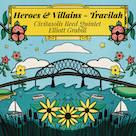
Elliott Grabill & Civitasolis Reed Quintet: Heroes and Villains / Travilah
Elliott Grabill & Civitasolis Reed Quintet
As a composer but also math teacher working and living in Baltimore, Maryland, Elliott Grabill brings an original, community-informed perspective to the music he creates. A graduate of the Peabody Conservatory and University of Virginia, his works have been performed by a number of ensembles and won prizes too. As the chamber pieces on his debut album reveal, his music's marked by textural richness and enticing melodic character. Heroes and Villains and Travilah are performed by the Civitasolis Reed Quintet, which formed in 2017 at the Florida State University College of Music and comprises Luis Gallo Quintero (oboe, English horn), Amy Humberd (clarinets), Beth King-Bennett (saxophones), Ryan Pereira (bass clarinet), and Alexandra Castro (bassoon), all five boasting impressive credentials and their playing reflecting their advanced abilities.
Recorded at the university's Dohnanyi Recital Hall, the release is also the Civitasolis Reed Quintet's debut album. In keeping with Adrienne Young's cartoonish cover illustrations, the album is engaging, its wide-ranging music vibrant and entertaining more than lugubrious and angst-ridden. The quintet format is a splendid fit for these pieces: with only five players involved, clarity and separation are maximized, yet the ear's also tickled by the pronounced contrasts in timbre between their reeds.
No, Heroes and Villains (2022), Grabill's first reed quintet, isn't a Smile-based chamber music homage to The Beach Boys—though the prospect of a suite featuring treatments of “Cabin Essence,” “Wind Chimes,” and others definitely tantalizes. No, Grabill's work was conceived as both a five-movement meditation on modern American political life and a companion piece to his 2019 song cycle Teacher Tales, based on things he observed while teaching in a variety of prison systems. Like that work, Heroes and Villains emerged out of the composer's frustration with the American political system and his witnessing of the concomitant polarization between its citizenry. Shady wheeling-and-dealing, mudslinging, paybacks, and subterfuge accentuate the seamy underbelly of the political system, with the lines distinguishing heroes and villains in these times fuzzier than ever.
Given such origins, one might expect the music to exude a perhaps downtrodden and even despairing quality. Not so: its tone is ruminative, even at times mocking, circus-like, and acerbic. Dissonances are woven into the writing, but subtly so as not to curb listenability. Gabrill's portrait advances from the bright squawks and squeals of its richly contrapuntal opening movement, “Heroes and Villains” to the shadowy portentousness of “Dark Money,” sardonic mockery of “Jeering Song,” and impish playfulness of “Patty Cake” before concluding with the appropriately ponderous “Elegy.” During the work's spirited episodes, the music at times calls to mind chamber music by Stravinsky such as Dumbarton Oaks and Ebony Concerto.
Less politically charged is Grabill's second reed quintet Travilah (2023), whose four movements are pastoral and nature-inspired. Interestingly, in a reverse move he composed the movements first and then, after considering the specific location a movement evoked, affixed names. The titular movement immediately announces a shift in mood from “Elegy” to something brighter. The wide-eyed “Travilah” blossoms like a spring flower with energized interlacings of reeds conveying optimism and hope. Inching past thirteen minutes, the movement affords the quintet ample opportunity to demonstrate its artistry. With instrument fragments entwining and flittering about, the animated “Lewis Orchards” paints a picture of birds, chipmunks, and other creatures frolicking on a summer's day. Slower and elegiac by comparison, “Violette's Lock” provides the work's lyrical rest-stop until the smooth-fingered “Preakness” ushers the work to an uplifting close.
Gabrill benefits considerably from having Civitasolis Reed Quintet as his collaborator for the collective virtuosity its five players bring to these performances. The ensemble clearly benefits too in having been provided with expressive material that offers such a terrific showcase for its members' talents.May 2026