

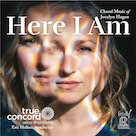
Jocelyn Hagen: Here I Am
Reference Recordings
On Here I Am, two world premiere recordings of works by American composer Jocelyn Hagen are performed by the Tucson, Arizona-based True Concord Voices & Orchestra, and without wishing to shortchange the value of its opening setting, The Notebooks of Leonardo da Vinci (2019), it's the second, Here I Am (2021), that is the recording's crowning achievement. This eloquent and empowering statement on behalf of womanhood deserves to be—nay, should be—presented not just in concert halls but at high school auditoriums and town hall gatherings. Weaving orchestral music, choral singing, and a libretto comprising recitations of words by forty-seven women, Hagen has created a work of affirmation that's profound and uplifting. It's a rare work that has the power to irrevocably change those that hear it, but Here I Am qualifies. All such praise risks downplaying the quality of its companion, The Notebooks of Leonardo da Vinci, which is, on its own terms, a work of clear and considerable merit.
Here I Am is but one example of Hagen's advocacy for gender equality and inclusivity. Through her “Compose Like A Girl” initiative, she champions female-identifying composers and campaigns for more equal concert programming, plus has a podcast through which she discusses such issues with fellow composers. Hagen's a pioneering composer in other ways too, specifically in the way her works extend the boundaries of composition into multimedia and electro-acoustic realms. Her songwriting origins remain part of even the most complex production, however, when vocal elements are critical to their design. Described as a “multimedia symphony,” the live presentation of The Notebooks of Leonardo da Vinci involves choral singing, orchestral playing, and video projections of his drawings and texts.
Hagen's material is performed by the 2004-founded True Concord Voices & Orchestra as conducted by Music Director Eric Holtan, with soprano Susanna Phillips, the Tucson Girls Chorus, and narrators Naomi DeVries Pomerantz, Kerry Ginger, Chelsea Helm, and Emily Marvosh joining for the performance of Here I Am. Interestingly, the idea for the latter work came not from Hagen but Holtan, who suggested she compose a piece celebrating the women's suffrage movement and the 2020 centennial of the nineteenth amendment, and from that seed a work of profound significance grew.
Structured in nine movements, The Notebooks of Leonardo da Vinci has been performed more than fifty times since its 2019 premiere and helped foster a fresh appreciation for the artist-scientist's brilliance. That Hagen would choose da Vinci as a subject doesn't surprise when her own work is driven by the same sense of curiosity and wonder that was so central to his own. Introduced arrestingly by solo flute, the music incrementally blossoms to include other woodwinds, strings, and, of course, choral voices. The elegant sweep that characterizes Hagen's music is present here too, from its opening “Painting and Drawing” movement to its rousing closer “Look at the Stars.” Graceful counterpoint by male and female singers makes for a spellbinding beginning that carries over into the subsequent eight sections. Hagen devotes as much care to the instrumental writing as the vocal (consider, for example, the vivid orchestral treatment that simulates rippling generated by a stone flung into water or the vocals-free sixth part “Invention”) in a work that alternates between dynamic passages of excitement and others of lyrical wonder. As if anticipating the message of Here I Am, the da Vinci work includes the words “Every obstacle yields to firm resolve” during “The Greatest Good.”
Here I Am celebrates the greatness of women throughout the world and history by threading their insights into a forty-three-minute tapestry. Delivered expressively by the narrators, the texts continually uplift as the work progresses and honours the perseverance of women who fought for equality and for their voices to be heard. Any number of passages might be cited to convey the work's humanizing tone, but those by Sarah McBride (“When you know someone's story, it becomes much harder to hate them”) and Audre Lorde (“It is not our differences that divide us; it is our inability to recognize, accept, and celebrate those differences”) are especially timely and should be posted on bulletin boards everywhere. Inspiring messages from political figures (Shirley Chisholm, Barbara Bush, Hillary Rodham Clinton, Margaret Thatcher, Kamala Harris) and artists (Virginia Woolf, Ethel Smyth, Toni Morrison, Ursula K. Le Guin, Frida Kahlo, Ella Fitzgerald) appear in turn and contribute to the mounting feeling of transformation the work engenders.
The work advances from “There is a Girl,” with its wry description of women as “the furniture in men's lives” and spoken parts punctuated by choral episodes, to “The Other Side” and its fervent expressions of desire for doors to open and equal opportunities to be made available. A model of poise and control, Phillips elevates the oft-elegiac second movement with a transcendent vocal turn, after which “Voting for Ourselves” argues, vehemently and boldly, for action (Kate Sheppard: “Do not think your single vote does not matter much: the rain that refreshes the parched ground is made up of single drops”). Here I Am concludes stirringly with “Write the Story” and emboldening words about self-actualization (Brené Brown: “We are the authors of our lives”) and caps the work with a glorious vocal trio by Emily Lau, Julie Bosworth, and Margot Rood. As engrossing as the libretto is, Hagen's music shouldn't be overlooked as it continually supports the texts with complementary moods and changes of colour. Any choral company looking to add a work of musical accomplishment and thematic relevance to its repertoire need look no further than Here I Am. The dissemination of its message has never been more necessary than right now.October 2026