

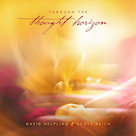
David Helpling & Scott Reich: Through the Thought Horizon
Spotted Peccary Music
A sign of the ever-encroaching AI times in which we're living, the words “Produced Entirely by Humans” appear on the back cover of this superb joint effort from electronic artists David Helpling and Scott Reich—not that such clarification is needed when the music couldn't more possibly reflect a human touch and the sensibilities of its creators. Both figures are long-standing practitioners of the ambient art, and the two appear to bring out the best in each other when pooling their talents as they do here.
While details about “who plays what” are clarified, the nine compositions are credited to both, making it impossible to determine who might have been more involved in the production of a given piece or whether each was equally involved. And with both credited with grand pianos (sampled and Yamaha CP-70 electric), keyboards, and synthesizers, it's similarly a challenge to determine who's responsible for a given sound, the electric guitar textures contributed by Helpling one of the few elements attributable to him exclusively. The California-based Helpling did play a bigger part in the production end of things, however, as he's credited as having produced, recorded, and mixed the material at his Dream Anchor set-up in Coronado Island.
The album gravitates in a New Age direction and resplendently so. To be sure, Through the Thought Horizon isn't watered-down sonic pablum but rather refined ambient soundscaping of the most immersive, introspective, and spiritually replenishing kind. Never purely academic in its design and expression, the duo's music is genuine and heartfelt without ever feeling precious or remote. Accentuating the soothing end of the spectrum, the productions settle, not fray, the nerves. Some of the projects with which Helpling has been involved have featured music of a more epic and aggressive kind; his collaboration with Reich moves in the opposite direction without being any less affecting. No doubt the latter's background in classical and jazz and his expertise in compositional form and harmony factored significantly into the project's development. Conversely, Helpling's command of sound design and texture had to have played a major part in the music's character too.
At the outset, silken synth washes, tinkling accents, and guitar shadings invite the listener into “The Simplest of Miracles” before the music morphs into a downtempo flow of piano sprinkles and atmospheric ear candy. As the material slows to near-stasis midway through, it reassures with its quiet confidence and its creators' artful handling. A climax of sorts is reached, but gradually and with an expert shaping of tension and build. “Into Our First World” transports with acoustic piano flourishes that allude subtly to jazz harmony, almost as if Lyle Mays might have been recorded during an intimate studio break without being aware. In a typical album piece, piano, sometimes reverb-drenched, acts as the lead instrument when it prettily intones at the forefront of an always mutating soundscape design. "Breath of a Flower” departs a little bit from that formula when guitar figures introduce it and then hand off to piano and chimes before resonantly reinstating itself amidst the enveloping shimmer. One of the loveliest compositions is “Fallen Skies, Remember Me” for the gentle intoxication its melodies and lilting pulse impart, even if the intensely dramatic “The Primordial Tower” isn't far behind when it likewise entrances with lulling rhythms and a wide-screen production design.
The serene tone of this New Age material and its calm-inducing effect encourage Through the Thought Horizon to be regarded as “healing” music, and certainly such material is very welcome in these unsettling times. In sharing these productions with us and in having brought them to a state of meticulous polish, Helpling and Reich have granted us an opportunity to enrich our inner selves with the fruits of their collaboration. Long may it continue.July 2026