

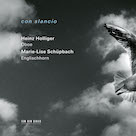
Heinz Holliger& Marie-Lise Schüpbach: Con Slancio
ECM New Series
Even more impressive than the fact that Con Slancio marks four decades of collaboration between Swiss oboist Heinz Holliger and ECM New Series is the youthful vigour with which the octogenarian plays. It's remarkable to first learn that György Kurtág's con slancio, largamente and Toshio Hosokawa's Musubi were written to honour Holliger's eightieth birthday seven years ago and then be confronted with the kind of playing one associates with an oboist half his age. True, the album material was recorded during the summer of 2020, but that still makes him eighty-one at the time of the Radiostudio sessions in Zurich. Clearly a fountain of youth's somewhere located on Holliger's property.
Two other details are worth noting at the outset. Of the dozen pieces performed, half are Holliger compositions, the others by Jürg Wyttenbach, Rudolf Kelterborn, Jacques Wildberger, Robert Suter and the aforementioned Kurtág and Hosokawa. Six are performed by Holliger alone on oboe and/or English horn, the remainder duets for oboe and English horn with Marie-Lise Schüpbach. Whereas an ensemble format would allow him to, literally, take a breath, playing either alone or with one other partner requires him to be playing pretty much without pause. For the most part, the duets couple Schüpbach on English horn with Holliger on oboe, though on one piece, his Lied im Gegenüber (contr'air), they switch.
As compelling as the solo performances are, those with Schüpbach (who studied oboe with Holliger in Freiburg im Breisgau) are especially riveting when their serpentine lines entwine. While many pieces were composed recently (all of Holliger's between 2018 and '20, for example), some were written decades ago, including Wyttenbach's Sonate (1961) and Wildberger's Rondeau (1962). In place of standard liner notes, the release booklet features an illuminating interview with Holliger conducted by Michael Kunkel in early 2023. In-depth exchanges about klangrede (“speech in sound”), poetry, and the album material do much to enhance one's appreciation of the release. It's ultimately the performances, however, that matter most, and in that regard Holliger and Schüpbach don't disappoint.
Performed solo on oboe, his own con slancio instantly captivates with its fluttering gestures, sinuous lines, and dancing figures. It sets an arresting scene for Hosokawa's Musubi, wherein the duet partners coil around one another, their instruments sometimes uniting and sometimes splintering apart. For ten minutes, they engage in a ceremonial dance that intoxicates for its pitch-bending swoops and tension-building. At times, the two, like birds calling to one another from separate trees, engage in intense to-and-fro, but their voices also overlap and wind into tight knots. Only Wyttenbach's Sonate für Oboe solo is multi-part, with each movement exploring different moods and effects. The unaccompanied presentation dovetails seamlessly with the probing introspection of the opening part; the second sustains that inward-probing orientation though does so with extra urgency and stress. A florid array of upper-register flutterings and staccato, bird-like calls dominates the restless third, after which the work's epilogue shifts the focus to longer tones and a mood of reflection.
In its opening moments, Holliger's Spiegel - LIED duet with Schüpbach calls Stravinsky's Elegy for J.F.K. to mind, oddly enough, while two others, à deux – Adieu and short Fangis (fang mich), flirt, respectively, with brooding, Bartók-ian atmospherics and rapid spiraling motions. Rivaling Musubi for length are Wildberger's Rondeau für Oboe solo, featuring an unaccompanied Holliger engaging in intense self-interrogation, and Kelterborn's elegiac Duett für Oboe und Englischhorn, one of the last pieces the Basel-born composer wrote before his 2021 passing. Particularly memorable is Suter's Oh Boe für Oboe solo from 1999 for its supplementing of sprechstimme to Holliger's oboe. A dada-like playfulness informs the vocal component when spoken-sung fragments sputter and writhe around the oboe core. How inspiring to see him ending the release so spiritedly.
While Manfred Eicher's ECM and ECM New Series imprints are perhaps most famously associated with Keith Jarrett and Arvo Pärt, many other artists have established long associations with the labels, Jan Garbarek, Gidon Kremer, Meredith Monk, Eleni Karaindrou, and Terje Rypdal a representative handful. Holliger's name deserves to be at the top of that list, however, when a recording such as Con Slancio adds one more distinguished chapter to his ECM New Series discography.June 2026