

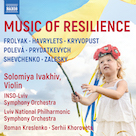
Solomiya Ivakhiv: Music of Resilience
Naxos
Violinist Solomiya Ivakhiv has long been a champion of her native Ukraine, and certainly the devastation wrought by invading Russian forces on the country since February 2022 has given her even more reason to be one. Eight works (all world premiere recordings) are presented on Music of Resilience that span the past century and deal in different ways with issues of perseverance, overcoming, and struggle. There are epic statements that capture the enduring character of the Ukraine people but also lamentations that mourn the monumental losses the country's suffered. As powerful as the former are, it's the latter that are the album's most moving expressions. Ivakhiv's third album for Naxos is inspirational in its fervent embrace of hope over despair.
Testifying to her commitment, in her role as Artistic Director of Music at the Music at the Institute (MATI) Concert Series in New York City, she's been a regular spokesperson on behalf of Ukrainian classical music. She studied at the conservatoire in Lviv but also at the Curtis Institute of Music and Stony Brook University and is currently on faculty at the University of Connecticut. Five years ago, she was named Honoured (Merited) Artist of Ukraine, the highest cultural honour the country bestows. She's joined on Music of Resilience by two orchestras in residence at the Lviv National Philharmonic: the INSO-Lviv, conducted by Roman Kreslenko, and the Academic Symphony Orchestra, by Serhii Khorovets.
Inaugurating the project on a lamenting note is Victoria Vita Polevá's Bucha. Lacrimosa (2022), an instrumental requiem she composed after seeing images of massacred Ukrainian civilians. An ethereal intro evokes the image of souls ascending, the violin emerging hauntingly from on high and sustaining itself determinedly. Percussive knocks and swirling strings enter to amplify tension and destabilize the music until an abrupt left-turn finds the music beset by activity and turmoil. Merciless hammer-blows convey the destruction caused by Russian troops at Bucha during March 2022 until stillness returns, the violin once again marking the ascent of another group of civilians.
Though Hanna Havrylets wrote Ex Libris in 1993, a tragic connection to the recent invasion arises in her case too as she died in February 2022 when she was unable to receive medical care because bridges in Kyiv had been either burned or closed off. Composed for the poet and violinist Sofia Maidanska, the four-part suite represents Havrylets' musical response to Maidanska's poetry and draws on Ukrainian folk traditions. The radiance of the prelude isn't unwelcome, arriving as it does after Polevá's lament, though, interestingly, Ivakhiv's violin, which appears sans accompaniment for the entire work, positions itself in a high register once again. The tone of the opening part's bolstered when the violinist delivers a rousing folk dance before a dramatic shift occurs in the blistering third and the work takes on an elegy-like character. Resolving the suite on an uplifting note, the rustic folk dance dimension of the second movement reinstates itself for the spirited finale.
Composed in early 2024, Bohdan Kryvopust's On the River was written in memory of protestors killed in Kyiv's Independence Square during 2014 demonstrations. Similar to Polevá's Bucha. Lacrimosa, On the River initially exudes a mood of peaceful splendour, but the music takes a tragic turn when turbulence signifies a devastating outbreak of violence. As the episode ends, calm re-asserts itself, the violin acting as a vessel through which the degree of destruction's assessed and the death toll tallied. Also written in 2024, Kryvopust's Ukrainian Suite advances through four parts, each evocatively titled. Pride and dignity are conveyed by the rapturous “On the Scythian land - Oh, Wondrous Birth,” after which a lighter tone's instated by the infectious dance moves of "The Hutsul Woman.” While sadness permeates “When I Got MY Draft Notice” in addressing the regrettable recruitment of young men into Ukraine's military, the composer opts to conclude the suite upliftingly with a hope-infused finale that champions the strength of the Ukrainian people and anticipates better days to come.
Representing an earlier generation of composers are Osyp Zalesky and Roman Prydatkevych, the former accounted for by Autumn Song and the latter the three-part Ukrainian Rhapsody No. 1. Ivakhiv gives resplendent voice to Zalesky's rhapsodic expression, while Prydatkevych draws on the late-Romantic violin tradition in his concerto-like set-piece. The violinist basks in the expressive opportunities the material offers, which, ranging from slides and pizzicati to harmonics and double-stops, are plentiful. As riveting as Autumn Song is Bohdana Frolyak's Nocturne, originally part of a suite she wrote for cello and piano in 2008 and newly re-arranged for violin and orchestra. Again, the material's perfectly tailored to Ivakhiv's strengths, her vibrato-rich voicings bringing forth the elegiac beauty of Frolyak's lament.
In encore-like manner, Ivakhiv's release concludes with We Do Exist! (We Are!), a poignant treatment by Yuriy Shevchenko of the melody of Ukraine's national anthem. Its title exudes triumph, yet there's sadness here too in that the piece was the composer's final work before succumbing to COVID-19 in March 2022. In acknowledging the co-realities of overcoming and death, the piece makes for a fitting end to this statement by Ivakhiv and her collaborators. Her expressive artistry as a violinist makes it an immensely rewarding release on musical grounds, but it's rendered all the more powerful in being so directly tied to pivotal real-world events. Regardless, any recording that includes pieces as soul-stirring as Autumn Song and Nocturne wholly justifies its recommendation.October 2026