

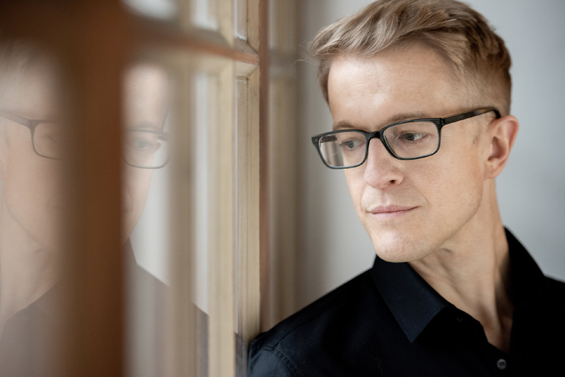
photo: Cyrus Allyar
FIVE QUESTIONS WITH LEVI HAMMER
Pianist Levi Hammer's debut solo piano album, Gershwin in Vienna, presents works by American icon George Gershwin and the Second Viennese School, spearheaded by Arnold Schoenberg and including his famous pupils Alban Berg and Anton Webern. Bringing extra resonance to the project is the fact that Gershwin, the celebrated composer of Porgy and Bess and Rhapsody in Blue, and Schoenberg, the iconoclast whose twelve-tone system exerted a profound influence on the development of twentieth-century classical music, were friends who lived in California during the 1930s and even tennis partners. The Iowa-born Hammer grew up absorbing the Great American Songbook but then later discovered the Second Viennese School and developed as fervent an attachment to it. With Gershwin in Vienna (reviewed here), he's indulged both loves by fashioning a dialogue of sorts between Gershwin and the other three. As the release reveals, Hammer's a tremendously gifted pianist, but he's also established himself as a conductor who's presented numerous opera productions and symphony orchestra concerts in Europe and America. While his experience as an opera conductor is touched upon in this recent interview, our discussion primarily focused on the solo piano project.
1. Gershwin in Vienna is fascinating for its juxtaposition of Gershwin and the composers of the Second Viennese School. Admittedly the idea of pairing him with the others is audacious, yet what your recording shows is that the approaches of the two sides, while dramatically different, are surprisingly complementary. How do you account for the fact that Gershwin's music sits so comfortably alongside the pieces you've selected by Schoenberg, Berg, and Webern?
I'm pleased that you like the juxtaposition. Even some of my closest friends and colleagues don't, which is fine of course! But to kindred spirits, it feels very natural. The Second Viennese School (as well as other musical modernists) undoubtedly influenced Gershwin, and even if Schoenberg and Berg respected Gershwin's compositional craft, I don't think the influence went in the other direction. The affinity is there, if not a direct influence. I recently visited Berg's home in Vienna with Simon Rattle. The apartment is virtually unchanged since 1935! And after I played Berg's piano, which Gershwin himself played in 1928, Simon took Berg's own copy of the piano score of Wozzeck off the bookshelf and pointed out a phrase that Gershwin blatantly stole for Porgy and Bess. This parallel passage is just one example of their affinity.
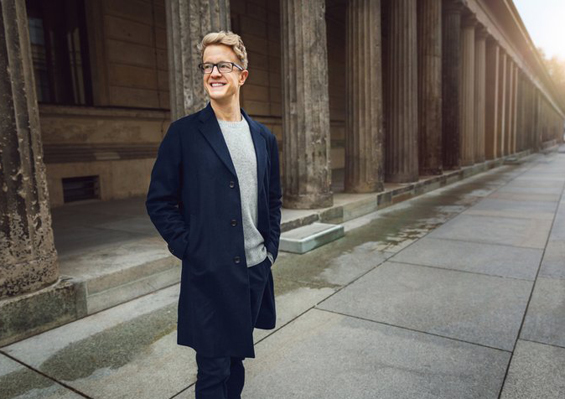
photo: Bearbeitet
2. Despite having what one would presume to be very different temperaments and beliefs, Gershwin and Schoenberg weren't just acquaintances respecting each other as artists from a distance but enjoyed a genuine friendship as Los Angeles residents in the 1930s. For those who imagined them as some oil-and-water proposition, seeing them enjoying each other's company at the tennis court (as seen in an online video) is riveting, and the affection that Schoenberg had for his American friend is clearly evident in the touching radio tribute he gave after he died and that you included at the end of your release. What was it that enabled such two fundamentally different men to have shared this deep connection?
I so appreciate this observation. Despite their very different histories, I don't think they were such different men, and I think that's probably where the personal affection came from. Yes, their respective arts are sometimes (not always!) seemingly opposite, but in my mind, they were two composers with different aesthetic intents walking separately but in parallel and in the same direction.
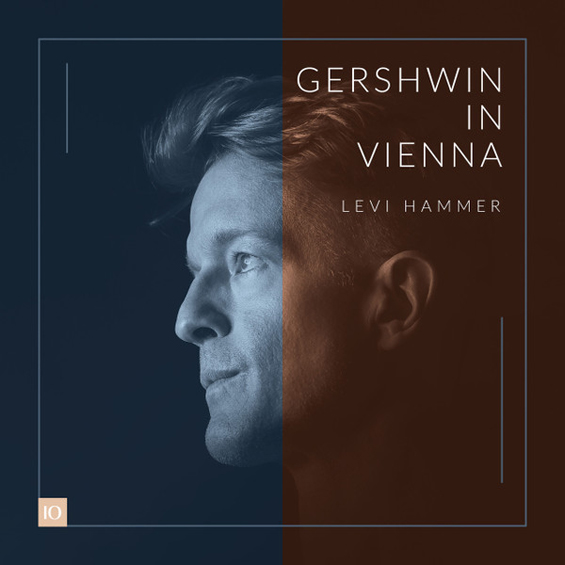
3. While Gershwin produced a staggering body of enduring work, his death at thirty-eight was an incalculable loss when one considers the music he might have created had he lived, say, thirty years more. Having immersed yourself so fully into his world and absorbed his music so deeply, what do you think he would have done musically had he lived longer and where might he have ventured? Were there sketches or plans left behind that indicated what his next moves might have been?
The early death of Gershwin was indeed a tragedy. One of the many things to admire about Gershwin was his curiosity. He could easily have churned out hit after hit, growing more commercially successful with each succeeding decade of a long and lucrative life. But his curiosity was driven by an inner compulsion to evolve. His music became more contrapuntal (there are fugues in Porgy and Bess!), his command of the orchestra became ever more sophisticated, his construction of larger forms more assured, his use of leitmotifs in Porgy came from Wozzeck (which in turn came from Wagner via Schoenberg) and probably most importantly, his harmonic palette expanded to include the quartal harmonies of the Second Viennese School, the bitonality of Stravinsky (Petrushka especially) and the innovative harmony of Debussy—all of this while keeping a foot in the popular American idioms of Tin Pan Alley, with its endlessly beguiling rhythms and syncopations. When you step back from the sheer pleasurable enjoyment of Gershwin's music and put it under a microscope, you can't help but admire the man who wrestled with the nuts and bolts of the craft.
It's tantalizing to speculate on what compositional direction he might have followed had his life not been cut so short, and my feeling from engaging with him my whole life is that his aesthetic would have remained closer to the more Romantic Berg. Because like Berg, Gershwin was a man of the theatre, and I don't think he could have fully plunged into a more severe atonality.
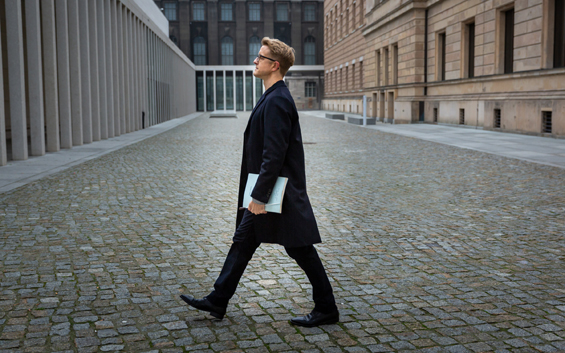
photo: Bearbeitet
4. Schoenberg's music has had remarkable staying power when one considers the considerable challenges it still poses to many listeners; that's even more noteworthy when one considers the natural tendency for important artistic figures of a particular era to slowly recede from view (at the risk of angering their champions, names such as Hindemith and Krenekcome to mind). How do you account for the fact that more than a century later so many of Schoenberg's works show no signs of disappearing?
I've had the pleasure of meeting two of Schoenberg's sons and many more family members, and yesterday I met Schoenberg's grandson Arnie Schoenberg in San Diego. I laughed when he mentioned the "cult of Schoenberg"– because it's easy to get obsessed with the richness and variety of Schoenberg's art. Those of us who perform these works do it despite the fact that it's considered what my German colleagues call "Kassengift"– box office poison.
Audiences are often still scared of this music. This is in part the fault of us performers for not playing it in its proper context, as a direct evolution from Wagner and Brahms and Mahler. The music of the Second Viennese School should be performed with the same expressive passion as the music from which it sprang. Many twentieth-century performers played it terribly dryly and inexpressively—like Boulez and Gould, for all of their noble advocacy of it. Fortunately musicians like Simon Rattle or Kirill Petrenko or Barbara Hannigan highlight its expressive urgency. I guess the integrity of the music lives on because of those of us in the "cult."
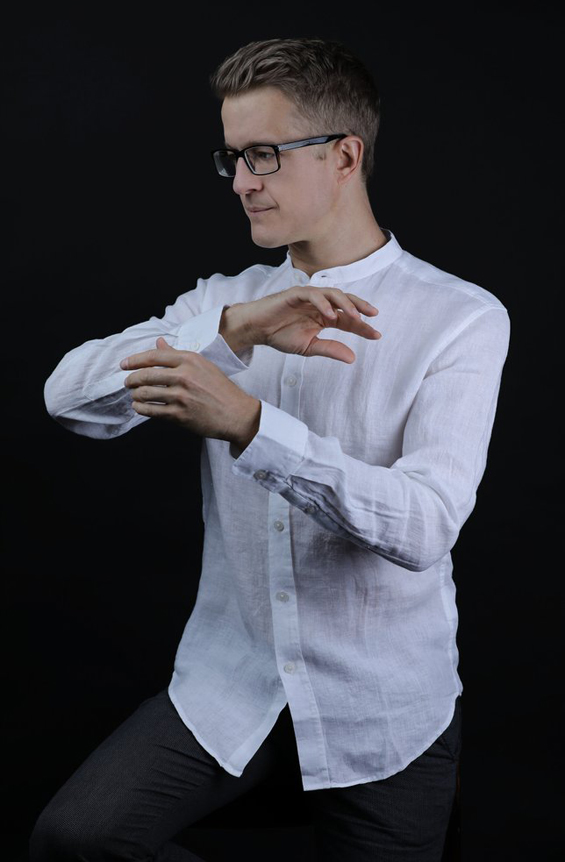
photo: Levi Hammer
5. To step away from the recording for a moment, you're also enjoying a remarkably successful career as an opera conductor, with performances of Wagner's Die Walküre and Kurt Weill and Bertolt Brecht's Die Dreigroschenoper part of your 2026 schedule. Being alone on stage delivering the “Gershwin in Vienna” piano recital must feel extremely different from guiding an orchestra and singers through opera performances. Am I correct in suspecting, however, that, much like your recording, the roles of opera conductor and solo pianist overlap and nurture each other in certain ways? Speaking of conducting, I'm also wondering what you learned most from your time working as an assistant conductor to Barbara Hannigan, Gustavo Dudamel, and Lorin Maazel.
There's a fine line between my work as a conductor and as a pianist. I can't imagine doing one without the other. Of course there are great conductors who are not pianists—like Gustavo Dudamel or James Gaffigan, to name two colleagues I deeply admire—and I think the thing that most helps a conductor coming from the piano is a sense of harmony, because as a pianist, you're forced to "think harmonically" to mentally process the sheer amount of material. Another way to say it is that you have to simultaneously think horizontally and vertically. So when I play a fugue, I have the sense that I'm conducting the various fugal voices, and when I play the Berg Sonata I'm thinking of the orchestra: I mentally orchestrate certain lines to sound like Berg's Violin Concerto, with a theme presented in a muted trumpet or a violin section playing in octaves with intense pianissimo vibrato to the very end of a high sustained note. Maybe this is just in my imagination, but I try to find these orchestral colours on the piano. An early piano teacher of mine felt that pianists make the best conductors in the same way that U.S. state governors, with their executive experience, go onto make the best presidents. Again, I don't know if this is true, but it's an interesting thought experiment.
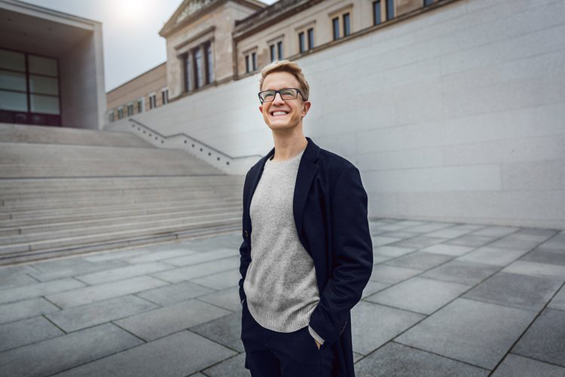
photo: Bearbeitet
Yes, I've assisted some really remarkable conductors, and I still occasionally prepare operatic productions for other conductors I especially admire. Most importantly, it's fun! I can't adequately summarize these great artists in a few lines, but I'll try. From Barbara, I'm inspired to be a true artist, to work damned hard and to fully invest in the colleagues we have the privilege of collaborating with. In Simon, I see the music just burst out of him – he's not so much conducting, as much as being music, which I guess is real conducting, and it's incredibly inspiring. I just prepared a new Walküre production in Los Angeles for Gustavo, and I feel like I become a better conductor just being in his orbit; his endless energy is matched by his mastery of the craft of conducting, and I learn so much every time I'm with him. I knew Maazel early in my development when I was terribly intimidated by his brilliance, and I wish I could learn from him now as a more mature musician; he was an idiosyncratic conductor, renowned for his technique, but he told me that more important than technique was “projecting" (his word) the music to the musicians, which I guess is the crux of conducting.
I didn't grow up in opera, and even after having done so much of it in the last ten years in Europe, my repertoire isn't expansive—mostly Mozart, Wagner, twentieth-century masterpieces, and of course the American musical theatre of my adolescence! Being a pianist helped as I learned the craft, but now with the perspective of a few years, I feel that my opera experience has most influenced my symphonic work. I had stellar training, but I could get myopic in my studying, obsessing over details sometimes at the expense of the big picture. And in opera, you crash and burn if you don't keep an eagle-eyed view of your musical surroundings, and the same idea applies to a Haydn or Mahler symphony.
website: LEVI HAMMER
June 2026