

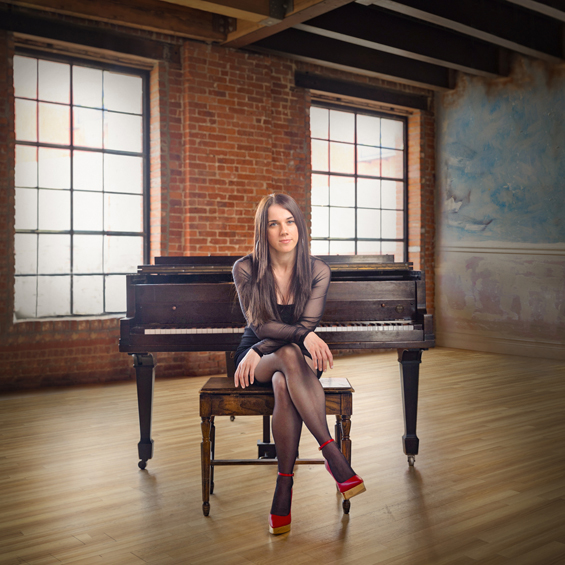
photo:
Mark S Kornbluth
FIVE QUESTIONS WITH MARIA KAUSHANSKY
Pianist Maria Kaushansky has just released her debut album, Northbound to Finch (reviewed here), but as is often the case with debuts decades of preparation went into its creation. Russian-born, she moved to Toronto at the age of ten and eventually obtained degrees from the University of Toronto and York University and an ARCT Diploma in Piano Performance from the Royal Conservatory of Music before moving to NYC in 2015. During the past decade, she's played with a variety of artists and performed at a number of venues in the city and in some cases enjoyed long residencies. All such experiences plus her classical training and years as an accompanist to ballet dancers have crystallized in a piano trio release that's remarkably mature and poised (not to mention a love letter to Toronto), and anyone listening to it will be impressed by her exceptional abilities as a player and composer. textura had the pleasure of speaking recently with Kaushansky about her musical development, her trio with bassist Paul Gill and drummer Anthony Pinciotti (who, sadly, died weeks after the recording of the album), life in NYC, and her time as a ballet accompanist, and thank her sincerely for doing so.
1. At what point in your development did you move beyond classically trained sight-reading into improvisation, and did it come naturally to you? As you were developing as a pianist, were there particular pianists you regarded as role models or whose playing you emulated, and how would you characterize or describe your own playing style?
During my formative years studying classical music, I felt that there was an assumption within that community that improvising is an innate gift that few people possess. I had wonderful teachers who gave me a strong foundation in classical music, but none of them encouraged me to improvise or even to listen to anything beyond classical music. I was playing very difficult pieces—works by Bach, Scriabin, Prokofiev, to name a few—but I couldn't really play a simple pop song (unless it was with sheet music). I sometimes would learn a pop song by ear for fun, but I never spent too much time on it.
When I was a student at the Faculty of Music at U of T, I got a job playing for ballet classes at a local dance studio. On my first day, they handed me several binders with sheet music to learn (all original compositions written specifically for ballet exercises, much of it not sight-readable but requiring practice). They also asked me to improvise a waltz and a march, which I couldn't really do. That first day of my job was a turning point. I had spent so many hours perfecting pieces I was working on for my private lessons, recitals, RCM exams, and university juries, but none of that prepared me for the skills I realized I needed if I wanted to keep my job.
Learning to improvise and play by ear was hard and pushed me out of my comfort zone. I had grown up listening to Louis Armstrong, Oscar Peterson, Bill Evans, Keith Jarrett, Brad Mehldau, Chick Corea, and Diana Krall. I began transcribing solos and took lessons with the great teacher Frank Falco. He showed me beautiful voicings and also explained how to break down and analyze solos and how to incorporate that analysis into my own playing.
When I began to study jazz, I felt a greater ownership of my playing because I wasn't only playing what I was reading on sheet music. Playing classical music is like learning choreography: you have to know where each finger has to go, how it's getting there, how loud or soft it needs to play, the articulation of each note. And of course, there is so much pressure to avoid playing the dreaded 'wrong note.' On the other hand, when you're improvising or playing by ear and making your own arrangements, there is so much more freedom and room to be creative. But the path to that freedom hasn't been easy for me, and is to this day is something I'm working on.
2. In being Russia-born and having lived for many years in both Toronto and NYC, you have a perspective that's different from most people. How does the experience of living in those two great cities compare, and what for you has been the biggest difference between living in them?
In terms of working as a musician, when I lived in Toronto, I was mostly playing for ballet dancers. Being in NYC has allowed me to pursue performing opportunities in addition to playing for dancers. In terms of lifestyle, NYC feels like an express train. It is always so comforting coming back to Toronto, where I feel like I can relax and unwind from the hustle of NYC.
3. It's been approximately ten years since you moved to NYC, yet Northbound to Finch is your debut album. As that could be seen as a long gestation time, I'm wondering if the compositions on the album were ones that you worked on and refined over a long period of time. Also, you're a great pianist but, as the compositions on the label show, a great writer too. Could you take us through your writing process by using one of the album pieces as an illustration (the lovely “Northbound To Finch,” perhaps)?
I worked on these compositions over the course of the last five years. I never composed much before that, because I didn't really think I was ‘ready.' Eventually, I realized I shouldn't wait for that anymore and just get to it. I played a lot of these tunes live over the last few years and was able to refine the arrangements over time.
I used different approaches when composing the album material. Sometimes, I began by just improvising freely for an extended period of time and seeing where that took me. I would make sure to record these improvisations, so that I didn't have to worry about ‘forgetting' something and could just be present in the moment. Other times, I had a specific idea I wanted to explore. For example, on “Northbound to Finch,” I played around with major/minor tonalities. The song begins with a G major chord, but in the third phrase, it becomes G minor. I also wanted to feature certain sounds that I particularly enjoy playing, such as a harmonic minor scale tonality mixed with a samba vibe on “Windchill -30,” a rock groove and classical elements on “Tangreen Court,” and a boogaloo on “Four One Six.”
4. Did you, Paul, and Anthony workshop the album material over a long period? I ask because it presents the trio playing with so much authority, confidence, and telepathy, it makes me think the three of you must have known the material so well going into the studio that you were able to deliver the performances effortlessly. Is the rapport you share with them something you cultivated over many years or is it something that was immediately and naturally present from the outset?
I feel so lucky to have worked with them over the last three years as a trio. Their experience, technical mastery of their instruments, creativity, and collaborative spirit made them the dream rhythm section. We had a chance to play my compositions at various performances in the past few years and worked out arrangements that I felt really took my compositions to another level.
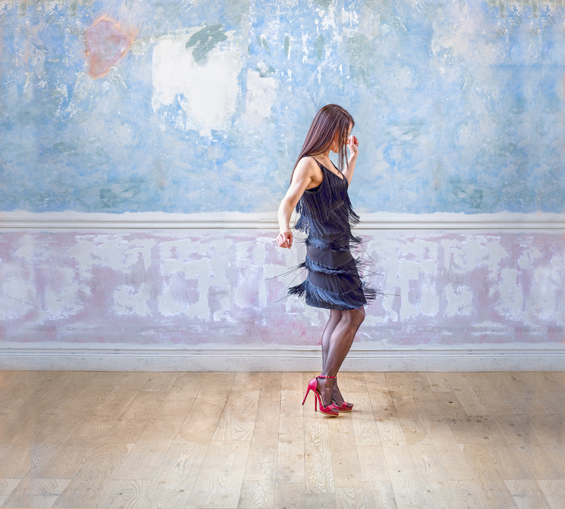
photo: Mark S Kornbluth
5. The album and its ballet companion version were recorded last year on December 9th at Trading 8s Recording Studio in Paramus, New Jersey. There's a relaxed vibe to the playing that belies the urgency I'm imagining you might have been feeling in knowing that you had one day to get the material down. How relaxed were you and the others during the session, and were you surprised at the amount of material you were able to record in that session?
We had been playing these compositions live in the last few years and also had rehearsals in preparation for the recording session. I knew that I would only have five hours to record both albums. It was my first time in a recording studio, and I was quite nervous about how it would go. However, Paul and Anthony, given their incredibly extensive experience with recording (I encourage listeners to check out their discographies!), gave me great advice on what to expect and how to make sure everything ran smoothly and on time. The recording engineer, Chris Sulit, was also amazing to work with. I couldn't have asked for a better recording experience.
I made sure that arrangements of the tunes were worked out in advance so that when we came to the studio, we could focus on being in the moment musically. It definitely felt different from performing live where you can take time to warm up and ease into playing.
Bonus question: I love your idea of issuing a companion set of the material in a version designed with ballet class accompaniment in mind. Something tells me that this part of your musical life isn't just a footnote but something important that you value very highly. Does the playing you do in that context influence your playing in the jazz trio context and vice-versa?
Playing for ballet dancers began as just a side job but grew to become a significant part of my life. A side note, which I think is important to mention: when playing for ballet, there is a distinction between playing for classes, which consists of a sequence of exercises (pliés, tendus, etc), and playing for rehearsals, where dancers might be working on a particular variation (a variation is a solo dance from a ballet) or another part of a ballet. In a rehearsal, the pianist would be required to play a piano reduction from a ballet score. On the other hand, in a class, the pianist really has the freedom to play whatever they want, as long as it is appropriate for each exercise (in terms of length, musical quality, and time signature). I have spent most of my career playing for ballet classes.
When I was first starting out, I played mostly from sheet music, pieces that were written specifically for ballet exercises. This is how I first learned what music each step requires. Nowadays, there's also a wealth of resources online that you learn from, including videos of ballet classes and ballet music albums. Gradually, I learned how to adapt all kinds of music into ballet exercises. I explored ballet repertoire, folk music, jazz and pop music. I always found that to be very fun and a chance to be very creative.For a long time, I felt like those ‘identities' were separate for me—I had repertoire I used to play for ballet and a different set of repertoire for jazz performances. Nowadays, I am striving to merge these worlds and have one large repertoire to draw from for any occasion.website: MARIA KAUSHANSKY
October 2025