


photo: Max Tan
FIVE QUESTIONS WITH MAX TAN
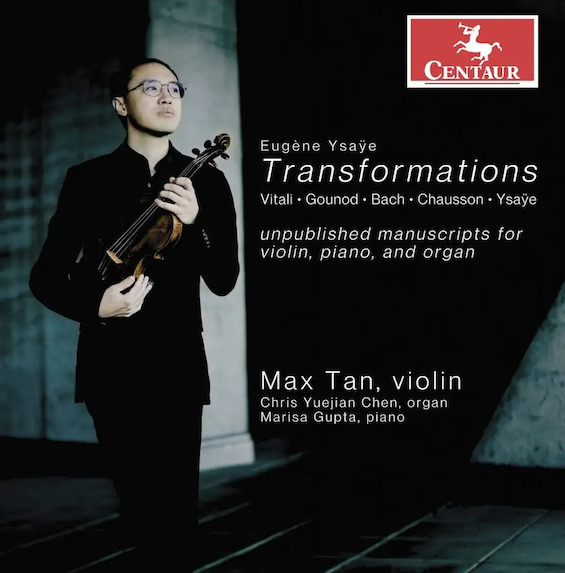
A fervent advocate of contemporary music, Taiwanese-American violinist Max Tan has premiered many a new work, be it one by French composer Jean-Frederic Neuberger or Catalan composer Marc Migó. It's safe to say, however, that the music associated with French composer Ernest Chausson and Belgian violinist Eugène Ysaÿe holds a special place in Tan's heart, considering that his dissertation research focused on Ysaÿe and Tan's recent Centaur release Transformations includes Ysaÿe's arrangements of Chausson's Poème, among other pieces. An alumnus of Harvard and Juilliard as well as a respected scholar and educator, Tan is joined on the release by pianist Marisa Gupta and organist Chris Yuejian Chen, itself a detail worth noting when Transformations (reviewed here) features the premiere recordings of Ysaÿe's arrangements of violin works for the three instruments. textura spoke with Tan recently about the recording project and some of the fascinating issues it raises, including Ysaÿe's influence on modern violin technique and the relationship that develops between a composer and performer when both participate in a work's creation, and we thank him for making time in his busy schedule for the interview.
1. Transformations, the Centaur Records release you issued in September 2024, features arrangements by Belgian violinist Eugène Ysaÿe (1858-1931) of works by Tomaso Antonio Vitali, Johann Sebastian Bach, and French composer Ernest Chausson plus a work by Ysaÿe himself. Given that your dissertation research also centred on Ysaÿe, what is it that prompted you to focus on him rather than another figure?
This is a very interesting question! It's true that my album and dissertation revolve around Ysaÿe, but I'm not sure I made a conscious decision to focus on him at all. It's more accurate to say that both the recording and dissertation are in fact different sides of a single project that originated from my interest in the Poème by Ernest Chausson.
When I first studied the work as a violin student now nearly fifteen years ago, I knew that it was dedicated to Ysaÿe; after all, the dedication is printed on every edition of the work. However, when I revisited the work within the last six to seven years, I learned that there were multiple versions of the piece. Most shocking was my discovery of the original version via the magnificent recording by Philippe Graffin with the Royal Liverpool Philharmonic. A few months later, I entered the doctoral program at Juilliard and expressed interest in the concept of Werktreue, or being true to the work, i.e. the composer's intentions. The unpublished arrangements featured on the disc were introduced to me by Jane Gottlieb, vice president of library and information resources at Juilliard. In my first year of doctoral studies, I created the first engraving of Ysaÿe's organ trio arrangement of Chausson's Poème for a class taught by Professor Michael Musgrave. I began studying the other arrangements after that, and my interest in Ysaÿe came much later.
There are many points of fascination with Ysaÿe, but as someone who loves historical manuscripts and recordings, I'm very interested in reconciling the legends of Ysaÿe with the evidence we have of him as an individual. Few recordings exist of him playing, although contemporaneous musicians testify that those recordings were made after the prime of Ysaÿe's career. Through his compositions and arrangements, I believe we have a different glimpse into his prowess as a violinist and interpreter. There are philosophical essays by Ysaÿe concerning the role of the performer and interpreter, the nature of true artistic virtuosity, and the power of the arts. It's not only remarkable these subjects are still relevant but that Ysaÿe articulates his thoughts with such great clarity.
2. In the release's liner notes (by you and Lev Mamuya), Ysaÿe's influence on modern violin technique is described as considerable. In what ways specifically did his approach have an impact, and how has your own technique been influenced by him?
Ysaÿe is often credited as the father of modern violin playing. There are several characteristics of the modern aesthetic that can be attributed to him, including vibrating on every note and singing through the phrase. Prior to the twentieth century, vibrato was used more sparingly. It is not that vibrato did not exist prior to Ysaÿe. Instead, one can think instead that the expressive importance of vibrato changed. Additionally, the concept of colour changes in the sound emerged from more creative bow usage emerged in violin playing of the last 150 years.
Perhaps one of the more unique and frequently discussed elements of Ysaÿe's playing is the unique sense of rubato, which has become an acceptable expressive element. In the few recordings of Ysaÿe that exist, one can hear the free and indulgent sense of timing. There is a very fast recording of him performing the last movement of Mendelssohn's Violin Concerto in which the rubato has a surging energy (contrary to much rubato of today which tends to slow down). There are also some rhythmic distortions from Ysaÿe that do not appear literally as Mendelssohn had notated in the score but certainly add to the cheerful and excited character of the music.
These expressive quirks that were once unique to Ysaÿe have seeped into mainstream modern violin playing today. As a student of these times, I grew up studying the violin with this aesthetic. Of course, I love everything it has enabled me to express on the violin, but I did go through a process of detaching myself from the present and turning myself into a third-party observer. It was necessary to do this in order to ensure that everything I expressed in my playing was an artistic decision rather than the mannerism made comfortable by my studies. It's also worth mentioning (not to go down an entirely different rabbit hole) that Ysaÿe's influence as performer-interpreter was likely increased exponentially by the emergence of both travel and recording technology. I think it is still the case today, although there are many more recordings accessible than during Ysaÿe's time.
photo: Andrej Grilc
3. Another fascinating aspect of the project has to do with questioning the customary relationship between composer and performer, whereby the latter is usually thought to deferentially comply with and serve the composer's concept and intentions for a particular work. Relatedly, in writing about the project, you described it as one that you believe “challenges the paradigm of how we understand composer's scores today.” How specifically did Ysaÿe upend that traditional model through his involvement in the development of Chausson's Poème?
The different versions of Poème were all influenced by Ysaÿe in some way. This was not really because he was the dedicatee of the work or that he had stature as a legendary violinist of his generation. Instead, the musical scores of these different versions require a special context. Consider Ysaÿe's testimony that although he wrote parts of Chausson's Poème, he “followed Chausson's framework.” Naturally, one is inclined to ask: what is that framework? (Those interested in following up on this story will find this in a small footnote on page 119 in Joseph Szigeti's memoir, With Strings Attached: Reminisces and Reflections.)
There is not enough time or space for me to dive into the discussion of what that framework is. After all, I did write an entire dissertation on that subject. Instead, I'd like to focus on what we as performers and interpreters do with a composer's framework. The traditional model of engaging with composer's scores today is generally literal. Composers use musical notation to prescribe or instruct what performers ought to do to achieve an acoustical result as well as to describe what the acoustical result ought to be. The balance of prescriptive and descriptive characteristics in the composer's score depends on many variables, and part of the performer's interpretive role is to elucidate this not only for their own creative powers but for their listeners. The literal approach I refer to is the tendency of many musicians to assume that notation is mostly prescriptive, regardless of the composer, style, period, or genre of work. It is not a fault, but it is an emerging and defining characteristic of the modern aesthetic.
The many versions of Chausson's Poème, as well as primary sources for the different performances and editions, show that Ysaÿe's modifications from one version to the next are like improvisational sketches dancing on the page. These are not isolated instances of trivial ornamentation. If we take him at his word that he was faithfully following Chausson's framework and we know that Ysaÿe was a highly regarded interpreter of his time, one of my conclusions was that the subsequent versions following the premiere, and most obviously the fifth version organ trio arrangement featured on this disc, were notated instances of Ysaÿe's interpretations of Chausson's musical work rather than fundamentally distinct works.
This innocent question unfortunately has a somewhat complicated answer that touches on several musical and philosophical issues. In the case of these five versions, there are issues of performance practice and the nature of the score. Of course, the way musical ideas are communicated in notation and sound also means that we must address the nature of music as some kind of communicative art, or even a language. To return to some issues brought back in a previous question: the advent of recording technology forever changed our way of listening and relating to music. Suddenly, composer's scores were no longer the only physical instances of musical works. Recordings fossilize performances. Music, once ephemeral, had a more permanent existence. The idea of the musical work was reinforced. As Marisa Gupta (our pianist on the disc) writes, “Before recordings, concerts were rowdy, exuberant, riotous affairs. This contrasts with today's mostly somber presentations of predictable pieces, performed in their entirety, and experienced in reverential silence.” Musicians are very tradition-bound to treat scores (and I would say even “ideal” recordings, whatever that might mean to any particular musician) as the ultimate expression of composer's intent. But somewhere in this obsession, we may easily forget our very reasons for being expressive artists in the first place.
How performers relate to composer's scores has changed throughout history, but there are some fun and interesting paradoxical practices employed by musicians that illustrate the complexity of this topic. Most musicians and listeners would agree that music is an activity, not an object. We listen to music and perform it by reading the score. However, there may be multiple sources for a musical work: the composer's score, program notes, the wisdom and feedback from a living composer, and recordings of composers performing their own works. Musicians generally approach the written score as the ultimate authority on composer's intentions. In instances where a composer's performance does not appear to adhere precisely to the notated score, the score takes precedence, and any other source of information is ignored.
Another paradox that I frequently experience is the default inclination to acoustically reproduce all details of visual notation. I am sure many musicians can relate to variations of comments in rehearsal to “bring out” a marking such as a crescendo or an accent or a subito piano, but such a comment itself seems to suggest that the notated score as an object is inherently expressive. I'm not sure performers' roles are as simple as reproducing a score acoustically, and I often wonder whether others would agree that musicians ought to use the score to create a more personal expression.
I often question why we do what we do (or at the very least, why I do what I do as a musician) because I find myself often trying to reconcile this idea that a faithful reproduction of an inanimate score is the same as interpretation. After engaging in this research, I believe that one of the interesting things Ysaÿe does in his writings is to show that the boundaries and rules are not as constraining as we'd like them to be. And if so, I then ponder why it is we may feel constraints where there are none.
photo: Andrej Grilc
4. It's a natural step to move from pondering Ysaÿe's contribution to the presentation of Poème to considering your own contributions to the five works presented on Transformations. To what degree are you imposing your own interpretation on these performances as opposed to adhering strenuously to the notations in the works' scores?
It's always important to consider the circumstances surrounding any performance. My collaborators and I wanted to record in a way that captured the flow of a live performance as well as the grandeur and romantic spirit of the music as the provenance of the manuscripts suggested. I don't think having a strong interpretation is at all opposed to adhering to the notations in the scores. We tried very hard to approach the manuscripts of understanding the truth at the heart of the music, and so I think our interpretation was our best attempt at understanding the intention encoded in the score, rather than an acoustical reproduction of what's written on the page. Recently, I had a conversation with Annie Dutoit-Argerich in which we had a collaboration project that involved narration, and she said something I thought is truly at the heart of interpretation: we are not so interested in the pronunciation as we are in the intention behind the written and spoken word. After all, there lies the meaning in what we communicate.
5. Is Transformations the first volume in what you're intending will be a Ysaÿe series, or are you planning on shifting the focus to another composer (or composers) for your next recording?
The disc was a happy tangent that accompanies the dissertation I completed as well as other efforts I am working on to bring these unpublished manuscripts to the public. This year is the start of several 100-year anniversaries surrounding the manuscripts, from the date of completion of the autograph scores to the copyist parts, etc. These anniversaries span the next four years. In 2031, the world will witness 100 years after Ysaÿe's passing, another important date.
I currently have no plans to release another disc focused on Ysaÿe, although it depends on where research takes me. I feel an affinity for great and relatively undiscovered music, be it by composers from a past or present generation. It's important for me to be sure I am the right advocate for that music. Recording projects also require the great fiscal support from grant funding and kind sponsors. So, while I have no plans now on what the next recording project will be, I am sure that if the stars align, I will very happily and humbly lay forth all of my artistic means to bring that to life!
web site: MAX TAN
June 2025