

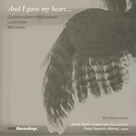
Jakob Bloch Jespersen & Peter Navarro-Alonso: And I gave my heart
OUR Recordings
With And I gave my heart, Danish bass-baritone Jakob Bloch Jespersen and Danish-Spanish organist Peter Navarro-Alonso present three dramatically contrasting song cycles by Danish composers Pelle Gudmundsen-Holmgreen (1932–2016), Bent Lorentzen (1935–2018), and Nicolai Worsaae (b. 1980). Clear changes in tone distinguish Gudmundsen-Holmgreen's portentous Seven Solomon Songs from Lorentzen's rapturous Erotic Hymns and Worsaae's theatrical A Shipwreck, the result a fascinating exploration of the possibilities a vocal-and organ presentation affords.
Both performers trained at the Royal Danish Academy of Music, with Jespersen also studying at the Opera Academy at Copenhagen's Royal Danish Theatre and Navarro-Alonso at the Real Conservatorio Superior de Música de Madrid. The bass-baritone made his stage debut in 2002 and since then has participated in numerous opera productions and performed with multiple ensembles. His recital partner has delivered more than 400 recitals and since 2021has served as organist at Our Saviour's Church in Copenhagen.
With respect to the composers, Gudmundsen-Holmgreen looked early on for inspiration to Bartók and Stravinsky before venturing around 1960 into post-war serialism and then rejecting it to become a proponent of “the New Simplicity.” Augmenting his formal university education, Lorentzen attended courses in Darmstadt and Munich and studied electronic music at the Stockholm Electronic Music Studio. Whereas the early works of Worsaae have been described as lyrical, recent compositions have been characterized as direct and strongly rooted in storytelling traditions.
Interestingly, Seven Solomon Songs, a set of transcriptions from the opera Sun Rises, Sun Sets, was prepared posthumously. Planning for a 2015 concert series, organist Jens E. Christensen and Jespersen approached the composer with the idea of transcribing the Old Solomon's sections from the opera into a set of biblical songs for bass and organ. While he was receptive to the idea, he died in the summer of 2016 before it could be realized and was thus completed by the performers. After Christensen retired in 2021, Navarro-Alonso, his successor at Our Saviour's Church, created a new arrangement of the score for bass singer, organ, and bass drum, the one featured on the recording. Presented as a seven-part suite, the work introduces the album on a rather gloomy, even macabre note. Unsettling organ and bass drum gestures map out the bleak terrain before Jespersen's guttural voice—in moments a tad reminiscent of Tuvan throat singing—cloaks the music in a shroud of torment and anguish. With the advent of the second movement, desperation mounts as expressions grow grief-stricken, the bass drum intermittently intoning like a death knell. Decrying humanity's vanity, the singer groans, snarls, and roars, his delivery agitated and the organ swelling portentously alongside him. After the material rises wildly to a peak during its fifth part, it turns elegiac in the sixth before madness reinstates itself to conclude the work in the same spirit with which it began.
As mentioned, the tone shifts dramatically in the transition from Seven Solomon Songs to Lorentzen's Erotic Hymns, which Christensen commissioned for the 300th anniversary of the Our Saviour's Church organ in1998. Juxtaposing texts from H. A. Brorson's The Rare Treasure of Faith (1739) and Ole Sarvig's Hymns and Beginnings for the 1980s (1981), the nine-part setting meditates on themes of love in a lyrical style that's harmonically in places Wagner-esque (echoes of Tristan und Isolde suggest themselves). Passionate outpourings couple with softly murmuring organ tones to amplify the romantic mood and intensify the intimacy of the music. There are intimate supplications (song six, “My breath, so close, so close …”) and rapturous declamations (song three, “And when your mighty voice …”) before the ninth song (“I lie so close upon Jesus's breasts”) brings the work to an orgiastic resolution.
Exploring themes of life, death, and resurrection, Worsaae's seven-part theatre piece for bass voice and organ, A Shipwreck, concludes the album by casting the church organ out onto turbulent seas. Using two poems from Simon Grotrian's Især til de levende (2010) as a foundation, Worsaae has the bass singer personify a sailor extinguishing fires and doing whatever he can to prevent shipwreck until death by drowning overwhelms him and his fellow crew members. A sense of chaos pervades the opening part when gleaming organ chords collide with bell and drum accents and Jespersen's desperate voice. Less tumultuous is the second, even if pounding bass drum adds an ominous element. Harrowing siren sounds and violent battering noises reinstate mayhem for the third part until, again, a less nerves-fraying movement, the ghostly “Recitativo,” follows. Of all the song cycles, Worsaae's calls the most on the pipe organ's potential for extra-musical sound creation.
Full texts (in Danish and English) for the three compositions are provided in the release booklet to enhance the listening experience and facilitate greater understanding of the project and appreciation for what the composers and performers have done. Among other things, the collaborators have created a recording that stands proudly apart from others for its vocal-and-organ presentation and the distinctive character of each song cycle. Don't be surprised if the sound of Jespersen's booming bass voice, especially when self-accompanied by booming bass drum, and Navarro-Alonso's resonant pipe organ stays with you long after the recital's over.
May 2026