

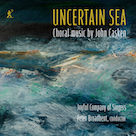
Joyful Company of Singers: Uncertain Sea: Choral Music by John Casken
Métier
John Casken's profile rose considerably when his first opera, Golem, received the first "Britten Award for Composition" in 1990 and its Virgin Classics release won a Gramophone award for “Best Contemporary Recording” a year later. While that work and the recording hold up splendidly, the Northumberland-based composer, born in 1949, has produced a substantial body of other vocal and instrumental material deserving of attention. As shown by this new choral collection, Casken draws for inspiration from literary sources, visual imagery, and Northumbrian landscapes, skies, and coastlines. Seventy-one minutes in length, Uncertain Sea is performed by Joyful Company of Singers (JCS) under the direction of its founder and conductor, Peter Broadbent, and is the product of two years of working alongside the composer, the British amateur chamber choir's Vice-President since 2024. Casken's writing sources extend from John Donne, Robert Burns, Gerard Manley Hopkins, and Sylvia Townsend Warner to Northumbrian cow-herder Caedmon, Northumbrian poet Katrina Porteous, and the composer himself.
Eleven works written between 1990 and 2023 appear, all single-movement but for the two-part From this Red Earth, and generally grouped according to theme and subject matter. Whereas Northumberland's seascape is the focus of Uncertain Sea, other pieces explore religious themes and leave-takings. Set to two Porteous poems about the fishing communities along the Northumbrian coast, Uncertain Sea advances from the first poem, “The Sea Inside” to “The Bottom o' the Sea,” the latter written in a Northumbrian dialect that captures the character of the hard-working locals. The texts are conjoined in the work, but the change from the one to the next is musically clear. The JCS's lustrous SATB sound gives melancholic voice to the first part before a more animated presentation signals the shift to the second. Here and elsewhere, individual voices sometimes extricate themselves from the whole, even if the presentation largely orients itself around the interwoven tapestries of the ensemble.
Composed as a sixtieth birthday gift for James MacMillan and set to Hopkins's “Pied Beauty,” For Dappled Things facilitates the transition to works with sacred ties by celebrating the natural glories of God's kingdom (“skies of couple-colour as a brinded cow … rose-moles all in stipple upon trout that swim …”). Set to George Herbert's “Prayer,” The Land of Spices exudes an ethereal, enigmatic quality, Casken here flirting with a style that suggests kinship with Ligeti's and Penderecki's vocal works. Using a late seventh-century poem by a simple cow-herder as a springboard, Caedmon's Hymn sustains the religious connection by expressing rapturous praise for the “protector of heavenrealm.” Casken selected the first two poems from the twenty-eight in Donne's A Litany for From this Red Earth, with “The Father” and “The Son” addressing the Father of heaven first and the Son of God second. Humble reverence and supplication colour the hushed first expression, the second more dynamic and emotionally charged. Concluding the “Sacred Shaper” section, the richly contrapuntal Floore of Allegories, set to Herbert's “The Church-floore,” meditates on the virtues of patience, humility, love, and charity.
One of two settings to deviate from a vocals-only arrangement is The Knight's Stone, which adds flutist Philippa Davies to the vocalists, her woodwind personifying a falcon. While the narrator's identity isn't clarified, Casken proposes that it might be a maid “lamenting that the falcon has taken her love away.” Coupling with flute, ethereal harmonies vividly paint the scene and convey the maid's sorrow as she kneels by the knight's bedside, weeping night and day. Set to “Early One Morning,” a 1928 religious poem by Warner, Sunrising was created in 1993 as a gift to Durham Cathedral to commemorate its 900th anniversary. Beginning mistily, the work recounts the morning an unnamed protagonist ventures out alone to meet Christ, recognized immediately by his worn clothes and carpenter's gear.
Two resonant pieces make up the album's closing section “Fare Thee Well,” the first Ae Fond Kiss a tender setting of Burns's same-titled poem about lovers parting forever and created in 2020. A farewell on a much grander scale, Memorial was created in tribute to, in Casken's words, “men from Upper Coquetdale, in north Northumberland, who perished during the First World War and who were never found, their names alone recorded on the many stone memorials.” Augmenting the vocal group are mezzo-soprano Rozanna Madylus, baritone Marcus Farnsworth, and percussionists Owen Gunnell and Aaron Townsend. Roll calls of twelve men appear twice in a reverential, bell-tolling work (the album's longest at eleven minutes) whose text by Casken references WWI poetry and Remembrance Day prayers.
While the album's credited to Joyful Company of Singers and Broadbent as the performers, it's obviously as much Casken's. In fact, one presumes Uncertain Sea to be one of his most personal releases for three reasons: not only are the compositions his, they're performed by a company with which he's formed a deep bond, and that the painted image shown on the release cover and booklet was created by him testifies further to the strong personal connection he has to the project.May 2026