

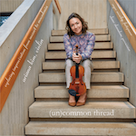
Ariana Kim: (un)common thread
Saffron Soul Records
Splitting her release between on the one hand sonatas by Mozart and Beethoven and the other world folk music inspired by her five-month 2025 stay in India to study Carnatic music, violinist Ariana Kim partners with fortepianist Roger Moseley on the recording's first half and as gloriously with percussionist Shane Shanahan on the second (the latter's also credited with writing three of the album's settings). Kim's violin becomes the bridge connecting the halves, even if she's playing a gut-stringed instrument on the early pieces and a steel-stringed one on the others. Bifurcation's further eased when the track that effects the transition features her alone, though in being a Carnatic improvisation the track aligns itself clearly to the album's second half.
Kim's certainly up to the challenges of this ambitious project. A violinist with the Aizuri Quartet and a long-standing member of The Knights, the versatile, award-winning Minnesota native made her New York recital debut at Carnegie's Weill Hall while studying for her doctorate at Juilliard and is now a tenured professor at Cornell University. Before relocating to Karnataka to absorb the violin and musical traditions of South India, she spent time in 2021 in South Korea studying the gayageum. Moseley and Shanahan bring impressive credentials of their own to the recording, the former an author and associate professor of music at Cornell and the latter a founding member of the Silkroad Ensemble and in-demand percussionist.
Another thread connecting the album's parts is improvisation. Whereas its role within a Carnatic context is obvious, it's less clearly present in a composed classical work from centuries ago. Yet improvisation is very much a part of Mozart's Violin Sonata in B flat major, K. 454. When violinist Regina Strinasacchi performed the work in 1784, she was accompanied by the composer, who provided her with a fully notated part but didn't do so for himself, content as he was to react to the performance in the moment. The visceral rendition by Kim and Moseley is inspired, but part of its energy no doubt stems from the excitement that arises when interpreters collaborate in a high-wire undertaking where in-the-moment creation is a factor. After an elegant opening statement that accentuates the beauty of Kim's tone as well as the arresting timbres of the fortepiano, the work's “Largo-Allegro” movement moves from the tranquility of the intro to light-speed exchanges that dazzle in their breeziness and pinpoint precision. Building on the charm of the first part are the gentler “Andante” movement, its slower tempo helping to deepen the spell, and lively “Allegretto,” which marches determinedly through its sunny themes and rapid-fire exchanges.
Arriving only five years after the Mozart piece, Beethoven's Violin Sonata in E-flat Major, Op. 12 No. 3 (1798) begins with a dramatic gesture, after which the “Allegro con spirito” achieves liftoff with high-velocity arpeggios by Moseley and somersaulting trade-offs. The fire the two bring to the performance is undeniable and shows them doing anything but half-interestedly “going through the motions.” Dignified and lyrical, the slow “Adagio con molta espressione” movement offers a welcome moment of calm before the zestful “Rondo: Allegro molto” reinstates the high energy of the opening part to usher the work to a joyous, high-spirited close.
As mentioned, Kim's unaccompanied improvisation on the Raga Aalapana, Bahudari, eases the transition into the album's second half, which augments Carnatic material with treatments of folk pieces from Macedonia and Bulgaria. The raga's entrancing allure is amplified by the melismatic undulations of Kim's vocal-like expressions, which in moments call L. Shankar's to mind. Delivered in 7/8 (3-3-2), the Macedonian tune “Lesnoto Cveta Moma Ubava” gravitates in a more mournful direction and thus allows Kim an opportunity to lament affectingly. The Bulgarian “Krivo Sadovkso Horo,” by comparison, opts for a whirling dervish of a folk dance—in 13/8 (2-2-2-3-2-2), no less.
Shanahan's first setting, Audacity, was conceived as a tribute to Barack Obama and designed to convey hope for a better world. Associated meanings aside, the piece engages for its infectious interlacing of jazzy, percussion-generated swing and spirited violin phrase-making. The rousing second, Oil Field Fires, is livelier still, while the third, Khanda Jog, morphs from serene meditation to jubilant dance. Abetted by a looper pedal, Kim composed a piece for the project too, with Migrating Home augmenting ululating violin phrases with harmonics and plucking.
One comes away from these performances awed by Kim's dexterity and articulation but as impressed by Moseley and Shanahan, who both match the violinist every step of the way. For her, the distance separating the one realm from the other is smaller than it first appears. Improvising on the Carnatic material has enhanced Kim's ability to do the same when tackling a Mozart sonata, for example, and the principle applies the other way around. Spontaneity—even when a fully notated score's in play—is central, regardless of the genre zone one's operating within. Each context enriches her playing within the other, and the thread tying them together ends up being, yes, far less uncommon than expected.August 2026