

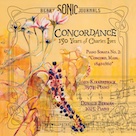
John Kirkpatrick & Donald Berman: Concordance: 150 Years of Charles Ives — Piano Sonata No. 2: “Concord, Mass., 1840 - 1860”
Owsley Stanley Foundation
While other works by Charles Ives (1874-1954) memorably exemplify the sensibility articulated by poet Walt Whitman—“Do I contradict myself? Very well then I contradict myself (I am large, I contain multitudes)”—it's the maverick American composer's second piano sonata, “Concord, Mass., 1840-1860,” that perhaps most powerfully embodies it. Even calling it a sonata does it a disservice when it refuses to be contained by a musical form marked by specific structural parameters. This Mount Everest of piano works has been scaled by many a pianist, but performances by two of its more historically important interpreters are featured on this deluxe release from The Owsley Stanley Foundation (OSF) as part of its “Bear's Sonic Journals” series. Its two discs are housed within a lavish, hardcover booklet and with photos, interviews, and commentaries included in its 112 pages.
A bit of context first: the non-profit OSF is dedicated to preserving Owsley Stanley's immense archive of concert soundboard recordings from the ‘60s, ‘70s, and ‘80s. The roughly 1400 analog reel-to-reel recordings Stanley (aka "Bear," who died in 2011) collected will eventually deteriorate if they're not preserved, hence the foundation's existence. As the group's soundperson, he was a long-running associate of The Grateful Dead, but the OSF has issued releases by other artists, including Johnny Cash, The Chieftains, Ali Akbar Khan, and, of course, Ives.
Huge aficionados of his music, Stanley and The Dead's bassist Phil Lesh attended pianist John Kirkpatrick's performance of Ives' Concord in March 1974 at Marin Veterans Memorial Auditorium (it was Lesh who encouraged Stanley to record the set); that performance comprises the first of the two discs, the second featuring a live rendition Kirkpatrick's final student, pianist Donald Berman, recorded fifty years later in honour of Ives' 150th birthday (fittingly, Berman's was performed in Concord, Massachusetts in February 2025). Enhancing the release are four world premiere recordings of Concord-inspired pieces by Eve Beglarian, David Sanford, Marti Epstein, and Elena Ruehr. Collected under the title Concord Legacy: Other Transcendentalists, the works were commissioned by Berman to celebrate Harriet Tubman, Emily Dickinson, Louisa May Alcott, and Margaret Fuller.
Ives' Concord aspires to musically capture the characters of Ralph Waldo Emerson, Nathaniel Hawthorne, The Alcotts (teacher Bronson and writer-daughter Louisa May), and Henry David Thoreau and to that end weaves all manner of elements into its sprawling design. Unlike the conventional sonata, which comprises the articulation of a theme, development thereof, and recapitulation, Ives' unfolds in a wholly different manner, in fact what might be called a reverse or cumulative form. In his case, fragments gradually cohere into a thematic statement, what Ives called the “human faith melody” and which emerges in full during the slow third movement, “The Alcotts.”
Ives wasn't averse to modifying a score, and he repeatedly revised the sonata from its 1911 inception until his death in 1954. Interpreters are therefore emboldened by his example to let their own selves seep into their treatments; far removed from a work whose notation pianists are expected to follow religiously, Ives' sonata is designed to allow a personal stamp to be imposed and even perhaps for moments of improvisation to appear. Let's not go too far, however: the two published scores of the Concord present clearly laid-out designs, with each movement possessing a distinct character. The work teems with tunes (church hymns, military marches, popular songs, rags, classical quotes), real-world references (church bells, trains, people singing), and polytonal and polyrhythmic gestures.
As far as the performers are concerned, Kirkpatrick wasn't just a pianist with a passing interest in Ives; he gave the world premiere of the sonata in 1939 at NYC's Town Hall, was the first pianist to record it, and the one famously responsible for its dissemination. His first exposure to the work came in Paris in 1927 when he was studying with Nadia Boulanger, and he later recorded it in 1945 and 1968. A respected Ives authority, Berman is the president of the Charles Ives Society when not performing or operating as Chair of Keyboard Studies at Longy School of Music of Bard College. Earlier recordings by him of the composer's work include The Unknown Ives (issued in two volumes, in 1999 and 2004) and a studio recording of Concord in 2024 (on Avie Records), the latter a stage-setter for the live version here.
Kirkpatrick imbues his reading of “Emerson” with intense percussive thrust but also a voice pattern-like lyricism perhaps influenced by sections in the score marked “prose” and “verse.” Like Emerson declaiming to rapt followers, it's a momentum-charged performance that's by turns jaunty, jovial, and fiery and teeming with snippets that give it a patchwork quality. Rhapsodic, blues-tinged allusions to the “human faith melody” surface amidst dense patterns that cluster into engulfing waves. Even more dazzling is “Hawthorne,” which Kirkpatrick delivers with authority, the pianist undaunted by the material's complexity and the challenge of executing different songs at the same time using both hands; again gentle passages anticipate the compete statement of the tender theme that will come in the next movement, and rollicking rags and marches also surface to enliven the proceedings. “The Alcotts” enchants with a reverential hush, yearning expressions, and Scottish airs, even if turbulence still sometimes factors into the equation. The pastoral “Thoreau” is at times a blink-and-you'll-miss-it stream that sees Ives jump-cutting from one stylistic channel to another.
It's fascinating to compare the versions. As shown by the track times on the back cover, Berman's renderings are in every case longer than Kirkpatrick's, the longer duration of the former's first movement also due to his inclusion of a two-minute introductory section absent from Kirkpatrick's. A clear difference in sound quality also separates the earlier recording from the later one. Whereas Kirkpatrick's hiss-heavy one was exhumed from a (mislabeled) tape (after a search lasting more than twelve years), the pristine one by Berman was formally recorded live (with no overdubs) and meets contemporary in-studio recording standards. “Emerson” initiates his version in towering manner, though it's more ruminative than Kirkpatrick's. As Berman states, in his treatment the music “pushes and pulls, stretching rather than bolting forth.” Such an approach feels ideally suited to the calm voicing of the theme that appears seven minutes into the movement. “Hawthorne” entangles with spidery interlacings, angular rhythmic stabs, and rousing rags. Berman gives “The Alcotts” an eloquent reading that imparts the calming effect of a church hymn and then suggests that the lugubrious closing movement might “be heard as a meditation on his father's passing” when George, Ives' dad, passed away just after Charles began college and the aspiring composer took solace in the writings of Thoreau.
Written between 2019 and 2023, the Concord Legacy works that conclude the release add significantly to its value, even if they're not the main draw. In totaling approximately thirty-seven minutes, they're hardly miniatures either. Celebrating poet Emily Dickinson, Beglarian's As Syllable from Sound opens the micro-set with a quietly radiant homage sprinkled with chiming chords and a steadily rising trajectory. Inhabiting a shadowy realm by comparison, Sanford's Underground honours the legacy of abolitionist Harriet Tubman and the so-called Underground Railroad for which this indefatigable slave-liberator was the most well-known “conductor” (the late jazz figure Cecil Taylor was also an inspiration). Epstein celebrates Little Women author Alcott in The Piano at the Palace Beautiful by imagining the dreamy music her Beth character might have performed when invited by old Mr. Laurence to come to his mansion and play a piano that once belonged to his daughter. At the recording's close, Ruehr honours Margaret Fuller with Summer on the Lakes, in 1843, the composer's treatment a collage-like, stream of consciousness-styled flow of ideas and impressions. The contemplative ruminations that conclude this ambitious project feel far removed from the tumult of Ives' Concord yet complement it nevertheless. The release is a remarkable accomplishment on multiple levels and of immense historical value for including Kirkpatrick's 1974 performance.July 2026