

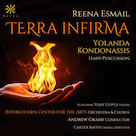
Yolanda Kondonassis: Terra Infirma
Azica Records
Harpist Yolanda Kondonassis and composer Reena Esmail come to this collaboration from very different backgrounds, yet their visions fluidly align when the album's works reflect on our relationship to the environment, a topic near and dear to both artists' hearts. Kondonassis, one of today's greatest ambassadors for the harp and an educator, author, and multiple Grammy award nominee, is also a fervent environmental activist whose books include Our House is Round: A Kid's Book About Why Protecting Our Earth Matters, published in 2012 and recently released in a paperback edition under the title My Earth, My Home. As environmentally conscious, Esmail, a Juilliard and Yale graduate who separates herself from her composer colleagues by fusing Hindustani and Western classical music into an ultra-personal hybrid, was inspired to write the album's titular work after witnessing from her Altadena home base the catastrophic fires that swept through the Los Angeles area in January 2025. Complementing that seven-part concerto for harp and percussion are Sandhiprakash and Earth Speaks: Curiosity, scored for for violin and harp and chorus and harp, respectively.
The most elaborate work is Terra Infirma, which couples Kondonassis (credited with both harp and percussion) with the Andrew Grams-conducted Interlochen Arts Academy String Orchestra. Sandhiprakash partners her with violinist Vijay Gupta and on Earth Speaks: Curiosity the Carter Smith-directed Arts Academy Chorus. Interestingly, the fifty-three-minute album was recorded at Interlochen Center for the Arts, whose Arts Academy Kondonassis attended as a high school student. Terra Infirma continues the work the harpist presented on her 2022 release FIVE MINUTES for Earth, which features pieces (including one by Esmail) commissioned through her non-profit organization Earth at Heart.
As satisfying as it is to have the two other works packaged with the title piece, it's Terra Infirma that is the primary work. As she regularly does in her composing practice, the Indian-American Esmail integrated Hindustani music into a Western framework. The idea of immolation came naturally to her as she walked through Los Angeles and saw how extensively wildfires had ravaged the area. It was immediately clear to her that the ancient Hindustani raags drawn upon would be Deepak, associated with fire, and Megh, which extinguishes it through rain. There's a theatrical dimension to the work that's visible live when the harp, symbolizing Earth, is moved by Kondonassis across the stage and makes stops at consecutive arrays of percussion. A programmatic element informs the material too as it advances from the moments before the initial spark, endures the decimating impact of the wildfire, and eventually resolves with the possibility of new growth literally rising phoenix-like from the ashes.
Hinting that the water-parched setting is dangerously susceptible to fire, the ominously tense “bone-colored branches” establishes portentous atmosphere via bowed vibraphone and strings. Much as flames suddenly erupt, “immolation” does the same with churning strings and rapid harp plucks. Even in the absence of visuals, one pictures Kondonassis rapidly moving between instruments when the music alternates between harp and drum flourishes. Solo violin passages imbue “helium ember” with a mournful caste, the harpist accenting the music with (what sounds like) glockenspiel, crotales, and chimes when not plucking. Images of smoke rising from the scorched earth emerge during the desolate “roaming the ghost forest” as stunned residents survey their ruined neighbourhood and calculate the damage. Glimmers of hope do surface, however, that reach their fullest culmination in the peaceful closing movement, “facing the flame.” Before we reach that destination, we encounter the sound of a distant melismatic singer in “skeletal silhouette” and gestures of violent delirium in “swallowed.” Kondonassis is the star attraction of the concerto, of course, but it's very much a full ensemble performance when the orchestra is as much a musical focal point as the soloist.
In featuring Gupta and the harpist only, Sandhiprakash (‘the joining of light') is much starker than the concerto; the change is refreshing, however, when the nine-minute setting grants the pair such a tremendous playing field. The two take their time, with the violinist and harpist entwining seductively as if to suggest day's dawning and its eventual setting. Gupta's vocal-like wails work effectively as a sultry counterpoint to Kondonassis's mystery-laden plucks and strums. Striking too is the three-part, fourteen-minute Earth Speaks: Curiosity, which uses as texts the list of stops the rover Curiosity made on Mars in 2011 and haikus that were created to commemorate the launch. In place of violin, angelic SATB voices partner with harp, their contrapuntal interlacings intricate but their union pleasing and sonorous. The dramatic opening movement “Ethereal” is warmer than the title implies when the music's humanized by the chorus's emoting and the harpist's crystalline textures. Tinges of harmonic dissonance do, on the other hand, lend “Remote. Icy” a chilly quality; the becalmed finale “Intimate, Serene” is as gentle and uplifting as expected, however. One anticipates that the collaboration between Kondonassis and Esmail will carry on into future projects, given how fruitful the results have been to date and how aligned the two are in their visions. Hearing the harpist embroider the composer's evocative music is rewarding, but it's rendered even more satisfying when the subject matter of the titular work is so timely.June 2026