

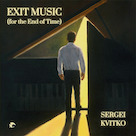
Sergei Kvitko: Exit Music (for the End of Time)
Blue Griffin Recording
If you've ever given thought to the music you'd choose for your funeral ceremony, you'll have some idea what pianist Sergei Kvitko went through in determining the set-list for his purportedly final release. It was an encounter in Madrid with the late Russian pianist Dmitri Bashkirov that planted the seed for the decision, and specifically the words the then-octogenarian shared with his younger colleague, “You know, when I turned eighty, I decided to stop playing. I felt like I could not play any better, and I didn't want to play any worse.” To be clear, Kvitko's life is hardly at its end, but with a successful career as a producer and label head demanding from him time and energy, his decision to step away from the keyboard is understandable if still regrettable.
With selections influenced by themes of departure and ending, Kvitko's assembled a set-list that covers large stylistic and temporal ground. There's Radiohead but also Rachmaninoff, Björk (by way of Biedenbender) and Bach, Mahler, Mozart and Messiaen, and many more—a highly personalized mix-tape, as it were, of Kvitko favourites. Fourteen transcriptions appear, with ones transcribed by him lending the release an even more personal dimension. That it was produced and engineered by Kvitko and recorded at Blue Griffin's studio on February of this year is all the more fitting.
Kvitko opens the set with his own Dichterliebe Rückblick (after Robert Schumann), which, as reflected in its title, is more a collaborative work in that it folds two parts from a Schumann song-cycle into its design. Regardless, the music's wistful lyricism dovetails perfectly with the elegiac theme of the project, and the elegance of Kvitko's keyboard artistry induces early regret over his decision to make the album his final one. Viewers familiar with Lars von Trier's Dancer in the Dark will recognize Björk's “Overture” from the film in which she appeared and which David Biedenbender's Falling Light uses as a springboard for a deeply rhapsodic treatment. No matter how elaborately it's dressed in this new rendering, the haunting quality of the original melodies remain firmly in place.
Biedenbender's Björk makeover anticipates the later appearance on the recording of Christopher O'Riley's finessed re-imagining of Radiohead's haunting “Exit Music (for a Film).” Another contemporary composer who contributed to Kvitko's project is Lowell Liebermann, whose “Zueignung” (from Five Etudes on Songs of Richard Strauss) transforms the original material into a rapturous, if brief, etude. From Brahms' final set of choral preludes, Ferruccio Busoni's transcription of “Herzlich tut mich verlangen” distills the essence of the original organ score into pianistic form. Kvitko's affection for Rachmaninoff's “How fair this spot” (from 12 Romances) comes through in his luminous realization of Arcadi Volodos's transcription. For his treatment of Mozart's Ave Verum Corpus, Franz Liszt showed admirable restraint in translating the dignified choral hush of the original into a poetic keyboard expression. As enrapturing is Kvitko's performance of Eugène Ysaÿe's “Malinconia” (from the Violin Sonata No. 2 in A Minor), expertly re-modeled by Noah Mallett into a gripping panorama.
Sometimes a transcription need do no more than hew closely to the original, Kvitko's own arrangement of “Louange à l'Éternité de Jésus” from Messiaen's Quartet for the End of Time a case in point. Yet while the transcription of the cello line might have been effected literally, the performer's sensitive handling of pacing and dynamics elevates the treatment. It plods, yes, and tension does build almost unbearably, yet the performance also evokes the feeling of a soul slowly ascending. During the recording's second half, the pianist presents his own transcription of the “Adagietto” from Mahler's fifth symphony, the nearly ten-minute result an admirable attempt at translating the original harp-and-strings arrangement into a single instrument form. Again, it's Kvitko's sensitive attunement to the character of the material that enables the reduction to work effectively. Meanwhile, Leopold Godowsky's transcription of “Gute Nacht” from Schubert's Winterreise retains the cryptic aura and trudging flow of the original, while Emile Naoumoff's arrangement of “In paradisum” from Fauré's Requiem likewise distills the work's celestial incandescence and stirring serenity into solo piano form.
Rather than end the album with the Radiohead tune, Kvitko opted for Igor Iachimciuc's treatment of Kvitko's favorite hymn “Precious Lord, Take My Hand,” here called Precious Lord (Fantasia on the Hymn Tune) and endearing for the heartfelt simplicity of its folk-like quality. Certainly no one doubts Kvitko's sincerity in presenting the album as his final one, but then again some future project might prove so enticing he'll have a change of heart and enter the recording studio again. No one would hold it against him if that were to happen, and if anything more piano music from him would be welcomed with open arms. But if Exit Music (for the End of Time) does turn out to be his last recording, it's a graceful and oft-exquisite farewell of which he can be proud.October 2026