

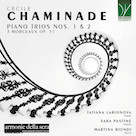
Tatiana Larionova, Martina Biondi, &Sara Pastine: Cécile Chaminade
Da Vinci Classics
Recent years have witnessed a resurgence of interest in the work of French composer Cécile Chaminade (1857-1944), this recent set by pianist Tatiana Larionova, violinist Sara Pastine, and cellist Martina Biondi testifying to that trend. Chaminade was indisputably prolific: she created more than 400 pieces, ranging from art songs and solo piano works to ones for orchestra and ballet. Operating very much within the French tradition of her time, she entices the ear with melodic expression, harmonic finesse, and lucid craft, the three chamber works featured here evidencing such qualities. Form and content wed seamlessly in these pieces.
Only six years separate the works, yet it's nevertheless possible to discern development from the Trio no. 1 in G Minor (1881) to the 3 Morceaux (1885) and Trio no. 2 in A minor (1887). Whereas youthful energy and exuberance inform the first trio, the Morceaux suggests a move inwards that carries over to the second trio. Regardless of differences in scale and character, all exemplify a high level of craft and eloquence of expression. Let's be clear, however: Chaminade was no revolutionary but rather a composer content to ensconce herself within the French musical tradition and embrace the values associated with it.
Her music benefits from the involvement of Larionova, Pastine, and Biondi when the players boast excellent credentials as live performers, awards recipients, and recording artists (detailed bios appear in the release booklet, as do informed commentaries by Giuliano Marco Mattioli). We begin with the four-part trio from 1881, with the elegance of Chaminade's writing announced immediately in a declarative “Allegro.” A singing quality is conveyed through contrapuntal gestures, the movement's lyrical theme voiced winningly by one instrument and then another. As the trio delivers the material with enthusiasm, the piano acts as a fluid partner to the strings, the three engaging in a crisp joint expression and each echoing another's melodic statement. Following that rhapsodic opener, the slow “Andante” finds Pastine and Biondi entwining rapturously and, with the pianist supporting them gently, their individual artistry impressing. The playful agility of the “Presto” movement makes for an effective contrast to the “Andante,” while the concluding “Allegro Molto” reinstates the expansive robustness of the opening part.
From there we move to the Morceaux, scored for violin and piano and sequenced in compact “Andantino,” “Romanza,” and “Bohémienne” parts. With Larionova accompanying her with sparkling arabesques, Pastine shines in the first tableau, with vibrato-tinged lines exuding romance and the music seducing with a swooning lilt. The tender central movement is graced by a heart-stopping theme the violinist returns to repeatedly using subtly different shadings and inflections. Giving the work an entirely different character, an insistent folk-dance pulse animates “Bohémienne” and imbues it with a rustic, even in moments raw character.
Chaminade's second trio returns Biondi to the fold for a three-part work that reflects an advance in compositional form and harmonic sophistication. Establishing itself with authority, a mighty “Allegro Moderato” leads the way, the rhythm attack insistent and unwavering—until, that is, a an elegiac theme enters to nudge the music into another direction. Counterpoint is pushed further here than in the first trio's opening movement, and transitions between the contrasting sections are effected fluidly and with admirable poise. The central “Lento” is a model of quiet dignity, its plaintive, sweeping lines executed with intense feeling and drama; the finale, marked “Allegro Energico,” resolves the work with a spirited affirmation whose tone couldn't be more carefree.
A better argument for Chaminade's music than the first trio would be difficult to imagine, but if anything the second might be even stronger. And while it might be tempting to regard 3 Morceaux as secondary to the trios, there's much to recommend it too, even if the cellist's forced to watch from the sidelines. Regardless, the composer benefits greatly from the splendid interpretations the works receive from Larionova, Pastine, and Biondi. Chaminade's clearly fortunate to have them in her corner.June 2026