

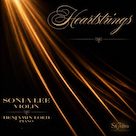
Sonia Lee & Benjamin Loeb: Heartstrings
St7dio Classical
Not a lot of background information accompanies Heartstrings, but the choice was perhaps deliberate on violinist Sonia Lee's part: when music is as emotionally expressive and direct as it is on this collection, words are hardly necessary and even perhaps interfere with the impression the music makes. Lee, ably accompanied by pianist Benjamin Loeb, presumably decided that nothing more than the performances were required in this instance.
Twelve standalone pieces are presented by the duo, with soprano Allison Charney guesting on one, a stirring treatment of Richard Strauss's “Morgen.” Yet while Lee's partners make distinguished contributions, without question Heartstrings is her album. The artistry of her violin playing—impeccable technique, immaculate tone, and sensitivity to touch, pacing, articulation, and dynamics—makes for performances that are never less than riveting. She executes with complete authority, and it obviously didn't hurt that the individual capturing the performances with pristine clarity was renowned producer and engineer Sergei Kvitko.
Yes, pieces such as J. S. Bach's Arioso, Jules Massenet's Thaïs “Meditation,” and Sergei Rachmaninoff's Vocalise, are familiar, but that in no way argues against them when they're delivered by the recitalists with such depth of feeling. One could imagine any one of the dozen works executed mechanically; by comparison, the performances by Lee and Loeb are expressive in the extreme. In addition to the four works mentioned, Heartstrings includes material by Edward Elgar, Fritz Kreisler, Pyotr Ilyich Tchaikovsky, Charles Gounod, William Grant Still, Jesse Montgomery, Vittorio Monti, and Spielberg's go-to composer, John Williams.
A sampling of the recital's commanding treatments will suffice to convey the character of the album. At the outset, Lee's choice of tempo is perfect for Bach's stately Arioso when it enables her tremulous violin to float serenely over Loeb's hushed chords. The singing tone showcased in Arioso is even more pronounced during her endearing rendition of Elgar's romantic Salut d'Amour, and one listen to her sensitive renderings of Massenet's haunting Meditation and Rachmaninoff's melancholy Vocalise reminds us why they're so beloved of violinists (and listeners). Tenderness is powerfully evoked by her heartfelt readings of Still's Mother and Child (don't miss her lovely double-stopped gestures) and Williams' “Theme” from Schindler's List. On an album that favours slow romantic settings, Monti's Czardas stands out for concluding the set on a rousingly effervescent note.
While Loeb's role is definitely a supporting one, his artistry is highlighted in certain moments too, such as when he introduces Tchaikovsky's Canzonetta before Lee's entrance and then accompanies her so gracefully thereafter. Witness the total control with which she delivers the piece's upper register phrases and trills during this duet and how she intensifies emotion elsewhere through her vocal-like vibrato.
Contending that “classical music is essential for the spiritual qualities it contributes to society and peoples' lives,” Lee, a Detroit native who's currently Concertmaster of the SBSO Orchestra and the Michigan Sinfonietta, was inspired to make Heartstrings upon reflecting on the impact classical music could have when listeners are grappling with AI and struggling with social media issues and crippled attention spans. It's natural that she would feel that way, of course, yet the argument posed by Heartstrings makes a compelling case in support of it. Works so beautiful and played with such humanity remind us of the spiritual comfort classical music can engender for those willing and able to receive its message.October 2026