

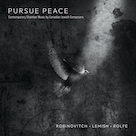
Noam Lemish / Sid Robinovitch / James Rolfe: Pursue Peace
New Focus Recordings
Pursue Peace, the inaugural recording from the “Jewish Music at York” initiative, celebrates the artistry of contemporary Canadian Jewish music with chamber works by Noam Lemish, Sid Robinovitch, and James Rolfe. Its release couldn't be more timely, of course, given the woeful resurgence of anti-semitism currently happening around the globe. The project was initiated by Lemish in 2022 to, in part, establish York University as a world-class hub for Jewish music creation, performance, and education, with annual performances and recordings designed to foster that goal. Consistent with that, this first release in the series was recorded at York University over three days in January 2025.
Grounded in a humanistic philosophy that champions values of inclusion, dialogue, and bridge-building, the initiative also emphasizes the diversity of Jewish musical expression, with the works presented testifying to that. In a perfect world, the work Lemish and his colleagues are doing would reach beyond the school to connect with communities, Jewish and non-Jewish, in the greater Toronto area and beyond. While each piece is different and was written during different years, all address themes of war, peace, and reconciliation and draw for inspiration from Jewish texts.
Whereas Robinovitch's Adieu Babylon (Psalm 137: “By the waters of Babylon, there we sat down and wept”) was composed in 1991 in response to the Persian Gulf War, Lemish's titular work (Psalm 34: “Avoid evil and do good in the world; seek and pursue peace”) was created for the Israeli-Iranian Musical Initiative (I=I) debut concert in 2015 when tensions between Israel and Iran were running high. Rolfe's O Greenest Branch, on the other hand, was written in 2019 but looks back to the twelfth century and medieval Christian mystic Hildegard von Bingen, the conundrum considered here having to do with the juxtaposition between the beautiful music being created in Germany and the slaughtering of Jews at the hands of their Christian neighbours.
Each composer brings impressive CVs to the endeavour, Robinovitch a composer whose works have been performed by multiple ensembles and choirs and who's written music for film, radio, and TV, Rolfe an award-winning Toronto-based instructor at the University of Toronto whose material has been presented by orchestras and opera companies throughout the world, and Lemish a pianist, composer, and York University professor who's issued a number of albums, including the Juno-nominated Twelve (2022), and who's recognized as both a jazz artist and chamber classical composer.
Written after the 1991 bombing of Iraq (the site of ancient Babylon) and performed by violinist Amy Hillis and pianist Katherine Dowling, Adieu Babylon opens the album powerfully. Tinged with Middle Eastern flavourings, the single-movement work advances through contrasting episodes, some slow, others animated. Hillis and Dowling execute the material with patience, nuance, artistry, and sensitivity to its oft-fragile character. Flowing naturally out of it is Lemish's Pursue Peace (Bakesh Shalom Ve'rodfeyhu), which, unfolding across three movements, is performed by violinists Hillis and Noa Sarid, violist Catherine Gray, cellist Mark Chambers, and clarinetist Eric Abramovitz. Titled to induce listeners to ponder the metaphorical divide separating them, “What's the Distance Between Tel Aviv and Tehran?” arrests the ear with a haunting clarinet motive that at the same time vividly evokes the character of a Jewish lament. Oscillating between lyrical expressions and dynamic ones, “Two Plus Two (Shteim U'Shteim)” is buoyed by a romantic lilt when not venturing into darker realms. The work's most plaintive expression is its eight-minute title movement, whose lonely ache is resonantly expressed and articulated by the quintet.
A dramatically different sound-world emerges when conductor David Fallis guides sopranos Sara Schabas, Jane Fingler, and Vania Chan, altos Veronika Muggeridge and Rebecca Claborn, organist Clark Schaufele, and percussionist Mark Duggan through the six parts of Rolfe's song cycle. Originally commissioned to be a performed as a companion piece to Hildegard von Bingen's Ordo Virtutum, O Greenest Branch holds up perfectly well on its own terms. Despite an increase in the number of performers involved, the music retains intimacy when the singers are accompanied by organ and percussion only. The sparse arrangement also allows their voices to enunciate with clarity, such that while the inclusion in the release booklet of the work's texts is welcome, it's almost unnecessary. Schabas distinguishes the second movement, “Lament for the Massacre at Blois,” with a solo that gives affecting expression to the brutal horrors victims suffer and also gives resonant voice to despair and defiance during the harrowing “On the Slaughter (Al Hash'chitah).”
Music has for centuries played a critical role in helping those subjected to the horrors of war to survive it with resilience and an indomitable spirit. Beyond the scenarios evoked by the three composers here, one's thoughts might also gravitate to prisoners of WWII camps who staved off death by performing music for their captors or to composers who bravely continued creating when death at the hands of political oppressors was a very real and omnipresent possibility. A title such as Pursue Peace might seem overly optimistic given divisive times such as ours, yet our collective will to achieve peace refuses, it seems, to be extinguished.November 2026