

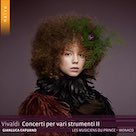
Les Musiciens du Prince: Vivaldi: Concerti per vari strumenti II
Naïve Classiques
Les Musiciens du Prince was founded a decade ago at the Opéra de Monte-Carlo at the behest of renowned Italian mezzo-soprano Cecilia Bartoli in collaboration with Jean-Louis Grinda, the Opéra's then-Director. Bartoli recruited many of the finest period instrument musicians to form an ensemble similar in kind to those popular at princely courts in seventeenth- and eighteenth-century Europe. While the orchestra's playing can make it feel as if one's stepping back into the Renaissance and Baroque eras, the musical ground it covers also extends to Mozart, Rossini, and most recently Wagner (Das Rheingold in 2025, specifically, with more parts from the Ring cycle to come).
Concerti per vari strumenti II is part of Naïve's Vivaldi Edition and features sumptuous renderings of his music by Les Musiciens du Prince under the guiding hand of Principal Conductor Gianluca Capuano. Before turning to the six concertos performed on the release, a few words about the Vivaldi Edition project are in order. Its story begins in 1930 when the National University Library of Turin purchased the personal collection of autographed manuscripts by Antonio Vivaldi. Named after the donors who facilitated the purchase, the Foà and Giordano collection comprises twenty-seven volumes of the composer's original manuscripts (some 450 works) and represents more than ninety percent of his surviving autographed output. Conceived and spearheaded by Italian musicologist Alberto Basso at the beginning of this century, Vivaldi Edition aspires to record this massive archive in its entirety, with more than fifty titles having been issued to date and two-thirds of the project now complete.
One of the more salient aspects of this latest release is the variety of instrument combinations Vivaldi incorporated into the concerti. Augmenting one scored for four violins and another for two oboes is one featuring both instruments; the first two concertos, on the other hand, give prominent roles to flute, oboe, bassoon, and strings and to bassoon and pairs of violins, oboes, and recorders in the other. Of course the presence of the full ensemble ensures that a unifying identity asserts itself throughout, no matter the changes in soloist.
In keeping with its "Tempesta di Mare" title, the opening Concerto for Flute, Oboe, Bassoon and Strings in F Major exudes turbulence in its framing movements, while the “Largo” offers a respite of relative calm. The zestful opening movement engages instantly when strings and recorder (subbing for flute) execute at light-speed, the music delectably effervescent and the tone triumphant. The stately central movement arrests the pace to allow for a melancholy recorder solo, while the closing movement makes good on its “Presto” marking with acrobatic gestures executed with precision. Stately too is Concerto for 2 Violins, 2 Oboes, 2 Recorders and Bassoon in C Major, which tickles the ear in its opening “Allegro non molto” when the paired soloists dazzle with expertly administered to-and-fro. The melancholy middle movement allows one to savour the charm of the timbral combinations when recorders, harpsichord, and bassoon engage in a slower dance. Engagement of a different sort occurs during the closing "Allegro non molto” when graceful dance-like gestures sweep one off one's feet.
In contrast to the opening concertos, the four movements composing the F Major one for violin and oboe are all up-tempo; curiouser still, the soloists only appear in the first and third movements and then always in unison. Such differentiating aspects in no way make the concerto less appealing, however, when the music's consistently spirited and the movements, like so many on the recording, are refreshingly concise. The B-Flat Major concerto for four violins might begin reflectively but quickly explodes in a firestorm of energy once the strings' conversational back-and-forth heats up. Reinstating the fast-slow-fast form of the opening concerti, this one serves up a lustrous “Largo” rich in contrapuntal allure before the mighty closing “Allegro” takes its turn. Changing things up again, the D Minor concerto for two oboes sequences the solemn “Largo” first before alternating between allegros and another slow movement. In truth the opening part's so succinct, it almost acts as an intro to the initial fast movement, which segues between solo and ensemble passages in rapid succession. The lengthier second “Largo” grants the oboes more time to work their seductive magic, after which the concluding allegro resolves the work on a note of Mozartian splendour. No less exquisite is the album-ending C Major concerto, its central slow movement particularly appealing for its coupling of solo violin with two harpsichords.
The listener coming to Vivaldi Edition for the first time through this release could be forgiven for salivating over the prospect of exploring those that preceded it. If they're of equivalent quality to this latest chapter, the excitement that listener might be feeling would be wholly warranted when such a treasure trove awaits. Even those whose musical appetite gravitates in a more contemporary direction will likely find themselves won over when the ensemble delivers these concerti with so much conviction and enthusiasm.July 2026