

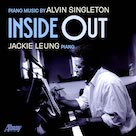
Jackie Leung: Inside Out: Piano Music by Alvin Singleton
Albany Records
In issuing this comprehensive collection of material by the distinguished Brooklyn-born composer Alvin Singleton (b. 1940), Canadian pianist Jackie Leung has not only done a service to him but to listeners everywhere, especially considering that Inside Out is the first album to feature all of his solo piano works written between 1966 and 2022. Adding to the presentation, vibraphonist Ryan Scott joins her on Greed Machine, while fellow pianist Erica Murase does the same for a “Piano Four-Hands” treatment of the title composition.
A New York University and Yale graduate, Singleton studied and worked in Europe for fourteen years before returning stateside to become composer-in-residence with the Atlanta Symphony Orchestra in the late ‘80s. He held a similar position with the Detroit Symphony Orchestra a decade later and has served as a visiting professor at the Yale University School of Music. He was elected to the American Academy of Arts and Letters in 2014, and recordings of his music are available on Albany, Elektra/Nonesuch, Tzadik, Innova, and other labels. He's been a creative force for decades and shows no signs of slowing down, with many new works materializing and performances and recordings of his music appearing during the past decade.
Toronto-born and a graduate of McGill University and Stony Brook University, Leung's been playing the piano since six and is today an admired performer, teacher, adjudicator, and scholar whose curatorial choices lean more in the direction of lesser-known repertoire than standard fare. Her interest in works that blend notation and improvisation makes her a perfect fit for Singleton, whose works incorporate both and challenge too in straddling classical and jazz. Further to that, his music veers between tonality and atonality and oscillates between restful passages featuring few notes to others densely multi-layered. There are vibrant rhythmic episodes but also contemplative ones, and breezy, jazz-inflected moments balanced by elegant, classically-tinged ones. A typical Singleton piece is unpredictable in its unfolding yet by its end reveals itself to have been constructed with a clear and lucid understanding of its form.
That he embraces both classical and jazz traditions is explained in part by formative early experiences. Seeing saxophonist Ornette Coleman perform at the Five Spot was pivotal in facilitating his appreciation for jazz and icons such as Charlie Parker and Thelonious Monk, but Singleton developed equal admiration for classical giants like Beethoven and Mahler—seeing Leonard Bernstein conduct the latter's Resurrection Symphony proved just as life-changing. Rather than bifurcate these interests in his work, Singleton assimilated them. It takes a special pianist to meet the challenges of his work, which Leung repeatedly shows herself to be as the album, recorded during July 2025 at Toronto's Noble Street Studios on a Fazioli S212 grand piano, plays.
The material ranges from miniatures lasting one to two minutes at a time to odysseys, the longest the eighteen-minute Inside-Out (1983–84). The radiant opener Changing Faces (1986) is succinct at two minutes yet could nevertheless pass for a microcosm of Singleton's music in its mercurial nature and coupling of repetition and change. A pattern sparkles as it incessantly repeats before splintering into different versions of itself. Collected under the title Cinque (1969), five short musical essays follow, each one explorative and incorporating extended techniques. It too presents a concise overview of his approach in wending between moments of jazz-like syncopation and Webern-styled chromaticity. Leung moves inside the piano during the third part by plucking and dampening its strings before advancing to the scurrying helter-skelter of the fourth. The fifth distances itself from the others in merging emphatically struck chords with hushed single notes, and with contrast in dynamics pushed to the extreme. The writing of the resonant Greed Machine was inspired by the playing of The Modern Jazz Quartet and vibraphonist Milt Jackson and pianist John Lewis in particular. That Singleton would have been captivated by the group's playing hardly surprises, given that it specialized in its own seamless fusion of jazz and classical.
Leading up to the album's closing epic are four solo piano settings, each slightly longer than the one before. Up first, Baked In The Cake (2012) alternates between jittery and pensive episodes that have Leung scampering across the keyboard when not resting gently upon it. Argoru I (1970), the first of ten pieces extending across fifty-four years (the most recent, Argoru X, was premiered by trumpeter Vincent Yim in 2025), is as prickly in its interlacing of chordal splashes and jagged rhythms. Singleton's first published solo piano work, Mutations (1966) works its spidery magic as a theme-and-variations that weds contrapuntal lines to frenzied patterning and jazzy grooves. The album-concluding Inside-Out, which was composed for Anthony Davis and Ursula Oppens and premiered at Carnegie Hall in 1985, has been likened by the composer to the chaos one encounters at a train station, where after exiting a train, riders disperse and pursue different directions. After an extended intro where C sharp intones repeatedly, Leung and Murase initiate their entwining, with each executing passages that mirror each other and improvising for about half of the piece's total time. As their playing grows in complexity, it's propelled by motorik drive and slowly builds into powerful percussive entanglement.
Enhancing one's appreciation of Singleton's music and providing helpful context are in-depth commentaries for each composition by Leung. One imagines him thrilled by the outcome: not only does she deliver sterling interpretations of his pieces, her liner notes function as an illuminating counterpoint to her performances, and the level of commitment she's brought to the project is exceptional.October 2026