

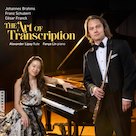
Alexander Lipay & Fanya Lin: The Art of Transcription
Navona
Records
Had flutist Alexander Lipay chosen a less revealing title than The Art of Transcription one might have presumed his release's three works were originally scored for the woodwind, so smoothly has the transition from strings to flute been effected. Accompanied by pianist Fanya Lin, Lipay has selected material that lends itself especially well to transcription and in doing so casts an illuminating light on works by Brahms, Schubert, and Franck. The combination of Lin's Steinway and his flute makes for sumptuous music.
A graduate of the universities of Southern California and California, Santa Barbara, Lipay is the Principal Flutist of the Tucson Symphony and True Concord Voices & Orchestra. He's also, surprisingly, established himself as a producer and engineer who in those capacities has won numerous awards. Lipay's a lucky man to have Lin by his side, the pianist having distinguished herself recently with her own release, Rhapsodic, and its treatments of Gershwin and Rachmaninoff. Recorded at the University of Arizona on February 13, 2025, the recitalists distinguish Brahms' Sonata No. 1 in E minor, Schubert's Sonatina No. 2 in A minor, and Franck's Sonata in A major with luminous performances.
The set begins with Brahms, his sonata originally composed for cello and piano and here transcribed by Lipay. Instantly the music transfixes when he and Lin couple effortlessly in the flowing “Allegro non troppo” movement. Moments of intense drama are offset by peaceful passages during this thirteen-minute travelogue. It's impossible to miss how telepathically the two are attuned as the music advances through shifts in tempo and dynamics. An endearing, animated “Allegretto quasi Menuetto” follows, its playful dancing melodies well-suited to both flute and piano. Sterner by comparison, the acrobatic “Allegro” serves up a breathless fugue for a triumphant finale.
Transcriptions for the other works are by Robert Stallman (Schubert) and Jean-Pierre Rampal (Franck), each originally written for violin and piano and structured in four parts as opposed to the three of Brahms. Like many a Schubert work, the sonatina was published after his death, the publisher naming it a sonatina despite Schubert calling it a sonata. The work perpetuates the beguiling quality of the opening work, even bettering it in places with the composer's wondrous gift for melody. The opening “Allegro moderato” is elevated by a particularly intoxicating theme whose well the instruments drink from repeatedly (and even revisit in the closing “Allegro”). The spell doesn't weaken either when its place is taken by a stately “Andante” or nimble “Menuetto: Allegro.”
A late work by Franck, the Sonata in A major was written in 1886 for the legendary Eugène Ysaÿe and receives a splendid transcription by the also-celebrated Rampal. The move into a more Impressionistic realm is announced by the dream-like lyricism of the opening movement and the graceful rise and fall of its chromatic phrases. Lin's virtuosity is called upon for the high-velocity passages of the at times tumultuous “Allegro” movement, but so too is Lipay's. The poetic delicacy and lyricism of the “Recitativo-Fantasia” and “Allegretto poco mosso” movements, on the other hand, are perhaps more representative of what we think of when we hear the name César Franke.
Lipay's selections reflect a smart curatorial sensibility when these alluring pieces lend themselves particularly well to an instrument whose sinuous timbres are so naturally conducive to entrancement. That he engaged Lin for his partner certainly testifies to his smarts in the performance area too.August 2026