

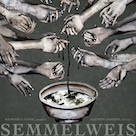
Raymond J. Lustig: Semmelweis
Sono Luminus
One might understandably wonder what inspired composer Raymond J. Lustig to base a song cycle on Dr. Ignaz Semmelweis, the nineteenth-century obstetrician known for promoting handwashing. It's easily explained: when the idea for the project first came to Lustig in 2007, he was a graduate student in music but also someone who'd spent several years doing biomedical research. Initially presented as a stage production in 2018, the recording isn't a literal document of that treatment; instead, Semmelweis is now a song cycle crafted with in-studio resources in mind. The composer likens the transition from stage to recording as a story “made of glass” that fell to the floor, splintered into shards, and was then put back together. Consistent with that, Lustig and lyricist Matthew Doherty designed the cycle to reflect the doctor's inner psyche during the last period of his life and with events from it re-surfacing, sometimes out of order and newly imagined.
That the idea for the project came to Lustig in 2007 might seem remarkably prescient, given the 2020 pandemic with its concomitant emphasis on proper hygiene. It was during the 1840s that Semmelweis realized that the epidemic raging during his own time was being spread to healthy mothers by the unsanitary hands of their doctors; much as medical experts were confronted with push-back during our pandemic, Semmelweis's research was met with initial resistance and only received validation decades later, long after his death.
Indicative of the production advantages the studio set-up offered, Lustig built soprano Charlotte Mundy into a choir rather than recruit and then record a number of like-sounding voices. Enhancing the presentation of Mundy's voice, the choir generated from it doesn't appear as a single massed entity; instead, her voice spreads out in the stereo field. Such a move obviously gives the music a three-dimensionality akin to singers distributed across a stage during a live performance. Lustig's idea was for those voices to be a chorus of “mother ghosts” who died prior to Semmelweis's discovery and who haunt his memory.
Stylistically, Semmelweis spans multiple genres, from chamber classical, theatrical art song, choral music, and indie-electronic pop. There are moments during the recording when the music calls to mind song-leaning material by Meredith Monk, Laurie Anderson, and Philip Glass (e.g., Songs from Liquid Days). Recorded at NYC's Hit Factory and Respirano on Hudson between 2023 to 2025, the album augments Mundy (Ekmeles, Tak Ensemble) and Lustig as lead vocalists with the string quartet The Rhythm Method, violinist Leah Asher, cellist Meaghan Burke, bass clarinetist Chrystof Knoche, and double bassist Ranjit Prasad. While Mundy personifies woman and the mother ghosts, Lustig assumes the persona of Semmelweis and also contributes instrumentally.
The album begins hauntingly in “What is the Day” with Mundy's unaccompanied swooping, the voice component swelling as one part's added to another and a heavenly choir gradually grows into mesmerizing counterpoint. That overture sets the stage for “Market Squares,” the first of many examples of Lustig's chamber-pop style, and a second polyphonic vocal setting, “Give Birth on the Earthworks.” Lustig's first lead vocal appearance arrives four tracks in with “Best Idea,” his delivery earnest and passionate and animated by an organ-driven pulse and Mundy's background accents. Parts thereafter extend from intimate art song ballads (“Never a Choice”) and soaring elegies (“Archaeology”) to dazzling choir expressions (“Our Skin So Fair”).
Lustig's not as technically accomplished a singer as Mundy, but he generally makes up for it in theatrical expressiveness (“My Dark Disgrace,” “The Only One”). Of the album's many contrasts, perhaps the greatest one is between his vocal delivery and Mundy's. Certainly her singing and in particular the choral textures generated from her voice are two of the recording's major selling-points—Lustig's a lucky man to have her. Many parts are distinguished by the arrangements he devised for them, with inventive chamber-styled backdrops assembled from strings, accordion, organ, music box, and piano. With the recording packing twenty tracks into its sixty-five-minute frame, Semmelweis doesn't feel overstuffed but instead surprisingly lean, with the journey made smoother when instrumental miniatures (“You Cannot Stay,” the Glass-like “Etiology”) effect bridges between the formal song-structured settings. In an interesting example of reverse engineering, one could easily imagine the 2026 iteration of Semmelweis being re-adapted for a stage production treatment.May 2026