

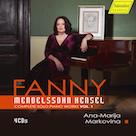
Ana-Marija Markovina: Fanny Mendelssohn Hensel: Complete Piano Works Vol. 1
Hänssler Classic
This first of two volumes by Ana-Marija Markovina of the complete solo piano works of Fanny Mendelssohn Hensel (1805-47) is nothing short of revelatory. If that word seems hyperbolic, consider: the four-disc set features seventy-eight tracks, half of which have never been recorded before. In presenting the material en masse as Markovina has done, the release also sharpens our awareness of the huge volume of music Mendelssohn Hensel produced and even more critically its consistently excellent calibre. That the 270-minute collection includes premiere recordings of dozens of pieces also significantly enhances its value. Her gifts as a composer are rendered all the more vivid when so many works are presented in a single collection.
It's not the first time Markovina's recorded a composer's entire solo piano output. In 2014, she commemorated the 300th birthday of Carl Philipp Emanuel Bach with an acclaimed box set of his entire keyboard works, four years later issued a recording of the complete solo works for piano by Anton Bruckner, and in 2022 issued her set of the entire solo piano works of Felix Mendelssohn, a project that naturally paved the way for a release of material by his sister. Markovina didn't turn her attention to Fanny because she's a female composer but primarily because of the quality of her work. Even so, the circumstances of Mendelssohn Hensel's life are compelling when one considers biographical details. Born in Hamburg, she grew up in a wealthy family, yet while she and her younger brother Felix grew up as equals Fanny realized as the entered adulthood that she would never enjoy the same degree of privilege as him. Stated otherwise, her musical gifts would not be, like his, publicly acknowledged and celebrated but instead recognized within the family circle only.
While she wasn't able to perform in public, she nevertheless created more than 450 works, 160 of them for piano. To everything there's a silver lining and that applies here too, for creating in obscurity and away from public scrutiny allowed her time to practise, study, and compose. Creating entirely to satisfy herself, she was able to fully indulge her artistic impulses. While her brother was establishing himself on the international stage, she found her outlet in the Salon and through the Sunday concerts she organized at the family home. The painter Wilhelm Hensel, whom she met in 1821 and married years later, recognized and encouraged Fanny's artistry and after her passing ensured that more of her works would be published beyond those she'd herself published at the age of forty.
Having recorded just under half of Mendelssohn Hensel's piano oeuvre, Markovina has acquired an insightful understanding of the music and describes it rightfully as highly refined, innovative, and “harmonically audacious.” Abundant in lyricism and melody, the pieces, many simply called Klavierstück and Übungsstück, are technically demanding and consistently call upon the pianist's virtuosity. There's much to recommend about the release, from the composer's eloquent writing to the pianist's superb performances. Also enhancing its impact is the fact that the pieces appear in chronological order and thus enable the listener to monitor the composer's development from youth to maturity. Without wishing to suggest that the material on the first three discs is any less impressive, a number of those on the concluding one particularly impress for their maturity and sophistication. These later settings show her incorporating daring chromatic gestures, “Allegro molto vivace ma con sentimento Es-Dur” (H 332) and “Notturno napolitano h-Moll” two examples.
Each disc contains terrific pieces, be they etudes, lieds, toccatas, bagatelles, sonatas, or fugues, that speak to Mendelssohn Hensel's brilliance. Varieties of mood, tempo, and tone are explored throughout, with one piece lively, spirited, and carefree and another forlorn, tender, and solemn. That melody was paramount in her mind is shown in the central role it plays and in how everything around it was designed to support it (“Allegretto g-Moll,” H 123; “Andante con espressione B-Dur,” H 314). The confidence and authority of her writing is present early on and distinguishes the “Andante E-Dur” (H 30) and from 1822's Sonatensatz (H 44) the “Allegro assai moderato.” Whereas most of the pieces are in the one- to three-minute range, a small subset sees pieces ambitiously stretching out for seven to eight minutes at a time, that Sonatensatz movement and the dramatic “Allegro con strepito” from Ostersonate (H 235) illustrations. Further to that, while most pieces are standalones, a small number are in a multi-movement format, the six-part Klavierbuch (H 214), for example. Striking too are the poise and the patience with which certain pieces develop, the Sonata o Capriccio f-Moll (H 113) and from Ostersonate (H 235) “Largo e molto espressivo” cases in point. There's occasional playfulness too, as evidenced by “Humoristisch und etwas ironisch fis-Moll” (H 165) and “Allegretto grazioso B-Dur” (H 294).
No artist creates in a vacuum, Fanny included. Yet while it's possible to hear an echo of Bach in one piece and Beethoven in another (in fact, a sparkling C major cadenza by the latter appears on the first disc), one comes away from this collection not hearing her as an imitator but as an original (even if a product of her time) with a clear identity. The second volume will feature the remaining works for piano as well as fragments and works-in-progress. For now, the first volume has more than enough to keep one occupied until that future release materializes. It also serves as a wholly satisfying treasure trove on its own, not to mention a testament to Mendelssohn Hensel's gifts. In notes included with the release, Markovina writes, “Fanny's universe moves me time and again to a state of reverential awe.” You may well find yourself echoing that sentiment after hearing this excellent account of her artistry.July 2026