

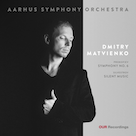
Dmitry Matvienko & Aarhus Symphony Orchestra: Prokofiev & Silvestrov
OUR Recordings
On paper, Sergei Prokofiev (1891-1953) and Valentin Silvestrov (b. 1937) might seem strange bedfellows, but the works performed by the Aarhus Symphony Orchestra under Dmitry Matvienko's direction turn out to be strikingly complementary. On the one hand, we have the great Russian composer's sixth symphony (as opposed to the more frequently heard fifth), on the other Silvestrov's Quiet Music, at ten minutes a short piece yet transfixing in its beauty. Whereas Prokofiev's symphony was composed in the immediate aftermath of WWII, as countries devastated by the war began the slow recovery from its horrors, the Ukrainian's three-part meditation was written in 2002, years before the tragic situation involving Russia with which Silvestrov's country is still grappling. Beyond offering a place of refuge, the calm that Quiet Music induces soothes when it follows the ever-threatening dramatics of Prokofiev's sixth.
The Belarus-born Matvienko's only been the orchestra's Chief Conductor since the 2024/25 season, but the experience he brought to the appointment was extensive. He's conducted many of the world's leading orchestras and conducted operas in many European countries too. Founded in 1935, the Aarhus Symphony Orchestra employs sixty-five full-time musicians and has recorded a significant number of Danish contemporary works as well as pieces from the standard classical repertoire. Both conductor and orchestra comport themselves admirably throughout the recording.
As contrasting in tone and orchestration as the two works are (Prokofiev's is scored for full orchestra, while Silvestrov's is performed by a chamber-styled ensemble of strings), they're both distinguished by their creators' exceptional command of melody and compositional form. Matvienko calls, for example, a Russian folk song-styled theme in the sixth symphony's framing movements “one of the most heartbreaking melodies and dramatic themes ever written,” and there's no denying its resonance.
Prokofiev's sixth isn't a programmatic work, yet in having been written during the two years following the war was clearly affected by it and by the catastrophic losses, human and otherwise, it incurred. The blustery horn phrases that introduce the work certainly arrest the ear, as does the sombre tone of the music that follows. An adventurous fourteen-minute travelogue, the “Allegro moderato” oscillates between episodes of austere lyricism and intense foreboding. A sardonic march passage brings a scabrous edge to the music before it convulses in a series of shrieks and drum-fuelled explosions. Calm returns as the movement nears its end, but not before the militant march asserts itself one final time. Matching the first movement in duration, the central “Largo” begins with a wail in the woodwinds but then pivots to a sweeping romantic expression from the strings. Aggressive rhythmic episodes and gentler evocations of a misty, dream-like character emerge to convey the expansive scope of the movement. The concluding “Vivace” lunges furiously from the opening bars, its triumphant spirit contrasting greatly with what's come before. Prokofiev's music is never one-dimensional, however, and soon enough the tone of the music moves from carefree to anxious, as if an echo of war is returning. Racing at light-speed, the music puts the orchestra to the test, but Matvienko and company are up to the challenge. The symphony's end is striking for the two detonations that appear just before the close, ruptures that naturally call to mind the atomic bombs that laid waste to Hiroshima and Nagasaki in August 1945 and helped usher the war to an end.
Much as the music of Arvo Pärt underwent a dramatic change when it turned away from the avant-garde for a purer style that communicates universally and connects with immediacy, so too did Silvestrov's, with 1972's Meditation, scored for cello and chamber orchestra, announcing a shift that would carry over to subsequent works, including, of course, Quiet Music. Matvienko rightfully describes the piece as “a kind of consolation, where any person of any nationality and religion can come … to seek solace and forget all his sorrows.” It takes mere seconds for the austere beauty of the material to assert itself when “Waltz of the Moment” makes its poignant presence felt. As haunting is “Evening Serenade,” while the plaintive tenderness of “Moments of the Serenade” resolves the work on an as-stirring note. Adding to the appeal of the release is its relative concision: at fifty-one minutes, space was available (on the CD release) for another piece to be included, but had a third been added the recording's impact might have been diluted when the two that do appear combine so splendidly and present such a powerful study in contrast. In its issued form, the release impresses as an exceptionally fine statement from Matvienko and his Aarhus Symphony Orchestra colleagues.July 2026