

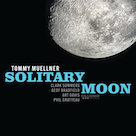
Tommy Muellner: Solitary Moon
Calligram Records
Some recordings fail to meet expectations; others surpass them. One such is Solitary Moon, a comprehensive portrait-styled album that's jazz pianist Tommy Muellner's first release as a leader since 1998's (All) About Time. In dedicating the release to his three grandchildren, he's clearly no twenty-something fresh out of college and eager to make his mark. Quite the contrary, Muellner's a cherished veteran of the Chicago scene who's supported a voluminous number of musicians and earned the admiration of colleagues and listeners along the way.
A scan of the new set's contents promises much in coupling originals and covers; even better, he's joined by his long-serving colleagues, trumpeter Art Davis and drummer Phil Gratteau, plus bassist Clark Sommers and saxophonist Geof Bradfield. It's when the music begins, however, that one realizes how special the album is. With the level of musicianship never less than stellar, the performances beguile from start to finish. Any thoughts about where the album fits, whether it's “in the tradition” or otherwise, fall to the wayside once the playing starts: the seasoned leader's the stabilizing force who excels at both soloing and comping, and his ever-versatile partners distinguish themselves throughout.
The release appeals for other reasons. Personnel shifts occur throughout, making for a set that features a different configuration from one track to the next and thus a presentation marked by variety and unpredictability. Stylistically, the album ranges from uptempo numbers to ballads, sambas, and show tunes. While a small number are Muellner originals, the majority come from the Great American Songbook and figures such as Johnny Mandel, Alec Wilder, Henry Mancini, and Leonard Bernstein. Adding to the variety, Bradfield plays tenor on some pieces, soprano others, and even works flute into the presentation.
There are also surprises. A couple of cuts sound as if the players are channeling Charlie Haden's Quartet West, given the music's romantic smolder (see Russ Freeman's ballad “The Wind”), and in titling his Monk homage “Monk See, Monk Do” one might have anticipated something playful, boppish, and upbeat; instead, Muellner's tune is a lovely ballad that doesn't ape Monk's style but rather pays affectionate tribute to him. Many of the fifteen pieces carry dedications, with Bill Evans (who Muellner cites as his primary influence), Steve Kuhn, Keith Jarrett, Fred Hersch, and others so honoured.
Recorded during two March days earlier this year at Chicago's Electrical Audio, the album opens strongly with a lithe treatment of Wilder's “While We're Young,” the performance vivacious and the tone uplifting. Bradfield, Davis, and Muellner sail breezily through their solos, while Sommers and Gratteau lock into the waltz rhythm briskly. Having established the album's character, the leader delivers “Like Someone In Love” in a piano trio arrangement that sees the drummer (on brushes) expertly supporting Sommers and the leader, the pianist marking the performance with an assuredly swinging solo. The trio format reinstates itself for lovely treatments of “I Remember You,” “Make Someone Happy,” and “Polka Dots and Moonbeams.”
Reflecting the personal dimension of the release, “Sandy Samba” is titled after Muellner's wife; the tune's more memorable, however, for its sultry pulse and sparkling solos by Bradfield (playing soprano), Sommers, and the leader. A similar samba groove animates “Cuz Tune,” its allure heightened by the front-line pairing of horn and flute. Again wielding soprano, Bradfield solos dynamically across Kuhn's free-floating “Oceans in the Sky,” the buoyant treatment also noteworthy for an explosive turn from Gratteau. The saxophonist's sultry tenor eases into “Monk See, Monk Do” like Ernie Watts on one of Quartet West's own classic ballad performances.
With Bradfield sitting out, Mancini's evocative "Soldier in the Rain” is elevated by beautiful flugelhorn contributions from Davis and sensitive playing by the others; Bernstein's classic West Side Story ballad “Somewhere” likewise receives a warm reading from the quartet. As the album enters into its final stage, it strips down for an intimate medley of “Diane” and “Danny Boy” featuring Bradfield (on tenor) and Muellner before concluding with a heartfelt, Bill Evans-inspired solo piano rendition of “Why Did I Choose You.”
Admittedly, the album's long at fifteen tracks and might have been better reduced to twelve at the most. That said, there's something undeniably cozy about Solitary Moon when the performances are delivered with so much warmth and affection. Muellner leads throughout with confidence and authority, which makes the listening experience all the more satisfying. Slipping into these tunes like the most comfortable of wardrobes, the pianist's love for the music is palpable from start to finish.October 2026