

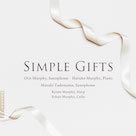
Otis Murphy, Haruko Murphy, & Masaki Tadenuma: Simple Gifts
Navona Records
The spiritual rewards of “simple gifts”— family, friends, and fulfilling work of meaning and honest toil—should never be undervalued, a message that resonates through every moment of this excellent chamber recording. A celebration of cross-cultural collaboration, Simple Gifts unites voices from the United States and Japan in common cause, with saxophonist Otis Murphy joined by his wife, pianist Haruko, two of their six children, harpist Renée and cellist Ethan, and a dear and long-time friend of the family, saxophonist Masaki Tadenuma. The warmth exuded by the eight performances on this “family project” make it feel all the more intimate and special. While Ryota Ishikawa doesn't perform alongside the others, he contributed three compositions to it and is thus as integral to the album's character.
The material was recorded in September 2019 at Bloomington's Indiana University yet the passage of time hasn't lessened the music's impact. The connection the Murphys have to the locale is strong, with Otis a Professor of Saxophone in the Indiana University Jacobs School of Music, Haruko a graduate of the university, and Bloomington home to the family. Augmenting the pieces by Ishikawa are ones extending from a Shaker tune, Jay Ungar's Ashokan Farewell, and Steven Galante's The Pawn to Jean-Marie Leclair's Sonata in C Major and the ‘80s movie hit “Somewhere Out There.” Arrangements change throughout, with the saxophonists moving handily between alto, soprano, and tenor.
For a project so infused with affirmation, it's appropriate that it should begin with Ishikawa's The Dance of Joy. The connection the players share is instantly clear when the alto saxophonists and Haruko spiritedly romp through the 9/8-metered gigue, with a smattering of Bach's “Jesu, Joy of Man's Desire” also woven into the performance. The entwining to-and-fro between the woodwinds amplifies the uplifting tone, as does the smoothness of their execution. Originally titled “The Gift to be Simple” and arranged by Yusuke Shinotsuka, Simple Gifts will be familiar to anyone acquainted with Aaron Copland's Appalachian Spring. After Haruko delicately establishes the plaintive mood, Otis's alto voices the stirring melody first before handing off to Tadenuma for a soprano restatement. Shinotsuka's arrangement brings forth the beautiful harmony the different saxophone types generate when conjoined plus the majestic dimension of the song.
Enrapturing in a different way is Ishikawa's The Goddess and Hourglass, a romantic folktale-crafted homage to the San-In region of Japan, Otis on soprano this time and Masaki alto. The composer also distinguishes himself with Songs Across the Sea, which weaves four songs from Japan and America into a suite beautifully scored for soprano saxophones and harp. Exemplifying the album theme in microcosmic form, the piece wends from the serene poetic lilt of “Autumn Colored Leaves” to the familiar American Civil War song “When Johnny Comes Marching Home” and the rousing love letter “Back Home Again in Indiana.”
Even material as saccharine as “Somewhere Out There,” sung by Linda Ronstadt and James Ingram in 1986 for the film An American Tail, overpowers whatever resistance one might have when the performance is mellifluous and the Shinotsuka arrangement for saxophones, piano, and harp winning. Stripping the number of performers to two, the saxophonists, both wielding altos, dig into Leclair's eighteenth-century Sonata in C Major as if possessed, the central “Sarabanda - Largo” particularly lovely. Following it is Galante's showstopping The Pawn, wherein the alto saxophonists, now accompanied by piano, acrobatically alternate notes in hocketing-like formation when not fluidly harmonizing or braying theatrically. At album's end, all five musicians gather for Ungar's Ashokan Farewell, a touching waltz delivered in a Scottish lament style; written in 1982, it was later used as the title theme for Ken Burns' The Civil War. Ethan's cello isn't heard often on the recording but definitely leaves a lasting impression here, as does the playing by the saxophonists and harpist.
The high level of musicianship demonstrated provides a constant source of listening pleasure, as does the repeated entwining of the saxophonists. As critical to the recording's impact is the diversity of compositions that range from a formal classical sonata to a much-loved movie ballad. The musicians commit to each work completely, no matter the style or genre in question (the conviction they bring to “Somewhere Out There” raises it to the level of art), and symbolize through the connectedness of their interactions the abundance of gifts family and friends bring. However “simple” they might seem, they're critical to our well-being and even potentially life-saving.October 2026