

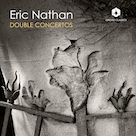
Eric Nathan: Double Concertos
Orchid Classics
With his sixth portrait album Double Concertos, composer Eric Nathan (b. 1983) continues to establish himself as one of his generation's most formidable voices. Ample ground has already been covered in his career, with imagination, open-mindedness, and ingenuity distinguishing the work he's created. Earlier sets include the space of a door (BMOP/sound, 2020) and the double-CD set Missing Words (New Focus Recordings, 2022), and commissions and premieres continue to crowd his calendar. Nathan recently completed the flute concerto, The Seas Between Us, and on the horizon are a violin concerto for the Rhode Island Philharmonic Orchestra and string quartet for the Balourdet Quartet.
On his latest recording, the Brown University Associate Professor of Music explores the expressive possibilities afforded by the pairing of instrumental voices. The idea's pursued in its purest form in Just a Moment, which is scored for two antiphonal oboes, but is broached as intensively in the double concertos that frame it, the first augmenting solo violin and clarinet with strings and the second two solo violas with, again, strings. Helping Nathan realize the recording's vision are violinist Stefan Jackiw, clarinetist Yoonah Kim, violists Hsin-Yun Huang and Misha Amory, oboists John Ferrillo and Amanda Hardy, the Parker, Ariel, and Jupiter Quartets, and musicians from Yellow Barn and the New York Classical Players. Dongmin Kim conducts the first concerto, while the second features the composer making his recorded conducting debut.
The idea of pairing voices was not embraced by Nathan for only formal reasons but as a way of exploring the personal bonds shared between them, whether that would involve, in his words, “the orchestra and the resonance of the hall, or, outside the musical realm, the pairings of husband and wife, teacher and student, individual and collective, living and deceased, distance and closeness, past and future.” It seems more than coincidental that all three works emerged during the pandemic, the first concerto slightly preceding its onset and the others written during it and after, when the distancing enforced during that time only made the desire for closeness and connection stronger.
That's never more affectingly expressed than in Just a Moment (2021) when Ferrillo and Hardy's oboes call to one another, their yearning amplified by one being placed on stage and the other in a balcony (a spatial arrangement that while deployed live was also utilized for the recording). Their tones appear as call-and-response but overlap and conjoin in unison too, and intensifying the emotion of the material is the oboe's capacity for evoking plaintive longing but also palpable joy. Delivered with exquisite patience so as to maximize tension, the haunting work, just shy of seven minutes, is the shortest of the three, but it's no less powerful than the others; if anything, concision amplifies its impact.
The concertos feature different instruments for soloists, but they're also structurally contrasting, the first a long-form single-movement setting and the second featuring five parts, a coda, and brief connecting interludes. The first, written in 2019 and featuring violinist Jackiw and clarinetist Kim as the soloists, enters with a stirring evocation of a mountainous landscape, with silken string glissandos providing a backdrop of stillness for Jackiw's emotive outpourings. Agitation develops as the collective string forces reach a climax before the pressure eases to set the stage for the clarinet's entrance, the moment subtly effected when the violin's note flows into the woodwind's. The quietly majestic aura of the opening minutes persists throughout this episode until the activity level intensifies and rapid trade-offs between the soloists occur. Furiously bowed strings complement the ferocity of their interactions before a sense of decompression takes hold and the music turns peaceful and introspective, the clarinet now hushed in its expressions and the violin following suit.
With Huang and Amory as the viola soloists, Double Concerto No. 2 (2023) picks up where the first leaves off when two voices come together but also tangle. Like the first, the second concerto enters quietly, with the soloists engaged in mournful supplications and the orchestra barely audible when breath-like textures are sourced from its members' instruments. The intensity ratchets up with the advent of the second movement (“Brilliantly; vibrantly”) and Nathan's incorporation of quotations from works by John Dowland and Pérotin. Given that, it's understandable that the music would take on a forlorn lamenting tone and exude a Renaissance-like quality. The activity level remains high throughout the relentlessly surging third part (“Vigorously; racing”) until a flood of strings announces the onset of the fourth (“Embracing; with warmth”) and music that slows for expressions both tender and passionate (Nathan acknowledges that the “Adagietto” from Mahler's Fifth Symphony was in his thoughts during the writing). Animation permeates the fifth part (“Dancing; joyous”), anguish replaced by affirmation as strings weave and flutter joyfully, until the brief coda reinstates the soft pitch of the opening with fragile harmonics and folk-like viola figures.
The strong impression made by Nathan's writing is bolstered dramatically when musicians of such exceptional calibre perform it, the composer fortunate to have such a distinguished collective of players for partners. With them as conduits, his desire to explore the creative possibilities afforded by the pairing of lead instruments is effectively and vividly realized. While Double Concertos isn't an exhaustive portrait of the artist, it certainly adds significantly to an appreciation of Nathan's work.September 2026