

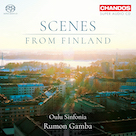
Oulu Sinfonia & Rumon Gamba: Scenes from Finland
Chandos
Any compilation of music representing Finland will naturally include Jean Sibelius, but, refreshingly, the recording assembled by conductor Rumon Gamba and the Oulu Sinfonia eschews familiar works—Finlandia, The Swan of Tuonela, or Valse triste, to name three—for a suite drawn from music created for Scaramouche, a 1912 two-act ballet-pantomime by Poul Knudsen. Better yet, the release complements the country's most celebrated composer with three others whose names might be less well-known, internationally speaking, but who distinguish the release with material of charm and distinction. A major part of the recording's appeal has to do with the storytelling dimension of the pieces, with those by Selim Palmgren, Einar Englund, and Kalervo Tuukkanen based on a fairytale (Cinderella Suite), film soundtrack (White Reindeer Suite), and nativity-associated story (Christmas Suite), respectively.
The British-born Gamba has been Chief Conductor of the 1937-founded Oulu Sinfonia since January 2022 and has recorded exclusively for Chandos for over twenty years; the orchestra has likewise amassed an impressive discography featuring recordings of material by Olli Kortekangas, Leevi Madetoja, and others. Gamba's talents extend beyond the podium, too, as he's credited with having arranged the album-opening suite by Sibelius. The storyline created by Knudsen centres on the hunchbacked dwarf Scaramouche, who with his viola playing bewitches a host's wife at a ball. After drawing her away, the dwarf eventually returns with the wife only to be stabbed to death by her husband; Scaramouche's viola calls to her from the grave, however, and leads her to again dance wildly until she collapses, dead, on stage.
Gamba's sequencing hews closely to the narrative as it progresses through eight parts. The strings and woodwinds that introduce the suite and establish the elegant formality of the ball setting are instantly identifiable as material by the composer; the lively bolero that follows similarly announces an introduction, in this case the viola-wielding Scaramouche, after which a waltz dance mounts in intensity to signify the wife's helpless seduction in response to his playing. Subtle shadings of dissonance anticipate the disaster to come, but before it a lovely flute-centred episode (delivered with immaculate control by Albert Stupak) appears to announce her return; even here, however, ominous strings emerge alongside it to hint at the tragedy ahead. Agitated gestures, sweeping strings, and chromatic flourishes act as a soundtrack to her death dance until the suite concludes on an intensely solemn note.
From Sibelius's younger contemporary Palmgren we have Cinderella Suite (1902 – 03), a seven-part concert piece created for Tuhkimo ja kuninkaantytär (Tuhkimo and the Princess) by Finnish playwright Larin-Kyösti. As the title implies, the play revolves around a passionate youth, Tuhkimo, and combines aspects of the classic Cinderella story with ones stemming from a number of folk tales and fables. Inducing fairytale enchantment, shimmering strings, glockenspiel, and woodwinds introduce the work in a prelude-like manner before a folk-dance section emerges to shift the work in a slightly different direction. The dance character carries over into the second movement, with this time a rustic “Musette” enticing the senses. The pace slows for a delicate “Intermezzo,” with a solo cor anglais and horns front and centre. Animation returns with an impish “Sinipiikojen tanssi (Dance of the Forest Fairies)” movement, regal “Valssi (Waltz),” and effervescent “Tanssi pyövelin vuorella (Dance on the Hangman's Mountain).” The emphasis on dance forms throughout the suite adds considerably to its appeal by imbuing it with lightness—even if the penultimate “Intermezzo” oozes more than its share of foreboding.
The recording's third and fourth pieces are by twentieth-century composers from the generation following Sibelius and Palmgren's, Englund (who studied with Palmgren and Aaron Copland, among others) and Tuukkanen. Englund based his well-received soundtrack for Erik Blomberg's 1952 film Valkoinen peura (The White Reindeer) on a folk-horror tale involving a shape-shifting young woman, Pirita, a local shaman, Tsalkku Niila, and her reindeer-herding husband, Aslak. A spell cast by Niila transforms her into a murderous white reindeer that's killed by Aslak, who witnesses the animal reassume its human form as it dies in his arms. Created in 1954, the five-movement suite performed here begins with an evocative prelude that mounts in tension when underpinned by an insistent drumbeat and sinuous woodwinds. Less portentous is “Tunturi (The Fell),” whose muted horns and woodwinds suggest immense expanses but also the presence of nature spirits. In keeping with its “Poroajot (The Reindeer Race)” title, the central movement's a whirlwind of activity, all energized drum patterns and boisterous horns. The title of the subsequent “Surumarssi (Funeral March)” likewise reflects its sombre, at times anguished tone, whereas the exuberant final movement exudes infectious folk-spirited uplift.
Tuukkanen's six-movement Christmas Suite stems from his 1953 score for a production of the play Die Erzählung des letzten Hirten (The Tale of the Last Shepherd) by German author Walter Bauer. Covering key aspects of the Christmas story, the nativity-based work opens with a vivid, picturesque evocation of the shepherds waiting in the fields on Christmas eve before a message from the angels is imparted in the glorious second movement to engender excitement and anticipation. An aura of calm infuses “Rauhan viesti (A Message of Peace),” while the gentle berceuse “Kehtolaulu seimellä (Lullaby at the Manger)” is as pretty as expected. A rather darker tone pervades the “Intermezzo. Beetlehemin surmanyönä (Intermezzo. The Night of Death in Bethlehem)” movement before “Paimenten ilo (The Shepherds' Joy)” reinstates the sunnier mood of the suite's opening.
At various times, the release content calls to mind other better-known works grounded in folk and fairytales, be it Stravinsky's L'Histoire du soldat or Prokofiev's Romeo and Juliet, and certainly the rich melodic character and vibrant scoring argues that all four could secure places on any number of concert stages and delight listeners. Certainly the performances by Gamba and the Oulu Sinfonia bring out the best in what each suite has to offer. Also enhancing the release are in-depth liner notes by Daniel M. Grimley, who provides informative context and historical background for all of the material.September 2026